Pakistan Air Force shot down six Indian fighter jets, says PM Sharif

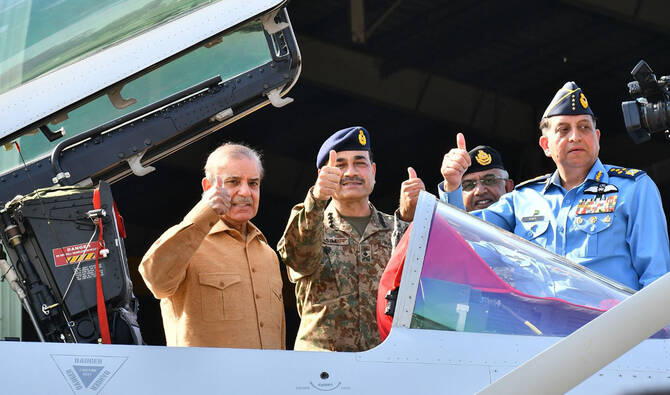
(From left to right) This handout photo, taken and released by Pakistan’s Inter-Services Public Relations (ISPR), shows Pakistan Prime Minister Shehbaz Sharif with Army Chief General Syed Asim Munir, Chief on the Naval Staff Admiral Naveed Ashraf and Air Chief Marshal Zaheer Ahmed Baber Sidhu during a visit to Kamra Airbase in Attock, Pakistan on May 15, 2025. (Photo courtesy: Handout/ISPR)
Short Url
Updated 16 May 2025
Follow

Pakistan Air Force shot down six Indian fighter jets, says PM Sharif

  • Pakistan PM visits air force base in eastern Kamra town with army chief, senior members of the cabinet
  • Pakistan and India engaged in combat for four days last week beafore agreeing to ceasefire on Saturday

ISLAMABAD: Prime Minister Shehbaz Sharif paid rich tributes to the Pakistan Air Force (PAF) on Thursday, crediting them for shooting down six Indian fighter jets during the military conflict between the nuclear-armed neighbors last week.

Pakistan’s government and the PAF recently hailed the use of the J-10Cs, saying they were used to shoot down five Indian fighter jets, including three French Rafales, during hostilities between the two sides on the night of May 6. Four days of fighting between India and Pakistan saw them pound each other with missiles, drones and artillery until the United States brokered a ceasefire on Saturday.

The Indian Air Force (IAF) has so far not commented on the reports that Pakistan downed five of its fighter jets, but its chief said admitted this week during a news conference that “losses are a part of combat.”

Sharif paid a visit to the PAF’s operational air base in Kamra, a town located in Pakistan’s eastern Attock district. Accompanied by Army Chief General Syed Asim Munir and senior members of the cabinet, including Foreign Minister Ishaq Dar, Sharif lauded Pakistani pilots for successfully defending the country when India fired missiles into Pakistani territories last Wednesday night.

“Just now we were given an excellent presentation and in that, the actual situation [of the conflict] surfaced,” Sharif told PAF personnel at the air base. “Based on the presentation I can tell the nation today without fear of contradiction that not five but these falcons, you, shot down six enemy jets.”

In a separate statement, the military’s media wing said the sixth Indian aircraft downed by the PAF was a Mirage-2000 fighter jet. It said the jet was shot down near Pampore, east of Srinagar in Indian-administered Kashmir.

Sharif paid trich tribute to the PAF, saying that it had proven to be superior in combat to the IAF based on its homegrown technical expertise.

“The entire nation takes immense pride in the valor and vigilance of its armed forces,” Sharif said. “Under the capable stewardship of the chief of army staff, our defenders have once again underscored that Pakistan’s security is inviolable and any act of belligerence will be met with a forceful, resolute and unforgiving response.”

Sharif warned India that Pakistan’s armed forces were ready to respond to any future acts of aggression.

“Pakistan’s armed forces remain fully prepared and resolutely committed to defending every inch of our territory,” he said. “We stand united, vigilant, and unshakable for the defense of our homeland.”

Dar earlier on Thursday informed lawmakers in parliament that the ceasefire agreement between Islamabad and Delhi has been extended till Sunday.

“For now, these are military-to-military communications, so obviously, then political dialogue will take place,” he said. “The resolution of all issues lies there.”

India and Pakistan, both bitter rivals who possess nuclear weapons, have fought three wars since 1947 after gaining independence from British colonial India. The root cause of their conflict is the disputed Himalayan Kashmir region, which they both claim in full but administer only parts of.


Pakistan reviews austerity measures amid Middle East crisis, urges strict nationwide implementation

Updated 11 March 2026
Follow

Pakistan reviews austerity measures amid Middle East crisis, urges strict nationwide implementation

  • Deputy Prime Minister Ishaq Dar chairs review meeting of austerity steps
  • Officials briefed on salary cuts, school closures, four‑day week, petrol conservation

ISLAMABAD: Pakistan’s government on Wednesday assessed progress on a sweeping set of austerity measures introduced to mitigate the country’s economic strain from sharply rising global oil prices and supply disruptions linked to the ongoing war in the Middle East.

Prime Minister Shehbaz Sharif this week announced a series of austerity steps, including a four‑day work week for government offices, requiring 50  percent of staff to work from home, cutting fuel allowances for official vehicles by half, grounding up to 60  percent of the government fleet and closing all schools for two weeks to conserve fuel amid the global oil crisis.

The measures were unveiled in response to global oil market volatility triggered by the conflict involving the United States, Israel and Iran, which has disrupted supply routes such as the Strait of Hormuz and pushed crude prices sharply higher, straining Pakistan’s heavily import‑dependent energy sector.

“The meeting stressed the importance of strict and transparent adherence to the austerity measures, promoting fiscal responsibility and prudent use of public resources,” Deputy Prime Minister and Foreign Minister Senator Mohammad Ishaq Dar said in a statement.

He was chairing a meeting of the Committee for Monitoring and Implementation of Conservation and Additional Austerity Measures, constituted under the directions of the PM, bringing together federal and provincial officials to review execution of the broad cost‑cutting plan. 

Dar emphasized the government’s commitment to enforcing the PM’s austerity steps nationwide. The committee’s review also covered reductions in departmental expenditure, deductions from salaries of senior officials earning over Rs. 300,000 ($1,120), and coordination with provincial administrations to ensure uniform implementation of the plan.

Participants at the meeting reiterated that all ministries and divisions must continue strict monitoring and reporting, with transparent oversight mechanisms, as Pakistan navigates the economic pressures from the prolonged Middle East crisis and its fallout on global energy and trade markets.