

Pakistan says ceasefire with India extended till May 18, Trump says both ‘very happy’

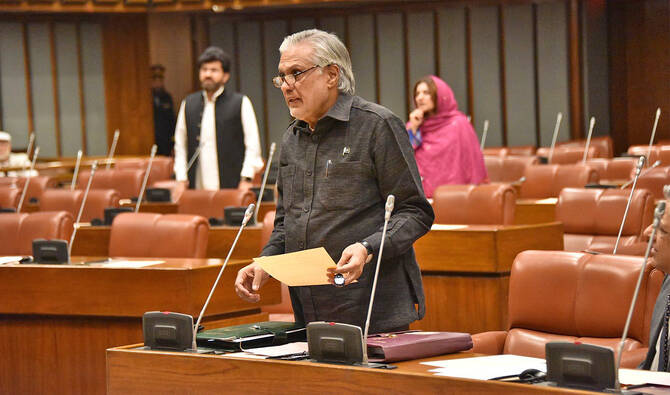
Pakistan’s Deputy Prime Minister Ishaq Dar is addressing a session of Senate in Islamabad, Pakistan, on May 14, 2025. (Senate of Pakistan/File)
Short Url
Updated 16 May 2025
Follow

Pakistan says ceasefire with India extended till May 18, Trump says both ‘very happy’

  • Deputy PM Ishaq Dar says Pakistan seeks “composite dialogue” with India to resolve outstanding issues
  • Speaking to troops during Gulf tour, Trump said on Thursday hostilities between Pakistan and India were “settled”

ISLAMABAD: Pakistan’s Deputy Prime Minister Ishaq Dar said on Thursday the militaries of India and Pakistan had agreed to extend last week’s ceasefire till Sunday, May 18, while President Donald Trump said both nations were “very happy” with the truce brokered by his administration last week.

Pakistan and India agreed to a ceasefire on Saturday after four days of the worst fighting since 1999 between the two nuclear-armed neighbors, who attacked each other with missiles, drones, fighter jets, and artillery fire. Tensions began when India alleged Pakistan was involved in an attack in Indian-administered Kashmir that killed 26 tourists last month. Islamabad denied involvement and called for an international probe into the incident. 

Tensions came to a head last Wednesday when India fired missiles into Pakistan, claiming it had struck “terrorist camps.” Pakistan said civilians had been killed and vowed retribution, saying it had downed five Indian jets. The worst of the fighting happened on Saturday when India attacked Pakistani air bases and Pakistan launched retaliatory strikes on military facilities and storage units. As the conflict spiraled alarmingly, US President Trump announced Washington had brokered a ceasefire on Saturday. 

The fragile ceasefire has been holding so far with only reports of a few violations on the first day. 

“Now it [ceasefire] has been extended till [May] 18, so obviously, now ultimately, things will go to the dialogue,” Dar said in televised comments to parliament. “For now, these are military-to-military communications, so obviously, then political dialogue will take place. The resolution of all issues lies there.”

Dar said the two nations needed to re-engage in a composite dialogue, which was a structured process initiated in 1997 to address a wide range of bilateral concerns, including peace and security, Kashmir, water, and economic cooperation. 

As tensions surged between India and Pakistan last month, both announced a raft of punitive measures against each other, including New Delhi unilaterally suspending the 1960 Indus Waters treaty, which governs the sharing of river waters.

India’s foreign minister said on Thursday the treaty with Pakistan would remain suspended until Islamabad ends “cross-border terrorism.”

“For us, this is a no-go area,” Dar told lawmakers. “We had announced it on April 24 as well that it [treaty suspension] will be treated as an act of war.”

India and Pakistan, both bitter rivals who possess nuclear weapons, have fought three wars since 1947 after gaining independence from British colonial India. The root cause of their conflict is the disputed Himalayan Kashmir region, which they both claim in full but administer only parts of. 

Speaking to troops at a base in Qatar during a Middle East tour, Trump said on Thursday hostilities between Pakistan and India were settled.


“And Pakistan was very happy with that [ceasefire] and India was very happy with that and I think they’re on the way,” Trump said. 

“We got that settled where everybody was very happy. I’ll tell you that it looked like it was really going to be escalating out of control.”


Pakistan transporters call off five-day strike after successful talks with Punjab government

Updated 5 sec ago
Follow

Pakistan transporters call off five-day strike after successful talks with Punjab government

  • Transporters went on strike against heavy fines, penalties imposed by Punjab over traffic violations
  • Punjab government sets up committee to resolve transporters issues, confirms provincial minister

ISLAMABAD: Pakistani goods transporters called off their five-day-long nationwide strike on Friday after successful talks with the Punjab government, officials and transporters confirmed, as the business community warned of an impending economic crisis if the dispute stayed unresolved. 

Transporters went on a nationwide strike on Dec. 8 against stringent traffic rules and heavy fines imposed by the Punjab government over traffic violations. These penalties were included in the Motor Vehicle Ordinance 2025 last month. 

The ordinance details hefty fines ranging from Rs2000 [$7] to Rs50,000 [$178] and mentions prison sentences going up to six months for various offenses committed by drivers, such as driving on the wrong side of the road or driving in vehicles with tinted windows. 

“Yes, the strike has been called off after our meeting with Senior Minister of Punjab Marriyum Aurangzeb,” Nabeel Tariq, president of the All Pakistan Goods Transport Association (APGTA), told Arab News. 

Tariq said fines ranging from Rs1000 ($3.6) to Rs1500 ($5.4) for traffic violations have been increased to around Rs20,000 ($71.3) as per the new rules. 

He said the APGTA has agreed to accept a 100 percent or even 200 percent hike in fines. However, he said an increase of 2000 percent was not “logical.”

“Our urgent demands have been accepted and a committee has been formed to review the ordinance and come up with recommendations,” Tariq said. 

Speaking to Arab News, Aurangzeb confirmed the strike had been called off after talks with the Punjab government and that a committee has been formed to resolve the transporters’ issues. 

The committee will be headed by Aurangzeb and will include representatives of goods transporters, a statement issued by her office said. 

“The government wants to protect human lives and make things better for all citizens,” the statement said. “We will resolve the issues (with transporters) amicably.” 

‘UNPRECEDENTED CRISIS’

Pakistan’s business and industrial community, meanwhile, warned of an impending crisis if the disputed was not resolved. 

The All Pakistan Textile Mills Association (APTMA) and the Karachi Chamber of Commerce and Industry (KCCI) have both appealed for immediate government intervention.

Imdad Hussain Naqvi, president of the Grand Transport Alliance Pakistan (GTAP), told Arab News that over 400,000 goods carriers had been stranded across Pakistan due to the strike, affecting supplies to millions of consumers.

Earlier, in a letter to Punjab Chief Minister Maryam Nawaz, APTMA Chairman Kamran Arshad said the strike has “critically impacted import and export operations which are backbone of the country’s economy.”

He said hundreds of cargo vehicles remain stranded across Punjab, creating “abnormal delays” in goods movement and triggering heavy demurrage, detention charges, missed vessels and production shutdowns due to the non-availability of raw materials.

Arshad warned the disruption poses “a serious risk of order cancelation of export orders by international buyers, which would have far-reaching consequences for Pakistan’s foreign exchange earnings.”

Meanwhile in Pakistan’s commercial hub Karachi, KCCI President Rehan Hanif issued an even stronger warning, saying the nationwide strike threatens to paralyze Pakistan’s economic lifeline. 

“The complete suspension of cargo movement is pushing Pakistan toward an unprecedented trade and industrial crisis,” Hanif said in a statement. 

He added that import and export consignments are now stranded at the city’s ports, highways and industrial zones.
