

Pakistan seeks greater collaboration with US in blockchain, artificial intelligence

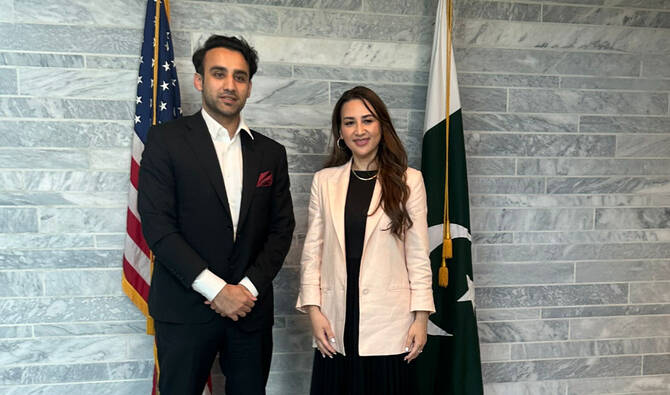
In this handout photo, released by Pakistan’s Finance Ministry on May 15, 2025, Pakistan Crypto Council CEO Bilal bin Saqib gestures with the Acting US Ambassador Natalie Baker during a meeting at the US Embassy in Islamabad. (Photo courtesy: Handout/Finance Ministry)
Short Url
Updated 15 May 2025
Follow

Pakistan seeks greater collaboration with US in blockchain, artificial intelligence

  • Pakistan Crypto Council CEO Bilal bin Saqib meets Acting US Ambassador Natalie Baker in Islamabad, says finance ministry
  • Pakistan says it plans to initiate joint programs, talent exchanges and MoUs between American companies and its startups

ISLAMABAD: Pakistan’s Crypto Council (PCC) CEO Bilal bin Saqib met Acting US Ambassador Natalie Baker on Thursday to seek deeper collaboration with Washington in blockchain and artificial intelligence (AI), the finance ministry said.

Pakistan has increasingly sought to formalize its crypto economy amid rising interest in blockchain technologies worldwide. The country is already among the world’s fastest-growing crypto markets, ranking near the top in global adoption rates, with an estimated $300 billion in annual crypto transactions and around 25 million active users.

As part of these efforts, the PCC last month partnered with World Liberty Financial (WLF), a decentralized finance platform backed by US President Donald Trump, to advance blockchain innovation, stablecoin adoption and decentralized finance (DeFi) integration across Pakistan.

“Pakistan Crypto Council CEO meets US ambassador to advance youth collaboration in blockchain & AI,” the finance ministry’s statement said.

It added that Saqib met Baker to discuss creating bridges between US institutions and Pakistan’s entrepreneurial ecosystem. The PCC emphasized Pakistan’s commitment to becoming a globally competitive innovation hub, with blockchain and AI at the core of its future economy, the council said.

“Pakistan is home to one of the world’s youngest populations — eager, ambitious, and ready to lead the future of Web3 and AI,” Saqib said. “This is the time to invest in them, to connect them with global leaders, and to create real pipelines of opportunity between the US and Pakistan.”

The ministry said that Pakistan plans to initiate joint programs, talent exchange and strategic memoranda of understanding between American tech companies and Pakistani startups to build long-term partnerships that benefit both nations.

“The Pakistan Crypto Council remains committed to using blockchain as a tool of diplomacy, education, and empowerment — ensuring that Pakistan’s youth are not left behind but stand at the forefront of the global digital revolution,” the statement concluded.

Pakistan’s proactive stance to formalize its crypto economy follows its broader push to position itself as a hub for digital finance innovation, with 64 percent of its population under the age of 30.

Rising mobile broadband access, a booming freelance economy and increasing government interest in blockchain have accelerated the country’s Web3 adoption.


Pakistani, Bangladeshi officials discuss trade, investment and aviation as ties thaw

Updated 28 December 2025
Follow

Pakistani, Bangladeshi officials discuss trade, investment and aviation as ties thaw

  • Pakistan and Bangladesh were once one nation, but they split in 1971 as a result of a bloody civil war
  • Ties between Pakistan, Bangladesh have warmed up since last year and both nations have resumed sea trade

ISLAMABAD: Pakistan's High Commissioner to Bangladesh Imran Haider on Sunday met Chief Adviser Muhammad Yunus in Dhaka, the latter's office said on, with the two figures discussing trade, investment and aviation.

Pakistan and Bangladesh were once one nation, but they split in 1971 as a result of a bloody civil war, which saw the part previously referred to as East Pakistan seceding to form the independent nation of Bangladesh.

Ties between Pakistan and Bangladesh have warmed up since former prime minister Sheikh Hasina’s ouster as a result of a student-led uprising in August 2024. Relations remain frosty between Dhaka and New Delhi over India’s decision to grant asylum to Hasina.

Pakistan has attempted to forge closer ties with Bangladesh in recent months and both South Asian nations last year began sea trade, followed by efforts to expand government-to-government commerce.

"During the meeting, both sides discussed ways to expand cooperation in trade, investment, and aviation as well as scaling up cultural, educational and medical exchanges to further strengthen bilateral relations between the two South Asian nations," Yunus's office said in a statement on X.

In 2023-24 Pakistan exported goods worth $661 million to Bangladesh, while its imports were only $57 million, according to the Trade Development Authority of Pakistan. In Aug. this year, the Pakistani and Bangladeshi commerce ministries signed a memorandum of understanding to establish a Joint Working Group on Trade, aiming to raise their bilateral trade volume to $1 billion in the financial year that began in July.

The Pakistani high commissioner noted that bilateral trade has recorded a 20 percent growth compared to last year, with business communities from both countries actively exploring new investment opportunities, according to the statement.

He highlighted a significant increase in cultural exchanges, adding that Bangladeshi students have shown strong interest in higher education opportunities in Pakistan, particularly in medical sciences, nanotechnology, and artificial intelligence. Haider also said that Dhaka-Karachi direct flights are expected to start in January.

"Chief Adviser Professor Muhammad Yunus welcomed the growing interactions between the two countries and emphasized the importance of increased visits as well as cultural, educational and people-to-people exchanges among SAARC (South Asian Association for Regional Cooperation) member states," the statement read.

"Professor Yunus also underscored the need to further boost Bangladesh–Pakistan trade and expressed hope that during Mr. Haider’s tenure, both countries would explore new avenues for investment and joint venture businesses."