

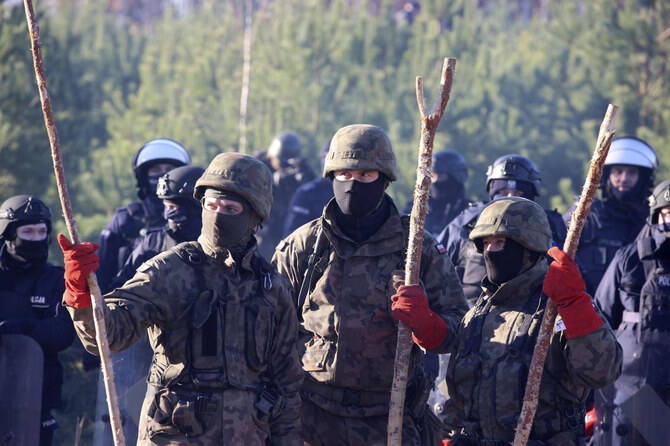
That ‘tourist’ in the forest might be a Russian spy, Latvia warns

In its annual report, Latvia’s Defence Intelligence and Security Service, known by Latvian acronym MIDD, offered advice on how to identify possible reconnaissance and sabotage operatives. (AP/File)
Short Url
Updated 15 May 2025
Follow

That ‘tourist’ in the forest might be a Russian spy, Latvia warns

  • MIDD offered advice on how to identify possible reconnaissance and sabotage operatives
  • It also warned that Russian saboteurs might also attempt to incite unrest or assassinate “socially significant individuals”

WARSAW: They might look like lost tourists — unkempt and overloaded with gear — or hikers with military haircuts, survival gear and no clue how to behave in the woods.

But Latvia’s intelligence agency said Thursday that they might actually be Russian saboteurs and spies.

In its annual report, Latvia’s Defense Intelligence and Security Service, known by Latvian acronym MIDD, offered advice on how to identify possible reconnaissance and sabotage operatives.

It’s an increasingly relevant concern given regional tensions and a string of arson and other acts of sabotage, which Western governments blame on Russia — allegations that Moscow has repeatedly denied.

The list of telltale signs is striking: slovenly appearance, mismatched military or sportswear, and a knack for asking locals suspicious questions. According to the security service, such groups may linger near military or critical infrastructure sites, pose as humanitarian workers or stay in remote areas without showing any interest in nature.

Some may carry specialized medical kits, maps or radios — items better suited for clandestine operations than camping trips.

The Latvian guidance comes as countries across the region, including new NATO members Sweden and Finland, have been issuing booklets with advice on how to survive war or a natural disaster.

Nearby Poland is now preparing its guidelines, while Norway recently published a book with advice on how to survive for one week.

“We live in an increasingly turbulent world,” it says. “Even though in Norway most things generally function as they normally would, we must remain aware that extreme weather, pandemics, accidents, sabotage — and in the worst case acts of war — can impact us.”

MIDD, one of Latvia’s three security services, alongside the State Security Service and the Constitution Protection Bureau, warned that Russian saboteurs might also attempt to incite unrest or assassinate “socially significant individuals.”

Their activities might also be focused on “studying the position of the target country’s society and inciting unrest directed against the existing government.”

The agency cautioned that appearances can deceive.

“The Ukrainian experience shows that Russian special services are able to adapt,” the report says. Not all spies will fit the mold, and suspicions must be judged in context.

It also warns that if a sabotage group is spotted, leave the James Bond heroics to the professionals.

“If you do think you might have spotted a sabotage group on Latvian soil, MIDD does not recommend tackling them yourself,” it said. “Instead report your suspicions to the State Police, special services, or the nearest armed forces unit.”


New ‘superfood’ transforms livelihoods in India’s rural east

A farmer harvests makhana, or lotus seeds, in Kapchhahi village in India’s eastern state of Bihar. (Mahesh Mukhia)
Updated 08 December 2025
Follow

New ‘superfood’ transforms livelihoods in India’s rural east

  • Known as fox nut or lotus seed, makhana is rich in protein, dietary fiber, minerals
  • Most of the world’s makhana production is in Bihar, one of India’s poorest states

BIHAR: Wading through knee-deep, stagnant water, Mahesh Mukhia plunges his hands into the mud, pulling up handfuls of sludge that he and others toss into a large, partially submerged basket.

After a while, they shake the basket to drain away the water and debris. What remains is makhana — round black seeds that have lately gained popularity as India’s new superfood.

A regional Indian snack, also known as fox nut or lotus seed, makhana is the edible seed of the prickly waterlily. The plant grows in freshwater ponds and wetlands in southern and eastern Asia.

After makhana seeds are handpicked from pond beds, cleaned, and sun-dried, they are roasted at high heat so their hard black shells crack open and release the white, popcorn-like puffed kernels, which are eaten as snacks or used in dishes.

It has long been known for its nutritional value — high in plant-based protein and dietary fiber, the seeds are also rich in minerals and gluten-free — which over the past few years have helped it gain global attention and are transforming farmlands in Bihar, one of India’s poorest states.

“Earlier, people were not researching it but now, after research, makhana’s nutritional values have been highlighted. Now this is a superfood. That’s why demand is growing everywhere,” said Mahesh Mukhia, a farmer in Kapchhahi village in Bihar’s Darbhanga district, whose family has been harvesting the seeds for generations.

“The difference is that my forefathers did farming in a traditional way, but we’ve learnt to do it in a scientific way,” Mukhia told Arab News.

“There is Bhola Paswan Shastri Agricultural College in the neighboring Purnea district. I went there for training. After I started practicing farming the way I learnt, the yield increased by more than 30 percent.”

Makhana farming is highly labor-intensive, starting with the cultivation of water lilies in shallow ponds. The plants require constant monitoring as they are sensitive to water levels and pests.

Harvesting takes place between August and October. Workers pluck the seeds by hand and then dry them under the sun for several days before they can be processed.

The processing and roasting of makhana also require significant effort. The dried seeds are first de-shelled by manually cracking them, followed by multiple rounds of roasting to make them crisp.

Whole families are involved in the production, which has been expanding since 2020, when the state government introduced the Makhana Development Scheme.

Besides training in farming and processing, growers who cultivate fox nut receive $820 per hectare.

“The rate has also gone up. The makhana that we used to sell at 200-300 ($2-$3) rupees per kg is now selling at 1,000 ($12) or 1,500 rupees per kg,” Mukhia said.

“Makhana farmers are now making a profit. Those who are growing makhana are earning well, those who are popping it are also doing well, and those involved in trading are making profits too. We are getting good demand from everywhere. I just received an order for 25 tonnes recently.”

Bihar currently produces over 85 percent of India’s makhana and accounts for most of the world’s production, according to Ministry of Commerce and Industry estimates.

According to reports by the Indian Brand Equity Foundation and the Agricultural and Processed Food Products Export Development Authority, India accounts for roughly 85 to 90 percent of the world’s production.

Farmland where the crop is grown has increased many times over the past decade and can now be compared to the area covering half of New York City.

More than 600,000 people are involved in the makhana industry in Bihar, according to Niraj Kumar Jha, Darbhanga district’s horticulture officer.

“Earlier, we were cultivating 5,000 hectares in the Kosi and Mithlanchal regions. But now it has expanded to 35,000 hectares, and with many supportive schemes, farmers are increasingly encouraged to grow makhana,” he said.

“We are strengthening our marketing channels. We’ll reach the metro cities as well as world markets ... We can see that makhana is growing very popular, not only in India.”