Saudi Arabia aiming to foster innovation and global collaboration, says economy minister 

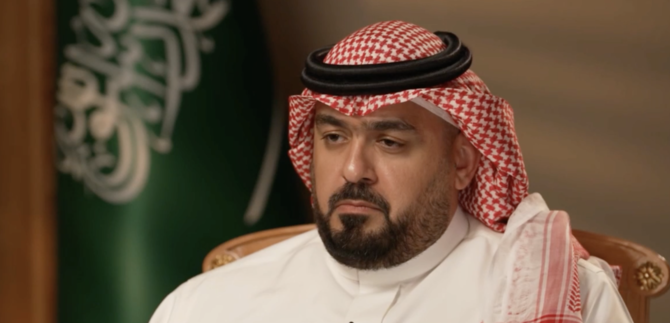
Economy and Planning Minister Faisal Al-Ibrahim speaking to Fox News. Screenshot
Short Url
Updated 15 May 2025
Follow

Saudi Arabia aiming to foster innovation and global collaboration, says economy minister 

RIYADH: Saudi Arabia aims to foster a dynamic private sector, create jobs for its citizens, and attract international talent as part of its Vision 2030 strategy, according to a top official. 

Speaking during an interview with Fox News on the sidelines of the Saudi-US Investment Forum, Economy and Planning Minister Faisal Al-Ibrahim said the Kingdom has embarked on a transformative path to unlock its potential and shift its growth narrative beyond oil. 

The forum was held on the occasion of US President Donald Trump’s visit to Saudi Arabia, during which he was accompanied by a delegation of leading business figures. 

Al-Ibrahim said: “We want a private sector that’s dynamic. We’re a young population, but in about 20, 25, 30 years, we’ll start the aging process. What we should look like at that stage is a government and a private sector and a third sector, and academia that is leveraging fully generative AI and other technological tools toward productivity.”  

He added: “But also that has created jobs for a lot of Saudis, and has been able to, in the process, attract a lot of talent to come to Saudi to make Saudi Arabia their home.” 

The minister emphasized that diversification has already begun to yield results, with sectors such as tourism, culture, and technology,  as well as sports and artificial intelligence, contributing significantly to gross domestic product. 

“We would love to be competitive in a large and vibrant consumer market, such as that in the US,” the minister said, highlighting the Kingdom’s increasing connections with global markets, especially American capital markets. 

Al-Ibrahim noted that the non-oil gross domestic product has surpassed 50 percent for the first time, but cautioned against complacency. 

“We’re not over-celebrating that, but we’re acknowledging this as a milestone. What we want to see is more non-oil exports growing. More non-oil exports of our manufacturing, GDP,” Al-Ibrahim said. 

The minister also emphasized the importance of service sector quality, adding: “We want to see user experience in the services side, especially on the tourism side, second to none. Still have a lot of work to do.” 

He noted that both Crown Prince Mohammed bin Salman and President Donald Trump have spoken of “peace and prosperity” as tools to address global challenges, reinforcing the Kingdom’s alignment with international efforts toward stability. 

“We’ve seen what dialogue has led to in terms of the US and UK deal, US and China deal, and what Saudi has led to also through dialogue in the region,” the minister added. 

On regional developments, he commented on the US decision to lift sanctions on Syria and its potential impact. 

“Something as strong and meaningful and material as lifting sanctions could help a country such as Syria to invest more capital in building the institutions they need to be a more stable country, but also bring more stability to the region and be a force for good,” Al-Ibrahim said.

Describing the relationship between the crown prince and President Trump, the minister added: “I see common values between both leaders, regardless of age and background, and I think that’s one of the things that really brings the mutual respect into the public eye.” 

Addressing skepticism about the Kingdom’s evolution, the minister concluded: “Saudi Arabia is a long-term reliable partner, if you ask anyone who has dealt with the Kingdom, government, people, anyone who has visited here ... Saudi Arabia has always been and always will be a force for good, for innovation.” 


Jordan’s industry fuels 39% of Q2 GDP growth

Updated 31 December 2025
Follow

Jordan’s industry fuels 39% of Q2 GDP growth

JEDDAH: Jordan’s industrial sector emerged as a major contributor to economic performance in 2025, accounting for 39 percent of gross domestic product growth in the second quarter and 92 percent of national exports.

Manufactured exports increased 8.9 percent year on year during the first nine months of 2025, reaching 6.4 billion Jordanian dinars ($9 billion), driven by stronger external demand. The expansion aligns with the country’s Economic Modernization Vision, which aims to position the country as a regional hub for high-value industrial exports, the Jordan News Agency, known as Petra, quoted the Jordan Chamber of Industry President Fathi Jaghbir as saying.

Export growth was broad-based, with eight of 10 industrial subsectors posting gains. Food manufacturing, construction materials, packaging, and engineering industries led performance, supported by expanded market access across Europe, Arab countries, and Africa.

In 2025, Jordanian industrial products reached more than 144 export destinations, including emerging Asian and African markets such as Ethiopia, Djibouti, Thailand, the Philippines, and Pakistan. Arab countries accounted for 42 percent of industrial exports, with Saudi Arabia remaining the largest market at 955 million dinars.

Exports to Syria rose sharply to nearly 174 million dinars, while shipments to Iraq and Lebanon totaled approximately 745 million dinars. Demand from advanced markets also strengthened, with exports to India reaching 859 million dinars and Italy about 141 million dinars.

Industrial output also showed steady improvement. The industrial production index rose 1.47 percent during the first nine months of 2025, led by construction industries at 2.7 percent, packaging at 2.3 percent, and food and livestock-related industries at 1.7 percent.

Employment gains accompanied the sector’s expansion, with more than 6,000 net new manufacturing jobs created during the period, lifting total industrial employment to approximately 270,000 workers. Nearly half of the new jobs were generated in food manufacturing, reflecting export-driven growth.

Jaghbir said industrial exports remain among the economy’s highest value-added activities, noting that every dinar invested generates an estimated 2.17 dinars through employment, logistics, finance, and supply-chain linkages. The sector also plays a critical role in narrowing the trade deficit and supporting macroeconomic stability.

Investment activity accelerated across several subsectors in 2025, including food processing, chemicals, pharmaceuticals, mining, textiles, and leather, as manufacturers expanded capacity and upgraded production lines to meet rising demand.

Jaghbir attributed part of the sector’s momentum to government measures aimed at strengthening competitiveness and improving the business environment. Key steps included freezing reductions in customs duties for selected industries, maintaining exemptions for production inputs, reinstating tariffs on goods with local alternatives, and imposing a 16 percent customs duty on postal parcels to support domestic producers.

Additional incentives in industrial cities and broader structural reforms were also cited as improving the investment climate, reducing operational burdens, and balancing consumer needs with protection of local industries.