Pakistan and Kuwait review trade, investment cooperation during bilateral consultations 

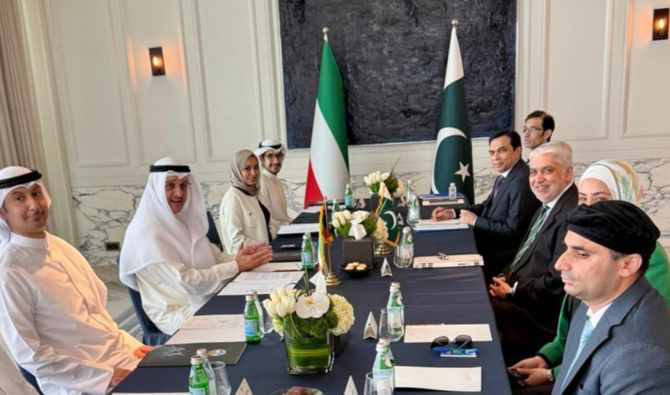
The delegation of Pakistan and Kuwait photo graphed during the fourth round of their Bilateral Political Consultations (BPC) in Kuwait on Wednesday. (Photo courtesy: @ForeignOfficePk/ X)
Short Url
Updated 15 May 2025
Follow

Pakistan and Kuwait review trade, investment cooperation during bilateral consultations 

  • Fourth round of Pakistan-Kuwait Bilateral Political Consultations held in Kuwait, says Islamabad 
  • Pakistan has increasingly eyed trade, investment to ensure consistent, sustainable economic growth 

ISLAMABAD: Pakistani and Kuwaiti officials reviewed their countries’ cooperation in trade, investment, human resource collaboration and other economic spheres, the Pakistani foreign ministry said on Wednesday, as the two sides held their bilateral political consultations. 

Pakistan and Kuwait held the fourth round of their Bilateral Political Consultations (BPC) in Kuwait on Wednesday. The Kuwaiti delegation was led by Sameeh Essa Johar Hayat, the Gulf country’s assistant foreign minister (Asia Affairs) while Additional Foreign Secretary (Middle East) Shehryar Akbar Khan led the Pakistani side. 

“The two sides reviewed the entire spectrum of bilateral relations including trade, investment, human resource collaboration, consular and people-to-people contacts with a view to further enhance bilateral cooperation,” the statement said on Wednesday. 

It added that the two delegations also exchanged views on regional and international issues, and reaffirmed their commitment to continued cooperation and consultation.

“While expressing satisfaction over the upward trajectory in bilateral relations and the momentum of high-level interactions and exchanges, both sides agreed to further deepen engagement in diverse areas of mutual interest,” the Pakistani foreign ministry said. 
It said that the next round of the BPC between the two sides will take place in Islamabad on mutually agreed dates.
Since narrowly escaping a default in 2023, Pakistan has eyed increasing foreign trade and investment with regional allies, especially Gulf countries. 
Islamabad formed the Special Investment Facilitation Council (SIFC), a hybrid civil-military government body, tasked with attracting international investment in key economic sectors such as tourism, agriculture, livestock, mines and minerals and others. 


Pakistan plans $80 million seafood zone at Karachi harbor to target Gulf markets

Updated 45 min 51 sec ago
Follow

Pakistan plans $80 million seafood zone at Karachi harbor to target Gulf markets

  • Plan aims to move exports away from raw seafood toward higher-value processed products
  • Project will be developed under public-private partnership or build-operate-transfer model

KARACHI: Pakistan plans to develop a seafood processing and export zone at Karachi’s Korangi Fisheries Harbor that could cost up to $80 million to boost value-added exports and position the country as a supplier to the Gulf and other regional markets, Maritime Affairs Minister Muhammad Junaid Anwar Chaudhry said on Saturday.

The proposed 100-acre project aims to shift Pakistan away from exporting raw seafood by building modern processing, cold-chain and packaging infrastructure linked to international buyers, as Islamabad looks to expand its blue economy and deepen maritime trade ties with the region.

In a statement, Chaudhry said the zone would be developed, financed and operated under a public-private partnership or build-operate-transfer (BOT) model, with private investors running the facilities and the Qur’angi Fisheries Harbor Authority retaining regulatory oversight.

“The estimated project cost ranges between $60 million and $80 million, based on regional benchmarks from countries such as Vietnam, China and Ecuador, which have developed similar seafood parks,” Chaudhry said.

He said the facility would include 20 to 25 medium- to large-scale seafood processing units for fish, shrimp and cephalopods, alongside large-scale cold storage, blast freezing, packaging facilities, logistics and export terminals, and a wastewater treatment plant to ensure environmentally compliant operations.

“Packaging and labeling units would operate under international food safety and quality standards, including HACCP and ISO certifications, offering vacuum packing, modified atmosphere packaging and retail-ready solutions,” he said, referring to Hazard Analysis and Critical Control Points, a preventive food safety system.

ISO certification verifies that a company’s management systems meet international standards.

The minister said the zone would be used exclusively for commercial seafood processing, packaging, cold storage and export-oriented activities, with multi-temperature storage ranging from minus 18 to minus 40 degrees Celsius and ice plants capable of producing 50 to 100 tons daily.

Chaudhry said the preferred investment structure is a BOT concession under which the private partner would finance, develop and operate the project for an expected 20-year tenure, with ownership reverting to the harbor authority at the end of the concession period.

He added that the estimated internal rate of return was projected between 13 percent and 17 percent, with revenue generated through lease rentals, processing fees, logistics services and export-linked earnings.

“The project will position Pakistan as a key maritime trade and seafood export hub serving Gulf, East African and Asian markets,” Chaudhry said.