WASHINGTON: Cheers broke out early Wednesday as Republicans on the House Ways and Means Committee signed off on the GOP tax breaks bill after a grueling round-the-clock session that pushed President Donald Trump’s package past overwhelming Democratic opposition.
But there’s still more work to do.
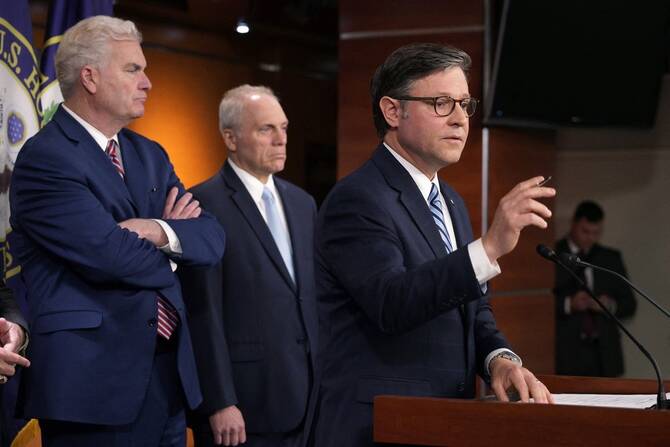
House Speaker Mike Johnson, R-Louisiana, also worked past midnight trying to resolve issues with Trump’s plan. Opposition is mounting from various corners of the GOP majority as he tries to muscle the party’s signature package to passage without any votes from Democrats.
On the one hand, the conservative leader of the Freedom Caucus derides the new Medicaid work requirements as a “joke” that do not go far enough at cost-cutting. Meanwhile, a handful of GOP lawmakers from New York and other high-tax states are refusing to support the measure unless changes are made to give deeper state and local tax deductions, called SALT, for their constituents back home.
“To say we have a gulf is an understatement,” said Rep. Chip Roy, R-Texas, a leader of the conservative wing.
Roy said there is “a significant number of us who could not bless this product” in its current form.
Nevertheless, momentum is building toward an end-of-the-week inflection point to stitch together the sprawling package. That means combining hundreds of pages of bill text covering $5 trillion in tax breaks and at least $1.5 trillion in spending reductions on Medicaid, food stamps and green energy programs to deliver Trump’s second-term legislative priority.
Democrats decry the package as a give away to the wealthy at the expense of safety net programs that millions of Americans rely on. But Johnson insists the Republican majority is on track to pass the package by Memorial Day, May 26, sending it to the Senate where Republicans are crafting their own version. With his slim majority, he can only afford a few defections from his ranks.
“We’re still on target,” Johnson said at the Capitol. “The American people are counting on us.”
Democrats also stayed up all night forcing marathon public hearings. One at the House Energy and Commerce Committee was still going more than 26 hours later before finishing Wednesday afternoon. All told, Democrats proposed hundreds of amendments trying to change the package, with dozens of votes that largely failed.
“It is a cruel, mean, rotten bill,” said Rep. Jim McGovern, D-Mass., as the House Agriculture Committee debated changes to the Supplemental Nutrition and Assistance Program, known as SNAP.
The nonpartisan Congressional Budget Office said at least 7.6 million fewer people would have health insurance with the changes to Medicaid, and possibly more with additional changes to the Affordable Care Act.
The CBO also gave lawmakers a preliminary analysis showing that 3 million fewer people each month would participate in the SNAP food program under the changes proposed.
More than 70 million Americans rely on Medicaid for health care, and about 40 million use SNAP.
The Republicans are targeting Medicaid and SNAP for a combined $1 trillion in cuts as a way to offset the costs of the tax package, but also to achieve GOP goals of reining in the social safety net programs.
Most of the cost-savings would come from imposing stiffer work requirements for those receiving the health care and food assistance, meaning fewer people would qualify for the aid. The legislation would raise from 54 to 64 the age of able-bodied adults without dependents who would have to work to qualify for SNAP. It also would also require some parents of children older than 7 — it’s now 18 — to work to qualify for the benefits. Under current law, those recipients must work or participate in a work program for 80 hours a month.
The chairman of the House Energy and Commerce Committee, Rep. Brett Guthrie, R-Kentucky, insists the changes would “strengthen and sustain” Medicaid for the future, and are the kind of “common sense” policies Trump promised voters.
But Democrats told repeated stories of their constituents struggling to access health care. Rep. Jimmy Gomez, D-Calif., revealed his own diagnosis with Type 2 diabetes at the House Ways and Means Committee hearing and the sticker shock of health costs.
Democrats had proposals to revive subsidies to help people buy insurance through the Affordable Care Act. Most of the amendments were failing.
One of the most difficult issues for Johnson, has been the more localized debate over state and local taxes as he works to come up with a compromise for New York, California and New Jersey lawmakers. They have rejected an offer to triple the deduction cap, now at $10,000, to $30,000 for married couples.
The speaker met for more than an hour with lawmakers in his office and later into the night.
Rep. Nick LaLota, R-N.Y., said the talks were cordial, but there was no deal. “More sizzle than steak in that meeting,” he said late Tuesday.
“The reality is you need 218 votes to pass a bill and the way this bill is currently constructed, it will not have that because it does not adequately the issue of SALT,” said Rep. Mike Lawler, R-N.Y.
The lawmakers believe they have leverage in the talks because without a deal, the $10,000 limit established under the 2017 tax bill expires at the end of the year and reverts to no cap at all.
“These things are in negotiation,” LaLota said, adding that his constituents “shouldn’t be asked to pay for the large amount of the bill like the were asked to pay for it eight years ago.”
But as Johnson and the lawmakers edge closer to a SALT deal, the conservatives are balking that their priorities must also be met.
Rep. Eric Burlison, R-Missouri, said he’s a no for now, but would be working to improve the bill so that he could support it.
The conservatives argue that the tax breaks without deeper spending cuts will pile onto the deficit, and they worry that the Medicaid reductions do not go far enough in rolling back federal funds to expand the Affordable Care Act. They also want the work requirements, which don’t take effect until Jan. 1, 2029, to start sooner.
“Basically Republicans are enforcing Obamacare, which is a surreal situation to me,” Burlison said.
Republicans are racing to extend Trump’s tax breaks, which are set to expire later this year, while adding the new ones he campaigned on in 2024, including no taxes on tips, Social Security benefits and others.
A new analysis from the Joint Committee on Taxation shows that most tax filers would see a lower tax rates under the proposal, except those at the lowest rates, who earn less than $15,000 a year. Their average tax rate would go up.


![]()

Divisions emerge among House Republicans over how much to cut taxes and Medicaid in Trump’s bill
Short Url
https://arab.news/y27jx
Divisions emerge among House Republicans over how much to cut taxes and Medicaid in Trump’s bill
- Democrats decry the package as a give away to the wealthy


Latest updates


© 2026 SAUDI RESEARCH & PUBLISHING COMPANY, All Rights Reserved And subject to Terms of Use Agreement.