UN peacekeepers say Israel hit Lebanon base with ‘direct fire’

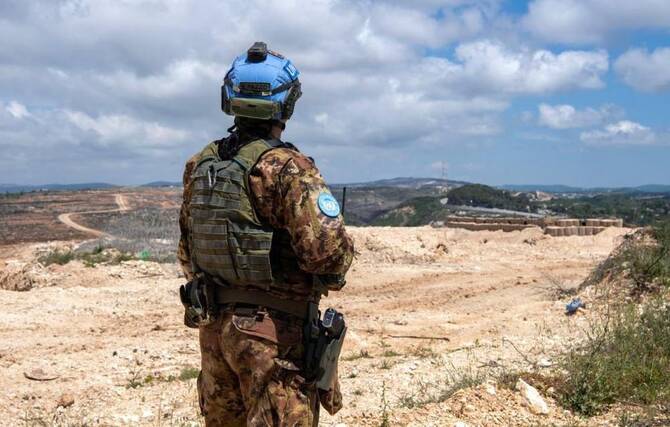
The UN peacekeeping force in southern Lebanon has protested at ‘direct fire’ by the Israeli military at one of its positions. (X/@UNIFIL_)
Short Url
Updated 14 May 2025
Follow

UN peacekeepers say Israel hit Lebanon base with ‘direct fire’

  • UNIFIL said it was ‘concerned by the recent aggressive posture of the Israel Defense Forces involving UNIFIL personnel and assets’
  • Included an ‘incident in which a direct fire hit the perimeter of a UNIFIL position south of the village of Kfar Shouba’

BEIRUT: The UN peacekeeping force in southern Lebanon protested on Wednesday at “direct fire” by the Israeli military at one of its positions, the first since a ceasefire between Hezbollah and Israel.

UNIFIL sits on the international committee created to supervise the ceasefire agreement that kicked in on November 27 and ended more than two months of all-out war between Israel and the pro-Iranian militant group.

In a statement, UNIFIL said it was “concerned by the recent aggressive posture of the Israel Defense Forces involving UNIFIL personnel and assets.”

That included an “incident in which a direct fire hit the perimeter of a UNIFIL position south of the village of Kfar Shouba,” which it said took place on Tuesday.

The force said it “observed two shots fired from south of the Blue Line,” in reference to the de facto border between Israel and Lebanon.

It was the first time since November 27 that Israel has directly hit a UNIFIL position, it said.

At the height of the fighting last October, the peacekeeping force accused Israel of having hit its positions or peacekeepers at least 20 times.

As well as the “direct hit” on Tuesday, UNIFIL said there were “at least four other incidents involving IDF fire near its positions” and “other aggressive behavior by the IDF toward peacekeepers performing their operational activities.”

It said that on Tuesday that peacekeepers patrolling alongside the Lebanese army “reported being targeted by a laser from a nearby IDF position.”

“UNIFIL protests all such and we continue to remind all actors of their responsibility to ensure the safety and security of UN personnel and property and to respect the inviolability of UN assets and premises at all times,” the statement read.

According to the terms of the ceasefire, the Israeli military is required to withdraw completely from southern Lebanon while Hezbollah must dismantle its military assets in the region and withdraw north of the Litani river.

Israel has largely completed its withdrawal, though it insisted on keeping its forces at five points inside Lebanon that it considers strategic and has repeatedly launched strikes inside the country.

The ceasefire is based on UN Security Council Resolution 1701, which requires that UN peacekeepers and the Lebanese army be the only armed bodies in southern Lebanon.


Lebanon foreign minister declines Tehran visit, proposes talks in neutral country

Updated 31 sec ago
Follow

Lebanon foreign minister declines Tehran visit, proposes talks in neutral country

  • Lebanon’s foreign minister Youssef Raji cited ‘current conditions’ for the decision not to go to Iran

Lebanon’s foreign minister Youssef Raji said on Wednesday he had declined an invitation to visit Tehran for now, proposing instead talks with Iran in a mutually agreed neutral third country, Lebanese state news agency NNA reported.

Raji cited “current conditions” for the decision not to go to Iran, without elaborating, and stressed that the move did not mean rejection of dialogue with Iran. He did not immediately respond to a request from Reuters for additional comment.

Iran’s Foreign Minister Abbas Araqchi had extended the invitation last week, seeking talks on bilateral ties.

Raji said Lebanon stood ready to open a new phase of constructive relations with Iran, on the condition that ties be based strictly on mutual respect, full recognition of each country’s independence and sovereignty, and non-interference in internal affairs under any pretext.

In an apparent reference to calls to disarm Hezbollah, the Lebanese armed movement allied for decades to Iran, Raji added that no strong state could be built unless the government held the exclusive right to hold weapons.

Hezbollah, once a dominant political force with wide influence over the Lebanese state, was severely weakened by Israeli strikes last year that ended with a US-brokered ceasefire. It has been under mounting domestic and international pressure to surrender its weapons and place all arms under state control.

In August, Iran’s top security official Ali Larijani visited Beirut, warning Lebanon not to “confuse its enemies with its friends.” In June, Foreign Minister Araqchi said Tehran sought a

“new page” in ties.