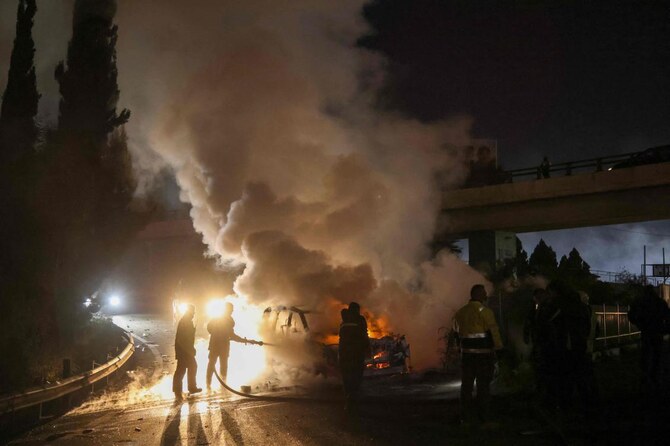
BEIRUT: Lebanese authorities said Saturday that more than 25 people had been arrested following an attack on a United Nations convoy the day before that wounded two peacekeepers, including the force’s outgoing deputy commander.
UN and Lebanese officials have condemned Friday’s attack, which came as Hezbollah supporters for a second night blocked the road to the country’s only international airport over a decision barring two Iranian planes from landing there.
“More than 25 people have been arrested by Lebanese army intelligence,” with another person detained by the security services, Interior Minister Ahmad Al-Hajjar told reporters after an emergency security meeting Saturday.
“This does not mean these detainees carried out the attack... but the investigations will show who is responsible,” he said.
The army and security agencies would bolster measures to “maintain security and stability,” Hajjar added, and violations would be treated “with all seriousness.”
The UN Interim Force in Lebanon (UNIFIL) has demanded an investigation after one of its vehicles was set on fire during the incident, which wounded outgoing deputy force commander Chok Bahadur Dhakal, a Nepalese national who was heading home after ending his mission.
UNIFIL deputy spokesperson Kandice Ardiel told AFP a second Nepalese peacekeeper was also wounded and hospitalized.
President Joseph Aoun vowed “the attackers will receive their punishment,” and said “security forces will not be lenient with any party that tries to upset stability and civil peace,” according to a statement from the presidency on X.
Prime Minister Nawaf Salam strongly condemned the “criminal attack” and promised to arrest the perpetrators during a conversation with UN Special Coordinator for Lebanon Jeanine Hennis-Plasschaert and UNIFIL Commander General Aroldo Lazaro.
In a meeting with Hajjar on Saturday, Salam emphasized the importance of maintaining security across the country, a statement from his office said. The premier was set to meet other “relevant ministers” later in the day.
The presidency’s statement said Aoun had stressed that the incident “cannot be allowed to be repeated,” adding that the judiciary “has begun investigations on the ground.”
The army said Friday that several areas around the airport had seen “demonstrations marked by acts of vandalism and clashes, including assaults on members of the armed forces and attacks against vehicles.”
Videos circulating on social media showed demonstrators, some hooded and carrying Hezbollah flags, attacking a man in military garb and another in civilian clothes near the torched UNIFIL vehicle.
It remains unclear who was responsible for the attack.
There was no immediate official comment from Hezbollah, but its television channel Al-Manar late Friday blamed unidentified “masked men.”
It said the protesters expressed “their rejection of the attack on the UNIFIL convoy,” adding their goal was “to secure the return of citizens stuck in Iran.”
The group’s ally the Amal movement, led by powerful parliament speaker Nabih Berri, said “the attack on UNIFIL is an attack on south Lebanon” and that “blocking roads anywhere is an assault on civil peace.”
Several countries have condemned the incident, as did UN chief Antonio Guterres.
“Such attacks are absolutely unacceptable... The safety and security of UN personnel and property must be respected at all times,” his spokesman, Stephane Dujarric, said in a statement.
“Attacks against peacekeepers are in breach of international law... and may constitute war crimes,” the statement said, adding that “UNIFIL must be allowed unrestricted freedom of movement throughout Lebanon.”
Israel has repeatedly accused Hezbollah of using Beirut airport to transfer weapons from Iran, claims Hezbollah and Lebanese officials have denied.
Iran-backed Hezbollah has a large popular base in Lebanon, though a year of hostilities with Israel and the ousting of its ally Bashar Assad in neighboring Syria have left the group weakened.
Lebanon’s Directorate General of Civil Aviation said Thursday it had “temporarily rescheduled” some flights, including from Iran, until February 18 as it was implementing “additional security measures.”
The date coincides with the deadline for the withdrawal of Israeli forces from south Lebanon and for Hezbollah to vacate positions there, under a ceasefire deal that began on November 27.


![]()

Lebanon says 25 arrested after attack on UN peacekeepers
Short Url
https://arab.news/gpv9d
Lebanon says 25 arrested after attack on UN peacekeepers
- “More than 25 people have been arrested by Lebanese army intelligence,” with another person detained by the security services, Interior Minister Ahmad Al-Hajjar said
- A fragile ceasefire has been in place in Lebanon since November 27, after more than a year of hostilities and two of months of open war between Israel and Hezbollah there


Latest updates


© 2026 SAUDI RESEARCH & PUBLISHING COMPANY, All Rights Reserved And subject to Terms of Use Agreement.