

Mauritania ex-leader Aziz jailed on appeal for 15 years

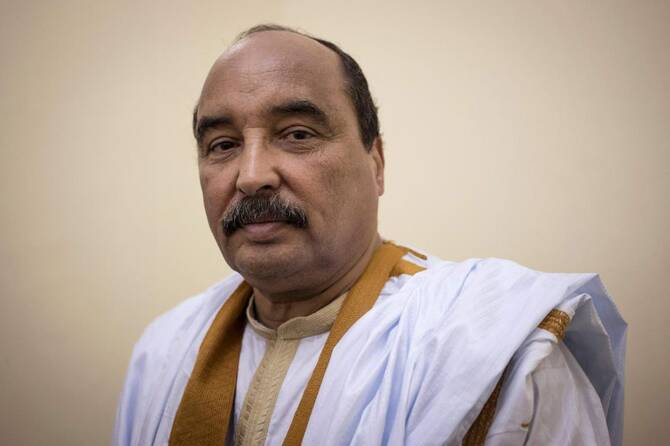
An appeals court sentenced Mauritania’s former president Mohamed Ould Abdel Aziz to 15 years in prison on May 14, 2025 for abuse of office and embezzlement. (AFP)
Short Url
Updated 14 May 2025
Follow

Mauritania ex-leader Aziz jailed on appeal for 15 years

  • Aziz had appealed his original five-year sentence after his conviction two years ago of using his power to amass a fortune
  • Aziz, 68, remained impassive when the decision was announced

NOUAKCHOTT: An appeals court sentenced Mauritania’s former president Mohamed Ould Abdel Aziz to 15 years in prison on Wednesday for abuse of office and illicit enrichment.

Aziz, who came to power in a 2008 coup, had appealed his original five-year sentence after his conviction two years ago of using his power to amass a fortune.

The former leader, who has been in custody since his original trial began in January 2023, appeared alongside several former top officials and advisers also facing charges of abuse of office, illicit enrichment, influence peddling and money laundering.

The court in the capital Nouakchott also upheld the confiscation of Aziz’s assets and the stripping of his civic rights.

Aziz, 68, remained impassive when the decision was announced, an AFP journalist saw.

Investigators estimate that Aziz, who led the northwest African country of 4.5 million people for more than a decade, accumulated assets and capital worth $70 million during his presidency.

He was found guilty and sentenced to five years in jail in December 2023.

Aziz was excluded from the 2019 presidential election, won by his former right-hand man, Mohamed Ould Cheikh El Ghazouani, who had been at his side for the coup and acted successively as his chief of staff then defense minister.

Aziz led the country linking the Maghreb and sub-Saharan Africa until 2019, returning to general stability a nation once prone to coups and jihadist activities.

He groomed Ghazouani as his successor and handed over to him after elections in 2019 in what was the first peaceful transition of power in a country that proclaimed independence from France in 1960 but then saw decades of political unrest.

At the time of his indictment investigators estimated that Aziz, the son of a merchant, had amassed wealth and capital of 67 million euros ($75 million) over his time in power.

Although not denying his wealth, Aziz has always strenuously contested the accusations against him, seeing a conspiracy to oust him from political life.

His successor has always denied any interference in the case. After remaining discreet about where he had obtained his wealth, Aziz surprised everyone toward the end of his trial by implicating his successor.

He claimed that, the day after the 2019 election, Ghazouani had handed him two suitcases filled with several million euros.


Japan to test mine rare-earth mud from deep seabed

Updated 5 sec ago
Follow

Japan to test mine rare-earth mud from deep seabed

TOKYO: Japan will conduct test mining of rare-earth-rich mud from the deep seabed off Minamitori Island, some 1,900 ​kilometers (1,180 miles) southeast of Tokyo, from January 11 to February 14, the head of the government-backed project said on Tuesday.
The operation will mark the world’s first attempt to continuously lift rare-earth mud from a depth of around 6,000 meters on to a vessel.
Tokyo, like its Western allies, is seeking to secure stable supplies of critical minerals as China, the ‌dominant supplier ‌of rare earths, tightens export controls.
“One of ‌our ⁠missions ​is ‌to build a supply chain for domestically produced rare earths to ensure stable supply of minerals essential to industry,” Shoichi Ishii, program director of the Cabinet Office’s national platform for innovative ocean developments, told reporters.
The Japanese government is pressing ahead with a national project as part of broader efforts to strengthen maritime and economic ⁠security.
The January test will focus on connecting the deep-sea mining system and confirming ‌its ability to lift 350 metric ‍tons of rare-earth mud per day. ‍Environmental impacts will be monitored both on board and on ‍the seabed throughout the operation.
No production target has been set, but if successful, a full-scale mining trial will be conducted in February 2027.
The government-funded project has spent about 40 billion yen ($256 million) ​since 2018, Ishii said, though estimated reserves have not been disclosed.
Ishii also said that while their research ⁠vessel was conducting rare-earth surveys within Japan’s exclusive economic zone (EEZ) around Minamitori Island from May 27 to June 25, a Chinese naval fleet entered the waters on June 7.
“We feel a strong sense of crisis that such intimidating actions were taken, despite our activities being limited to seabed resource surveys within our EEZ,” he said.
China’s foreign ministry said the activities of its military vessels are in line with international law and international conventions, and called on Japan to “refrain from hyping up threats and provoking ‌confrontation,” in a reply to Reuters’ request for comment.