

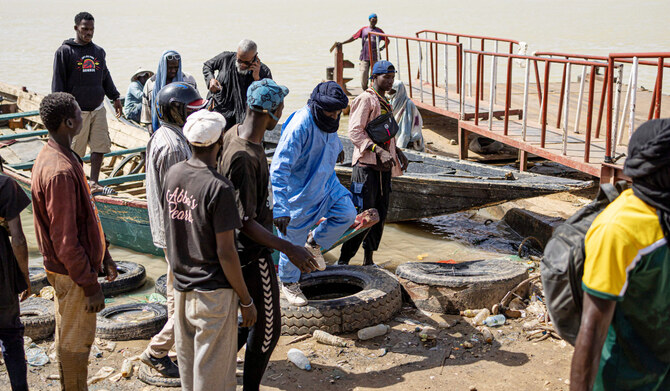

ROSSO, SENEGAL: Ismaila Bangoura has terrible dreams about the night when he says Mauritanian police burst into the place in Nouakchott he shared with other Guineans, beat them up, and carted them off to a police station.
After three days in detention without food or access to toilets, they were taken to the border with Senegal on March 7, the 25-year-old said.
Since then, the group has wandered the streets of Rosso with nowhere to go and no connections to this remote part of northern Senegal.
“They beat us and stuck us in jail without telling us why,” said Bangoura, a trained carpenter who emigrated to Mauritania in 2024 to earn a living.
“They took everything we had — money, watches, phones. They handcuffed us and crammed us into buses to deport us,” he said.
He was left with only the clothes on his back — a Guinea squad football jersey and a pair of black shorts.
For several weeks now, Mauritania has been throwing out migrants, mostly from neighboring countries in West Africa like Senegal, Mali, Ivory Coast, and Guinea.
The campaign has sparked indignation in the region.
The vast, arid country on the Atlantic seaboard is a departure point for many African migrants seeking to reach Europe by sea.
The authorities say their “routine” deportations target undocumented people.
They have not provided information on the number of people expelled.
None of the migrants said they intended to take to the sea.
Interior Minister Mohammed Ahmed Ould Mohammed Lemine told journalists all the foreigners deported had been in Mauritania illegally.
He said the expulsions were “compliant with international conventions.”
Government spokesperson Houssein Ould Meddou said migrants were returned to the border crossings through which they had entered the country.
NGOs, however, have condemned the “inhumane” deportations, and the Senegalese government has voiced outrage at the treatment of its nationals.
A few meters from the Rosso crossing, about 30 migrants — mostly Guinean men, women, and children — squatted in a dilapidated building littered with rubbish, each trying to carve out a space of their own in the narrow edifice.
“You have to get in there quickly if you want to secure a place to sleep at night,” commented a young man named Abibou.
The rest “sleep on the street,” he said.
The most fortunate end up at the nearby Red Cross premises, where they are looked after.
But Mbaye Diop, the head of the Red Cross branch in Rosso, said there had been such a large influx of migrants recently that his organization could no longer accommodate everyone.
“The people who come to us generally arrive exhausted. They’re hungry and need a shower. Some also need psychological support,” he said.
Around him, several migrants tried to get some sleep on old mats despite the constant noise and movement of people around them.
Others remained huddled in their corners, staring blankly.
“We’re hungry. We haven’t eaten anything since this morning,” one said.
Some said they were getting restless and now just wanted to go home.
Amid the hubbub, Ramatoulaye Camara tried to soothe her crying toddler.
She was also deported in early March.
Despite being heavily pregnant with another child, she was — like many others — beaten by Mauritanian guards, imprisoned, and stripped of all her belongings, she recounted.
“We suffered a lot,” she said quietly, trying to comfort the little girl.
Idrissa Camara, 33, has been working as a carpenter in Nouakchott since 2018.
On March 16, he says he was arrested at his workplace and deported. Since then, he has been wandering around Rosso in the same grey and yellow overalls and protective boots, his only remaining possessions.
“They got so dirty and smelly these past few days that I had to go and wash them in the river. I had to hang around nearby in my underwear while they dried,” he said.
The married father of two said he had kept his deportation secret from his family so as not to distress them and planned to return to Nouakchott and his job there.
“All I want is to be able to work and provide for my family. I haven’t harmed anyone,” he said.


