

Islamic Development Bank supports Pakistani project to reactivate out-of-work women doctors 

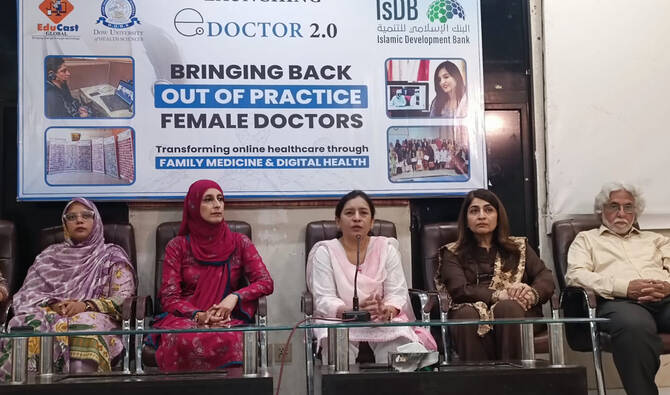
Dr. Jehan Ara Hassan, interim vice chancellor of Dow University of Health Sciences, speaks during the launching of “Doctor 2.0” program at the Karachi Press Club Auditorium in Karachi on May 14, 2025. (Photo courtesy: Handout/Educast)
Short Url
Updated 14 May 2025
Follow

Islamic Development Bank supports Pakistani project to reactivate out-of-work women doctors 

  • Originally launched in 2018, eDoctor program was born out of national need to bring licensed but inactive doctors back to work
  • As many as 35 percent of female medical doctors are unemployed in Pakistan, according to 2023 Gallup Pakistan survey

KARACHI: Pakistan’s Dow University of Health Sciences (DUHS) and health and education tech platform EDUCAST on Wednesday launched a telemedicine initiative aimed at reviving the careers of out-of-practice Pakistani women doctors in a project funded by the Islamic Development Bank.

Originally launched in 2018, the eDoctor program was born out of a national need to reclaim licensed but inactive female doctors who had exited the medical field due to social, familial, or logistical barriers, resulting in estimated Rs. 35 billion losses to the public exchequer. As many as 35 percent of female medical doctors are unemployed in Pakistan, according to a Gallup Pakistan survey in 2023.

The first phase of the project successfully trained and reactivated over 1,500 female doctors across 27 countries through a self-paced, digitally-enabled certification program in partnership with Germany’s Lecturio and Standford University’s Digital Medic platform.

The second phase of the project, Doctor 2.0, launched this week will offer advanced online certification in clinical practice and telemedicine, hands-on clinical observation opportunities at partner clinics, access to Al-powered virtual clinics via smartphones and integration into national initiatives such as ElderCare, polio eradication, MCH support, and rural telehealth.

“This is more than a training program, this is a movement to empower Pakistani women doctors through technology, purpose and dignity,” said Prof. Dr. Jehan Ara Hassan, Acting Vice Chancellor of DUHS. “With Doctor 2.0, we’re giving them a toolkit to reclaim their profession and serve their people.”

She added that Doctor 2.0 was positioned to become a “global model” for female-led, Al-powered, digital health, with plans to export the model to conflict-affected and underserved countries through partnerships with humanitarian agencies.

“This program embodies what modern, resilient, and inclusive health care should look like,” EDUCAST CEO Abdullah Butt said. “We’re proud to be the digital backbone of this transformative initiative.”

Past work of the eDoctor project include managing over 500,000 patients through EDUCAST’s COVID home care program in Sindh during the coronavirus pandemic.

In Afghanistan, the program provided teleconsultation services across 20 Afghan provinces, enabling cancer care, maternal health, and urgent second opinions, while in Yemen, through partnerships with NGOs like INSAN, it offered digital support in areas with no access to on-ground health services.

The program was also used to mobilize tele-triage and digital support during emergencies such as floods in Pakistan and is the backbone of Pakistan’s first elderly home health care platform, BRIDGE, supporting hundreds of senior citizens remotely.


Government says Pakistan preparing Cyber Security Act as digital expansion raises risks

Updated 51 min 23 sec ago
Follow

Government says Pakistan preparing Cyber Security Act as digital expansion raises risks

  • The proposed legislation will create Cyber Security Authority to oversee the country's cyber defenses
  • IT minister warns misuse of genetic and digital data could enable targeted cyber and biological threats

ISLAMABAD: Pakistan is preparing a Cyber Security Act and a dedicated regulatory authority to strengthen defenses against rising digital threats as the country rapidly digitizes government services and economic systems, IT Minister Shaza Fatima said while addressing a ceremony in the federal capital on Wednesday.

The planned legislation is part of Islamabad’s broader “Digital Nation Pakistan” initiative, which aims to expand e-governance, a cashless economy and online public services while safeguarding national cyber infrastructure.

“The more we move toward digitization, with the kind of opportunities that are opening up for us, it is also bringing an equal, or even greater, set of challenges,” the minister said. “This does not mean that we stop digitization. It means that we must make our cybersecurity systems robust.”

She said Pakistan had already activated its National Computer Emergency Response Team (CERT) and provincial CERTs to detect and respond to cyber incidents, while a multi-agency digital monitoring framework known as the National Threat Intelligence System (NTIS) operates around the clock.

“We have a Cyber Security Act coming up, under which a Cyber Security Authority will be established.”

The minister said cybersecurity was not a “generic” concept and required multiple technical specializations as well as comprehensive monitoring and regulation. She warned that the rapid expansion of data-driven technologies was creating new risks even as it opened opportunities in areas such as health and biotechnology.

Referring to advances in genomics and precision medicine, she said the same technologies that help treat diseases could also pose security risks if sensitive biological data were misused. She warned that access to large-scale genetic data could potentially allow hostile actors to develop targeted viruses or other biological threats against populations.

The minister also highlighted Pakistan’s cyber defense capabilities, saying government and military systems remained secure during last year's war with India despite sustained cyber warfare attempts.

She said multiple institutions, including the IT ministry, the National Telecommunication Corporation (NTC), national cybersecurity teams and the armed forces’ cyber command structures, worked together to defend critical systems.

“Despite that massive war ... we did not face a single communication breakdown and we did not allow any penetration into our government systems,” she said, adding that the experience demonstrated the need to further strengthen cybersecurity coordination across institutions.