

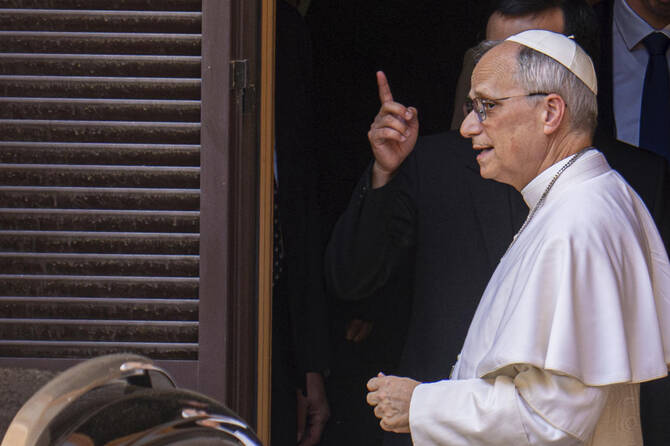

VATICAN CITY: Pope Leo XIV on Wednesday hailed Christian communities in the Middle East who “persevere and remain in their homelands, resisting the temptation to abandon them” despite war, marginalization or persecution.
“Christians must be given the opportunity, and not just in words, to remain in their native lands with all the rights needed for a secure existence. Please, let us strive for this!” he told a meeting of Eastern Catholic Churches at the Vatican.
The pope also offered on Wednesday to mediate between leaders of countries at war, saying that he himself “will make every effort so that this peace may prevail.”
“The Holy See is always ready to help bring enemies together, face to face, to talk to one another, so that peoples everywhere may once more find hope and recover the dignity they deserve, the dignity of peace. The peoples of our world desire peace, and to their leaders I appeal with all my heart: Let us meet, let us talk, let us negotiate!” he told a meeting of Eastern Catholic Churches.
Pope Leo XIV, the first American to head the global Catholic Church, pledged to make "every effort" for peace and offered the Vatican as a mediator in global conflicts, saying war was "never inevitable".
Leo, who was elected last week to succeed the late Pope Francis, has made repeated calls for peace in the early days of his papacy. His first words to crowds in St Peter's Square were "Peace be with all you".
He returned to the issue while addressing members of the Eastern Catholic Churches, some of which are based in conflict-ridden places such as Ukraine, Syria, Lebanon and Iraq and often face persecution as religious minorities.
"The Holy See is always ready to help bring enemies together, face-to-face, to talk to one another, so that peoples everywhere may once more find hope and recover the dignity they deserve, the dignity of peace," Leo said.
"War is never inevitable. Weapons can and must be silenced, for they do not resolve problems but only increase them. Those who make history are the peacemakers, not those who sow seeds of suffering," he added.
Pope Leo warned against the rise of simplistic narratives that divide the world into good and evil. "Our neighbours are not first our enemies, but fellow human beings," he said.
On Sunday, the pontiff called for an "authentic and lasting peace" in Ukraine, a ceasefire in Gaza, the release of all Israeli hostages held by militant group Hamas, and welcomed the fragile ceasefire between India and Pakistan.
Leo spoke to Ukrainian President Volodymyr Zelenskiy on Monday in his first known conversation with a foreign leader as pope. He offered to facilitate peace talks as world leaders come to his inauguration mass, the Ukrainian leader said.
Zelenskiy hopes to be present for the event in St Peter's Square on May 18 and is ready to hold meetings on the sidelines, the Ukrainian leader's chief of staff Andriy Yermak told Reuters on Tuesday.


