

India rejects Trump’s claim his trade concessions de-escalated tensions with Pakistan

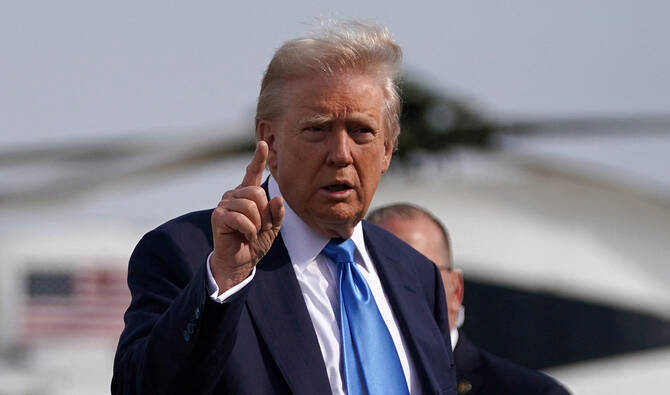
US President Donald Trump gestures as he walks to board Air Force One to depart for Rome, Italy, to attend Pope Francis’ funeral, at Joint Base Andrews in Maryland, US, on April 25, 2025. (REUTERS)
Short Url
Updated 13 May 2025
Follow

India rejects Trump’s claim his trade concessions de-escalated tensions with Pakistan

  • The India, Pakistan militaries last week engaged in one of their most serious confrontations in decades
  • Trump told reporters on Monday he had offered to help both nations with trade if they agreed to de-escalate

NEW DELHI: The Indian government on Tuesday rejected US President Donald Trump’s claim that he helped broker a ceasefire between India and Pakistan in exchange for trade concessions.

Addressing a weekly news conference, Randhir Jaiswal, the spokesman for India’s foreign ministry, said top leaders in New Delhi and Washington were in touch last week following the Indian military’s intense standoff with Pakistan, but there was no conversation on trade.

“The issue of trade didn’t not come up in any of these discussions,” Jaiswal said, referring to the conversations held between US Vice President JD Vance and Indian Prime Minister Narendra Modi, as well as between US Secretary of State Marco Rubio and his Indian counterpart, S. Jaishankar.

Following Saturday’s understanding reached between India and Pakistan in what was a US-mediated ceasefire to stop military action on land, in the air and at sea, Trump told reporters on Monday that he offered to help both the nations with trade if they agreed to de-escalate.

“I said, ‘Come on, we’re going to do a lot of trade with you guys. Let’s stop it. Let’s stop it. If you stop it, we’ll do a trade. If you don’t stop it, we’re not going to do any trade’,” Trump said.

“And all of a sudden, they said, ‘I think we’re going to stop’,” Trump said, crediting trade leverage for influencing both the nations’ decision. “For a lot of reasons, but trade is a big one.”

The militaries of India and Pakistan had been engaged in one of their most serious confrontations in decades since last Wednesday, when India struck targets inside Pakistan it said were affiliated with militants responsible for the killing of 26 tourists last month in Indian-administered Kashmir.

After India’s strikes in Pakistan, both sides exchanged heavy fire along their de facto border, followed by missile and drone strikes into each other’s territories, mainly targeting military installations and air bases.

The escalating hostilities between the nuclear-armed rivals threatened regional peace, leading to calls by world leaders to cool down tempers.

Trump said he not only helped mediate the ceasefire, but also offered mediation over the simmering dispute in Kashmir, a Himalayan region that both India and Pakistan claim in entirety but govern in part. The two nations have fought two wars over Kashmir, which has long been described as the regional nuclear flashpoint.

New Delhi also rejected Trump’s offer for mediation on Tuesday.

“We have a longstanding national position that any issues related to the federally controlled union territory of Jammu and Kashmir must be addressed by India and Pakistan bilaterally. There has been no change to the stated policy,” Jaiswal said.


Afghan interior minister welcomes Pakistani scholars’ ‘positive’ remarks about Kabul

Updated 5 sec ago
Follow

Afghan interior minister welcomes Pakistani scholars’ ‘positive’ remarks about Kabul

  • Pakistani religious scholars on Dec. 23 called for easing tensions between Islamabad and Kabul, resumption of trade
  • Sirajuddin Haqqani says Afghanistan is committed to regional peace, Afghans have “no intentions to threaten anyone”

PESHAWAR: Afghanistan’s Interior Minister Sirajuddin Haqqani recently thanked Pakistan’s Deputy Prime Minister Ishaq Dar and religious scholars from the country for expressing positive statements for Kabul despite tensions between the two countries. 

A meeting of religious scholars in Pakistan on Dec. 23, attended by Jamiat Ulama-e-Pakistan political party head Maulana Fazl-ur-Rehman, called for easing tensions between the two states. The scholars also called for allowing resumption of trade and movement of people between Pakistan and Afghanistan. 

Pakistani news media outlets reported on Saturday that Dar, who is also Pakistan’s foreign minister, praised Haqqani’s earlier statement in which the Afghan minister stressed resolving tensions between Islamabad and Kabul through dialogue. 

In a video statement on Sunday, Haqqani said Afghanistan is committed to peace and stability in the country and the region, adding that Afghans have “no intentions to threaten anyone.” He appreciated Rehman and religious scholar Mufti Taqi Usmani for speaking in a “positive” manner about Afghanistan in the Dec. 23 meeting.

“We are thankful and grateful for their approach and views,” Haqqani said. 

“Similarly, we really appreciate the positive remarks by Foreign Minister Ishaq Dar, who spoke in a positive way about Afghanistan.” 

The Afghan minister’s statement comes in the backdrop of increased tensions between Afghanistan and Pakistan amid a surge in militant attacks in the latter’s territory. 

Pakistan blames Afghanistan’s government for facilitating attacks by the Pakistani Taliban or TTP group. Islamabad accuses Kabul of allowing TTP militants to take shelter in sanctuaries in Afghanistan from where they carry out attacks targeting Pakistan. 

Kabul denies the charges and says it cannot be held responsible for security lapses and challenges in Pakistan. 

The two countries engaged in fierce border clashes in October that led to the killings of dozens of soldiers and civilians on both sides. Pakistan and Afghanistan subsequently agreed to a temporary ceasefire and have held three rounds of peace talks that remained inconclusive. 

Tensions persist as Pakistan has vowed to go after militants even in Afghanistan that threaten the lives of its citizens. Afghan officials have warned Pakistan of retaliation if it attacks Afghanistan.