

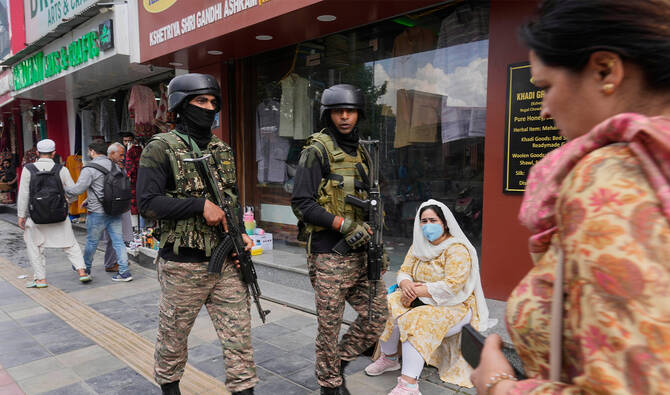

NEW DELHI: Three suspected rebels were killed in Indian-administered Kashmir on Tuesday in a gunbattle with soldiers, the army said, the first since an attack on tourists last month brought India and Pakistan to the brink of war.
The clash happened after the army’s special counter-insurgency force received information that militants were in Keller forest in the southern Kashmir valley, the army said.
The site is around 65 kilometers (40 miles) from Pahalgam, where militants last month killed 26 people, mostly male Hindu tourists, sparking the worst fighting between India and Pakistan since 1999.
A “search and destroy Operation” was launched leading to a clash, the Indian army said on X.
“During the operation, terrorists opened heavy fire and fierce firefight ensued, which resulted in elimination of three hardcore terrorists,” it said.
India accused Pakistan of backing the “terrorists” it said were responsible for the Pahalgam attack — a charge Islamabad denied — and last week launched missiles at sites in Pakistan it said were hosting the militants.
Four days of tit-for-tat jet fighter, drone, missile and artillery attacks followed, until they agreed to a ceasefire Saturday that US President Donald Trump said was brokered by Washington.
On Tuesday Pakistan’s army announced a new death toll from the fighting, saying that India’s “unprovoked and reprehensible dastardly attacks” killed 40 civilians, including seven women and 15 children, and 11 military service members.
“While defending the motherland with exemplary valour, 11 personnel of the Pakistan Armed Forces embraced martyrdom and 78 were wounded.”
Previously Pakistan’s official toll was 33 civilians with no military losses.
India has said that 15 civilians and five soldiers died.
Despite mutual claims on initial violations, the ceasefire still appeared to be holding on Tuesday.
Trump said Monday that US intervention had prevented a “bad nuclear war.”
“We stopped a nuclear conflict... millions of people could have been killed. So I’m very proud of that,” he told reporters at the White House.
Indian Prime Minister Narendra Modi said in a televised address to the nation on Monday that Pakistan has chosen to attack rather than help it fight “terrorism.”
“If another terrorist attack against India is carried out, a strong response will be given,” he said.
A post from his account on X Tuesday said he had met with service members involved in the conflict.
“It was a very special experience to be with those who epitomize courage, determination and fearlessness. India is eternally grateful to our armed forces for everything they do for our nation,” he said.
The flare-up in violence was the worst since the rivals’ last open conflict in 1999 and sparked global shudders that it could spiral into full-blown war.
Pakistan’s military statement Tuesday listed the highest ranked service member to be killed in the latest conflict as an air force squadron leader.
The military has said it downed five Indian jets but has not admitted losing any aircraft of its own.
India has not disclosed losing any aircraft.
Militants have stepped up operations in Kashmir since 2019, when Modi’s Hindu nationalist government revoked the region’s limited autonomy and took it under direct rule from New Delhi.
Divided Muslim-majority Kashmir is claimed in full by both countries, who have fought several wars over the territory since their independence from Britain in 1947.


