

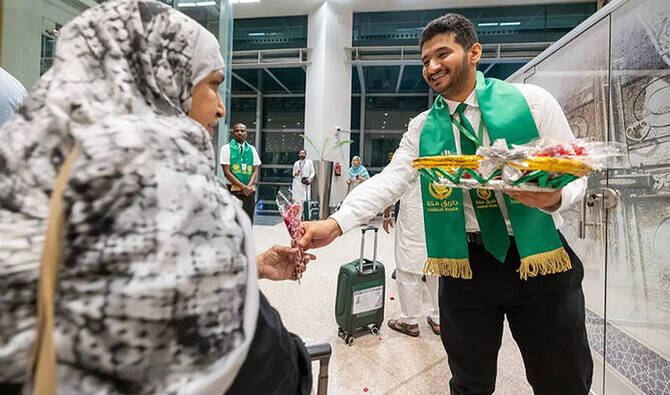
Pakistan says has introduced ‘historic’ new facilities for Hajj pilgrims

Saudi official gives flower to a Pakistani pilgrim departing from Islamabad International Airport in Islamabad, Pakistan, on April 29, 2025 for this year's Hajj. (Saudi Press Agency)
Short Url
Updated 13 May 2025
Follow

Pakistan says has introduced ‘historic’ new facilities for Hajj pilgrims

  • For the first time, Hajj pilgrims will have access to fully air-conditioned camps in Mina
  • New facilities part of effort to ensure smoother, more comfortable Hajj experience

ISLAMABAD: Director Hajj in Makkah, Azizullah Khan, said on Tuesday Pakistani pilgrims will this year enjoy “historic facilities” in Mashair, sacred sites used during the Hajj pilgrimage, including fully air-conditioned camps in Mina with sofa-cum-beds, and improved accommodation in Makkah.

Over the last few years, Saudi Arabia has launched mobile apps like Nusuk, Hajj Navigator, Tawakkalna and Asefny to streamline services, with the aim to make the Hajj experience smoother by offering real-time guidance and ensuring pilgrim safety.

For the first time, Pakistani Hajj pilgrims will have access to fully air-conditioned camps in Mina and be accommodated in top-of-the-line hotels and buildings in the Azizia and Batha Quraish neighborhoods.

Pilgrims will receive a specially designed bag containing the Pakistani flag, a QR code for identification, and relevant information. A mobile app will provide access to Hajj group information, training schedules, flight details, accommodation details, and live maps and locations during the pilgrimage.

“For the first time in history, Hujjaj will have sofa-cum-beds instead of mattresses while tents are upgraded with gypsum board walls and air coolers have been replaced with air conditioners,” Khan told Radio Pakistan, adding that elevated luggage storage racks had also been introduced to enhance comfort.

“Dedicated sections are overseeing food, health and transport related arrangements round the clock for maximum facilitation of the pilgrims,” he said, adding that 99 percent of pilgrims who had arrived in Saudi Arabia had received Nusuk cards.

The cards are an essential Hajj permit, not just an ID, for pilgrims traveling to Makkah and the holy sites. It facilitates movement and ensures the well-being of Hajj pilgrims by managing logistics and administration. The card also allows pilgrims to access information about their Hajj mission, schedules, and allows for communication with their mission. Additionally, it enables receiving alerts, evaluating services, and filing observations.

Compulsory Hajj training has been made available for all pilgrims in Pakistan, starting from Jan. 18, 2025, with details accessible through the “Pak Hajj 2025 Mobile App.” 

For the government Hajj scheme, the option of three easy installments has been introduced for the first time. 

All Hajj-related financial transactions have also been digitized, ensuring transparency and accountability. 

Pakistan’s Hajj medical mission includes a hospital each in Makkah and Madinah, along with two dispensaries in Madinah and nine in Makkah, all fully functional. 

A Monitoring Cell has been established to address potential issues faced by private pilgrims and provide support to them. Various specialized units, including a Wheelchair Desk, have been set up to cater to the needs of different groups of pilgrims. 


Pakistan denies reports army ordered ‘depopulation’ in Tirah Valley ahead of anti-militant operation

Updated 5 sec ago
Follow

Pakistan denies reports army ordered ‘depopulation’ in Tirah Valley ahead of anti-militant operation

  • Tirah Valley residents started fleeing homes this month ahead of a planned military operation against militants
  • Reports aimed at creating alarm among public, disinformation against security institutions, says information ministry

ISLAMABAD: Pakistan’s information ministry on Sunday denied reports the army has ordered depopulation in the northwestern Tirah Valley ahead of a planned anti-militant offensive, stating that any movement of residents from the area is voluntary. 

The denial from the government comes as residents of Tirah Valley in Pakistan’s northwestern Khyber Pakhtunkhwa (KP) province bordering Afghanistan flee their homes ahead of a planned military operation by the army against militants, particularly the Tehreek-e-Taliban Pakistan (TTP) group. 

Despite major military operations in the mid-2010s, Tirah Valley has remained a stronghold for insurgents, prompting authorities to plan what they describe as a targeted clearance.

“The government has taken notice of misleading claims in circulation regarding alleged ‘depopulation’ from Tirah Valley on the orders of the Army,” the Ministry of Information and Broadcasting (MoIB) said in a statement on Sunday. 

“These assertions are baseless, malicious, and driven by ulterior motives aimed at creating alarm among the public, disinformation against security institutions and furthering vested political interest.”

The ministry said Pakistan’s federal government and the armed forces had not issued directives for any such depopulation of the territory. It clarified that law enforcement agencies are “routinely conducting targeted, intelligence-based operations strictly against terrorist elements” with care to avoid disruption to peaceful civilian life. 

It said locals are increasingly concerned over presence of the “khawarij,” a term the military and government frequently use for the TTP, in Tirah Valley and desire peace and stability in the area.

The information ministry mentioned that the Khyber Pakhtunkhwa Relief, Rehabilitation and Resettlement Department issued a notification on Dec. 26 last year for the release of funds, reportedly Rs4 billion [$14.24 million], for the “anticipated temporary and voluntary movement of population from certain localities of Tirah.”

Families load their belongings onto vehicles in Pakistan’s Tirah Valley on January 15, 2026. (AN photo)

It also said that the notification mentioned that the deputy commissioner of Khyber District, where Tirah Valley is located, said the voluntary movement of people reflects the views of the local population articulated through a jirga at the district level. 

“Hence any stated position of the Provincial Government or their officials being conveyed to media that the said migration has anything to do with the Armed Forces is false and fabricated,” the information ministry said. 

“Given with malafide intent to gain political capital and unfortunately malign security institutions and therefore highly regrettable.”

The evacuation has exposed tensions between the provincial government, run by former prime minister Imran Khan’s Pakistan Tehreek-e-Insaf (PTI) party, and the military establishment over the use of force in the region.

“We have neither allowed the operation nor will we ever allow the operation,” KP Law Minister Aftab Alam Afridi said earlier this month, arguing that past military campaigns had failed to deliver lasting stability.

Pakistan military spokesperson Lt. Gen. Ahmed Shareef Chaudhry has previously defended security operations as necessary as militant attacks surge in the country. 

In a recent briefing, Chaudhry said security forces carried out 75,175 intelligence-based operations nationwide last year, including more than 14,000 in Khyber Pakhtunkhwa, attributing the surge in violence to what he described as a “politically conducive environment” for militants.