

Pakistan to get $1 billion IMF tranche today, no large fiscal impact of India standoff — finmin

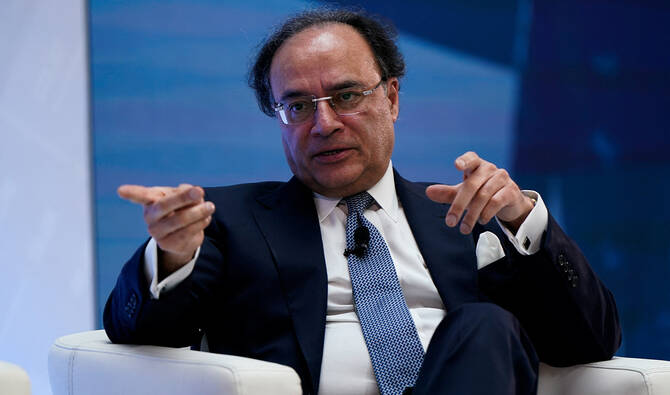
Pakistan Finance Minister Muhammad Aurangzeb participates in a panel titled “Navigating an Uncertain World” during the 2025 annual IMF/World Bank Spring Meetings in Washington DC, US, on April 25, 2025. (REUTERS/File)
Short Url
Updated 13 May 2025
Follow

Pakistan to get $1 billion IMF tranche today, no large fiscal impact of India standoff — finmin

  • IMF last week approved fresh $1.4 billion climate loan, $1 billion under bailout program 
  • Successful review approval brings disbursements to $2 billion within $7 billion loan program

KARACHI: Pakistan is expected to receive a $1 billion loan disbursement from the IMF today, Tuesday, as part of a larger $7 billion bailout agreement, Finance Minister Muhammad Aurangzeb has said.

The IMF last Friday approved a fresh $1.4 billion loan to Pakistan under its climate resilience fund and approved the first review of its $7 billion program, freeing about $1 billion in cash. The review approval brings disbursements to $2 billion within the $7 billion program. 

In a statement released after a virtual meeting on Monday between Aurangzeb and Johana Chua, head of emerging markets economies for Citigroup Global Markets, the finance ministry confirmed that Pakistan would receive the latest IMF tranche on Tuesday.

“The Minister also apprised the participants of the successful conclusion of a Staff Level Agreement with the International Monetary Fund (IMF) under the Extended Fund Facility (EFF), with the next tranche expected to be received tomorrow [Tuesday],” the statement said. 

“He further mentioned the approval of the Resilience and Sustainability Facility (RSF), calling it a milestone achievement for Pakistan.”

The loan disbursement comes amid a military standoff with arch-rival India, though Aurangzeb told Reuters in an interview on Monday the conflict would not have a large fiscal impact on Pakistan.

The finance minister described the conflict as a “short duration escalation” with minimal fiscal impact, stating it can be “accommodated within the fiscal space which is available to the government of Pakistan.”

When questioned about potential increased military spending in the upcoming budget, Aurangzeb deferred comment, saying it was premature to discuss specific plans. However, he said: “Whatever we need to do in terms of ensuring that our defense requirements are met will be met.”

Aurangzeb said he expects the Indus Water Treaty, which India unilaterally suspended, to be reinstated and rolled back to where it was.

He said there is not going to be any immediate impact from India’s suspension and Pakistan does not “even want to consider any scenario which does not take into account the reinstatement of this treaty.”

Tensions between India and Pakistan began mounting after the April 22 attack in Indian-administered Kashmir on Hindu tourists that killed 26 people, sparking the worst clashes between the nuclear-armed neighbors in more than two decades.

On Saturday, a ceasefire in the Himalayan region was announced by US President Donald Trump, following four days of fighting and diplomacy and pressure from Washington.

Pakistan’s federal budget for the next fiscal year, starting July, will be finalized within the next four weeks, with scheduled budget talks with the IMF to take place from May 14-23, according to the finance ministry. 


With inputs from Reuters


At UNSC, Pakistan warns competition for critical minerals could fuel global conflict

Updated 54 min 58 sec ago
Follow

At UNSC, Pakistan warns competition for critical minerals could fuel global conflict

  • The demand for critical minerals has surged worldwide due to rapid expansion of electric vehicles, advanced electronics and clean energy technologies
  • Pakistan’s representative says all partnerships in critical minerals sector must be ‘cooperative and not exploitative’ and respect national ownership

ISLAMABAD: Ambassador Asim Iftikhar Ahmad, Pakistan’s permanent representative to the United Nations (UN), has warned that intensifying global competition over critical minerals could become a new driver of global conflict, urging stronger international cooperation and equitable access to resources vital for the world’s energy transition.

The warning comes as demand for critical minerals and rare earth elements surges worldwide due to the rapid expansion of electric vehicles, advanced electronics and clean energy technologies, with governments and companies increasingly competing to secure supply chains while raising concerns that this may lead to geopolitical rivalries in the coming years.

Speaking at a Security Council briefing on ‘Energy, Critical Minerals, and Security,’ Ahmad said experience showed that the risks of instability increased where mineral wealth intersected with weak governance, entrenched poverty and external interference.

“Access to affordable, reliable and sustainable energy is essential for development, stability and prosperity. The global transition toward renewable energy, electric mobility, battery storage and digital infrastructure has sharply increased the demand for critical minerals,” he said.

“This upsurge has generated new geopolitical and geo-economic pressures. If not managed responsibly, competition over natural resources can affect supply chains, aggravate tensions, undermine sovereignty and contribute to instability.”

In several conflict-affected settings, he noted, illicit extraction, trafficking networks and opaque financial flows have fueled armed conflict and violence, weakened state institutions and deprived populations of legitimate revenues.

“The scramble for natural resources and its linkage to conflict and instability is therefore not new,” Ahmad told UNSC members at the briefing. “Pakistan believes that natural resources must serve as instruments of economic development and shared prosperity, and not coercion or conflict.”

He urged the world to reaffirm the right of peoples to permanent sovereignty over their natural resources, saying all partnerships in the critical minerals sector must be cooperative and not exploitative, respect national ownership, ensure transparent contractual arrangements and align with host countries’ development strategies.

“In order to prevent the exploitation of mineral-producing countries and regions, particularly in fragile and conflict-affected settings, support their capacity-building for strengthening domestic regulatory institutions, combating illicit financial flows, ensuring environmental safeguards, and promoting equitable benefit-sharing with local communities,” he asked member states.

“Promote equitable participation in global value chains. Developing countries must be enabled to move beyond extraction toward processing, refining and downstream manufacturing. Technology transfer, skills development and responsible investment are essential to avoid perpetuating structural imbalances.”