NEW DELHI/ISLAMABAD: Indian Prime Minister Narendra Modi warned Pakistan on Monday that New Delhi would target “terrorist hideouts” across the border again if there were new attacks on India and would not be deterred by what he called Islamabad’s “nuclear blackmail.”
Modi’s first public comments since Indian armed forces launched strikes on what New Delhi said were “terrorist camps” across the border last week indicated a hardening of India’s position on ties with its neighbor, which were icy even before the latest fighting.
Pakistan denies Indian accusations that it supports militants who attack it and says the locations hit by India last week were civilian sites.
Modi was speaking two days after the nuclear-armed neighbors agreed to a ceasefire, announced by US President Donald Trump.
The truce was reached after four days of intense exchanges of fire as the old enemies targeted each other’s military installations with missiles and drones, killing dozens of civilians.
The military confrontation began on Wednesday, when India said it launched strikes on nine “terrorist infrastructure” sites in Pakistan and Pakistani Kashmir following an attack on Hindu tourists by militants in Indian Kashmir last month that killed 26 men.
Islamabad denied any links to the attack and called for a neutral investigation.
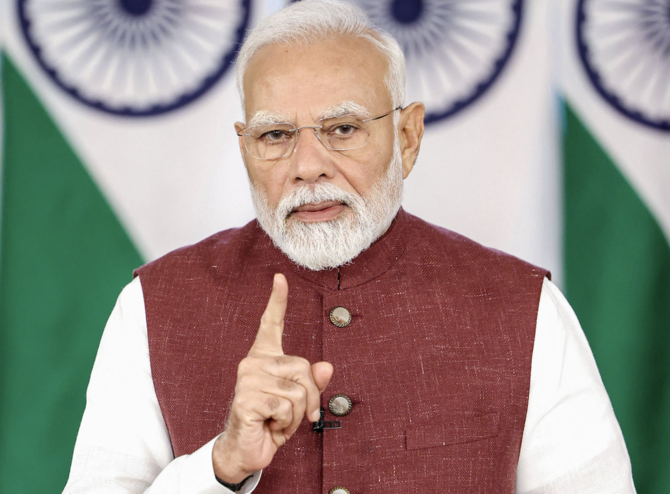
“If there is a terrorist attack on India, a fitting reply will be given... on our terms,” Modi said, speaking in Hindi in a televised address. “In the coming days, we will measure every step of Pakistan... what kind of attitude Pakistan will adopt.”
“India will strike precisely and decisively at the terrorist hideouts developing under the cover of nuclear blackmail,” he said, and listed New Delhi’s conditions for holding talks with Islamabad and lifting curbs imposed after the Kashmir attack.
“India’s position is clear: terror and talks cannot go together; terror and trade cannot go together. And water and blood cannot flow together,” he said, referring to a water sharing pact between the two countries New Delhi suspended.
There was no immediate response to his comments from Islamabad.
Military talks
Hindu-majority India and Muslim Pakistan both rule part of the Himalayan region of Kashmir, but claim it in full. They have fought two of their three wars since independence in 1947 over the region and there have been several other more limited flare-ups, including in 2016 and 2019.
The latest military conflict between the South Asian neighbors spiralled alarmingly on Saturday and there were briefly fears that nuclear arsenals might come into play as Pakistan’s military said a top body overseeing its nuclear weapons would meet.
But the Pakistani defense minister said no such meeting was scheduled.
Military analysts said this may have been Pakistan’s way of hinting at its nuclear option as Islamabad has a “first-use” policy if its existence is under threat in a conflict.
Modi’s address came hours after the military operations chiefs of India and Pakistan spoke by phone, two days after they agreed to the ceasefire.
“Issues related to continuing the commitment that both sides must not fire a single shot or initiate any aggressive and inimical action against each other were discussed,” the Indian army said.
“It was also agreed that both sides consider immediate measures to ensure troop reduction from the borders and forward areas,” it added.
There was no immediate Pakistani readout of the military operations chiefs’ talks.
In Washington, Trump said the leaders of India and Pakistan were “unwavering,” and the US “helped a lot” to secure the ceasefire, adding that trade was a “big reason” why the countries stopped fighting.
“We are going to do a lot of trade with Pakistan... and India. We are negotiating with India right now. We are soon going to negotiate with Pakistan,” he said, just ahead of Modi’s speech.
Pakistan has thanked the US for brokering the ceasefire while India, which opposes third-party involvement in its disputes with Pakistan, has not commented on Washington’s role.
Markets soar
Pakistan’s international bonds rallied sharply on Monday, adding as much as 5.7 cents in the dollar, Tradeweb data showed.
Late on Friday, the International Monetary Fund approved a fresh $1.4-billion loan and also the first review of its $7-billion program.
Pakistan’s benchmark share index closed up 9.4 percent on Monday, while India’s blue-chip Nifty 50 index closed 3.8 percent higher in its best session since February 2021.
In Beijing the foreign ministry said China, which also controls a small slice of Kashmir, was willing to maintain communication with both its neighbors, and play a “constructive role in achieving a comprehensive and lasting ceasefire” and maintaining peace.
India blames Pakistan for an insurgency in its part of Kashmir that began in 1989, but Pakistan says it provides only moral, political and diplomatic support to Kashmiri separatists.


![]()

India PM Modi warns Pakistan of more strikes if there is a ‘terrorist attack’
Short Url
https://arab.news/nymft
India PM Modi warns Pakistan of more strikes if there is a ‘terrorist attack’
- Modi was speaking two days after the nuclear-armed neighbors agreed to a ceasefire, announced by US President Donald Trump
- Pakistan denies Indian accusations that it supports militants who attack it and says the locations hit by India last week were civilian sites


Latest updates


© 2026 SAUDI RESEARCH & PUBLISHING COMPANY, All Rights Reserved And subject to Terms of Use Agreement.