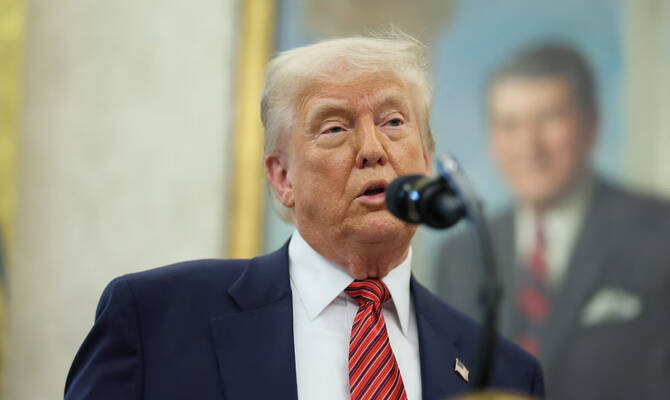
Trump promises to order that the US pay only the price other nations do for some drugs

President Donald Trump says he’ll sign an executive order on Monday that, if implemented, could bring down the costs of some medications. (Reuters)
Short Url
Updated 12 May 2025
Follow

Trump promises to order that the US pay only the price other nations do for some drugs

  • “Our Country will finally be treated fairly, and our citizens Healthcare Costs will be reduced by numbers never even thought of before,” Trump says

WASHINGTON: President Donald Trump says he’ll sign an executive order on Monday that, if implemented, could bring down the costs of some medications — reviving a failed effort from his first term on an issue he’s talked up since even before becoming president.

The order Trump is promising will direct the Department of Health and Human Services to tie what Medicare pays for medications administrated in a doctor’s office to the lowest price paid by other countries.

“I will be instituting a MOST FAVORED NATION’S POLICY whereby the United States will pay the same price as the Nation that pays the lowest price anywhere in the World,” the president posted Sunday on his social media site, pledging to sign the order on Monday morning at the White House.

“Our Country will finally be treated fairly, and our citizens Healthcare Costs will be reduced by numbers never even thought of before,” Trump added.

His proposal would likely only impact certain drugs covered by Medicare and given in an office — think infusions that treat cancer, and other injectables. But it could potentially bring significant savings to the government, although the “TRILLIONS OF DOLLARS” Trump boasted about in his post may be an exaggeration.

Medicare provides health insurance for roughly 70 million older Americans. Complaints about US drug prices being notoriously high, even when compared with other large and wealthy countries, have long drawn the ire of both parties, but a lasting fix has never cleared Congress.

Under the planned order, the federal government would tie what it pays pharmaceutical companies for those drugs to the price paid by a group of other, economically advanced countries — the so-called “most favored nation” approach.

The proposal will face fierce opposition from the pharmaceutical industry.

It was a rule that Trump tried to adopt during his first term, but could never get through. He signed a similar executive order in the final weeks of his presidency, but a court order later blocked the rule from going into effect under the Biden administration.

The pharmaceutical industry argued that Trump’s 2020 attempt would give foreign governments the “upper hand” in deciding the value of medicines in the US. The industry has long argued that forcing lower prices will hurt profits, and ultimately affect innovation and its efforts to develop new medicines.

Only drugs on Medicare Part B — the insurance for doctor’s office visits — are likely to be covered under the plan. Medicare beneficiaries are responsible for picking up some of the costs to get those medications during doctor’s visits, and for traditional Medicare enrollees there is no annual out-of-pocket cap on what they pay.

A report by the Trump administration during its first term found that the US spends twice as much as some other countries in covering those drugs. Medicare Part B drug spending topped $33 billion in 2021.

More common prescription drugs filled at a pharmacy would probably not be covered by the new order.

Trump’s post formally previewing the action came after he teased a “very big announcement” last week. He gave no details, except to note that it wasn’t related to trade or the tariffs he has announced imposing on much of the world.

“We’re going to have a very, very big announcement to make — like as big as it gets,” Trump said last week.

He came into his first term accusing pharmaceutical companies of “getting away with murder” and complaining that other countries whose governments set drug prices were taking advantage of Americans.

On Sunday, Trump took aim at the industry again, writing that the “Pharmaceutical/Drug Companies would say, for years, that it was Research and Development Costs, and that all of these costs were, and would be, for no reason whatsoever, borne by the ‘suckers’ of America, ALONE.”

Referring to drug companies’ powerful lobbying efforts, he said that campaign contributions “can do wonders, but not with me, and not with the Republican Party.”

“We are going to do the right thing,” he wrote.


FBI foils Daesh-inspired New Year’s Eve attack plot

Updated 2 sec ago
Follow

FBI foils Daesh-inspired New Year’s Eve attack plot

  • Christian Sturdivant,18, charged with attempting to provide material support to foreign terrorist organization
  • Investigators say he shared plans for the attack with an undercover FBI employee
CHARLOTTE, United States: The FBI said Friday it disrupted a New Year’s Eve attack plot targeting a grocery store and fast-food restaurant in North Carolina, arresting an 18-year-old man who authorities say pledged loyalty to the Daesh group.
Christian Sturdivant was charged with attempting to provide material support to a foreign terrorist organization after investigators say he shared plans for the attack with an undercover FBI employee posing as a supportive confidant.
Sturdivant was arrested Wednesday and remained in custody after a federal court appearance Friday. An attorney representing him Friday did not immediately respond to an email seeking comment. Another hearing was scheduled for Jan. 7.
The alleged attack would have taken place one year after 14 people were killed in New Orleans by a US citizen and Army veteran who had proclaimed his support for Daesh on social media.
The FBI has foiled several alleged attacks through sting operations in which agents posed as terror supporters, supplying advice and equipment. Critics say the strategy can amount to entrapment of mentally vulnerable people who wouldn’t have the wherewithal to act alone.
Searches of Sturdivant’s home and phone uncovered what investigators described as a manifesto detailing plans for an attack with knives and a hammer, FBI Special Agent in Charge James Barnacle said at a news conference Friday.
“He was willing to sacrifice himself,” Barnacle said.
US Attorney for western North Carolina Russ Ferguson said the planned attack in Mint Hill, a bedroom community near Charlotte, targeted “places that we go every day and don’t think that we may be harmed.”
Worried he might attempt violence before New Year’s Eve, the FBI placed Sturdivant under constant surveillance for days, including on Christmas, Ferguson said. Agents were prepared to arrest him earlier if he left his home with weapons, he said. “At no point was the public in harm’s way.”
The fact that Sturdivant encountered two undercover officers while allegedly planning the attack should reassure the public, Ferguson said. He declined to identify the grocery store and restaurant cited in the complaint, citing the ongoing investigation.
If convicted, Sturdivant faces up to 20 years in prison, according to court documents.
An FBI affidavit says the investigation began last month after authorities linked Sturdivant to a social media account that posted content supportive of Daesh, including imagery that appeared to promote violence. The account’s display name referenced Abu Bakr Al-Baghdadi, the former leader of the extremist group.
Some experts argue that Daesh is powerful today partly as a brand, inspiring both militant groups and individuals in attacks that the group itself may have no real role in.
The affidavit says Sturdivant had been on the FBI’s radar in January 2022, when he was a minor, after officials learned that he had been in contact with a person in Europe the FBI says was an Daesh member, and had received instructions to dress in black, knock on people’s doors and commit attacks with a hammer.
At that time, Sturdivant did actually set out for a neighbor’s house armed with a hammer and a knife but was restrained by his grandfather, the affidavit says.
The FBI in Los Angeles last month announced the disruption of a separate New Year’s Eve plot, arresting members of an extremist anti-capitalist and anti-government group who federal officials said planned to bomb multiple sites in southern California.
Other Daesh-inspired attacks over the past decade include a 2015 shooting rampage by a husband-and-wife team who killed 14 people in San Bernardino, California, and a 2016 massacre at a gay nightclub in Orlando, Florida, by a gunman who fatally shot 49 people.