

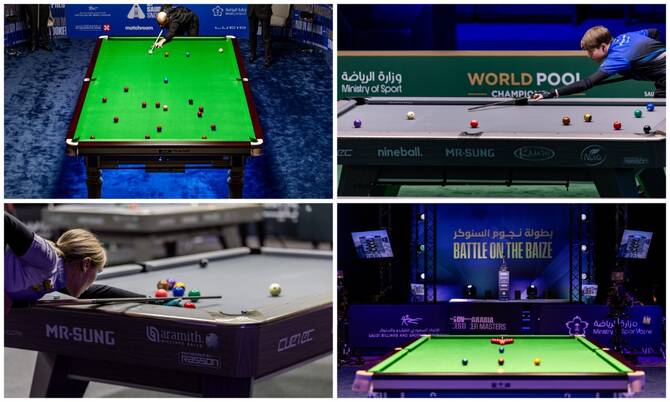
Jeddah to host World Pool Championship and Snooker Masters this summer

Saudi Arabia’s sporting calendar continues to expand with the announcement that Jeddah will host two major cue sports events in July and August 2025, the World Pool Championship and the Snooker Masters. (Supplied)
Short Url
Updated 11 May 2025
Follow

Jeddah to host World Pool Championship and Snooker Masters this summer

  • The tournaments are part of a landmark ten-year strategic partnership between the Saudi Billiards and Snooker Federation and Matchroom

JEDDAH: Saudi Arabia’s sporting calendar continues to expand with the announcement that Jeddah will host two major cue sports events in July and August 2025, the World Pool Championship and the Snooker Masters.

The tournaments are part of a landmark ten-year strategic partnership between the Saudi Billiards and Snooker Federation and Matchroom, in collaboration with the World Nineball Tour (WNT) and the World Snooker Tour (WST).

The events are being organized under the supervision of the Saudi Ministry of Sports and are set to feature top international players from around the world.

Returning to the Kingdom for the second consecutive year, the World Pool Championship will take place from July 21 to 26, 2025, at the Green Halls in Jeddah.

The tournament will gather the world’s top 100 players competing for a total prize pool of $1 million.

Among the headline names are current world champion Fedor Gorst of Russia, 2023 champion Francisco Sanchez Ruiz of Spain, and five-time US Open winner Shane Van Boening of the United States.

Following shortly after, the Snooker Masters will run from August 8 to 16, bringing together 128 of the world’s top professionals alongside 16 emerging Saudi talents, who will participate via special wild card invitations.

With a total prize pot of £2 million ($2.66 million), the tournament ranks as the second most lucrative event on the 2025 World Snooker Tour calendar and is widely regarded as the fourth most prestigious event in the sport.

Commenting on the announcement, Nasser Al-Jaweeni, President of the Saudi Billiards and Snooker Federation, said: “We are pleased to launch this partnership that places the Kingdom at the heart of global billiards and snooker, reflecting international confidence in Saudi Arabia’s organizational capabilities and offering an opportunity to develop local talent and nurture a new generation of Saudi players.”

Emily Frazer, CEO of Matchroom Sport, praised the Kingdom’s efforts.

“We are proud to return to the Kingdom as part of this inspiring partnership. Last year, we witnessed outstanding organization and an exceptional experience for the players, which raised professional standards and opened doors for the next generation of talent,” she said.

Steve Dawson, Chairman of the World Snooker Tour, described the hosting of the Snooker Masters as a landmark moment.

“Saudi Arabia’s hosting of the Snooker Masters marks a significant milestone in the sport’s history. The impact was evident from the very first edition, and we’re all excited to see Saudi players rise through the ranks in the years ahead,” he said.


From the Red Sea to the deep desert: inside the new route for Dakar 2026

Updated 4 sec ago
Follow

From the Red Sea to the deep desert: inside the new route for Dakar 2026

  • The seventh consecutive edition to take place in Saudi Arabia will run from Jan. 3-17

RIYADH: The Dakar Rally returns to Saudi Arabia for the seventh consecutive edition from Jan. 3-17, bringing with it one of the most demanding and wide-ranging routes since the first such event in the Kingdom.

Held under the supervision of the ministry of sport, organised by the Saudi Automobile and Motorcycle Federation, and promoted by the Saudi Motorsport Company, this year the race elevates the rally’s challenges, drawing competitors into a course through some of the country’s most iconic and challenging landscapes.

With a total distance of 7,999 kilometres, including 4,845 kilometres of timed special stages, the 2026 route almost matches the longest competitive distance of the rally’s Saudi era. It takes competitors through some of the Kingdom’s most varied landscapes, from the Red Sea coast to the deep desert and back again.

Fewer bivouacs mean teams arrive to better-rested support crews, while redesigned marathon stages help shape the rhythm of the event. Intense days are balanced with recovery opportunities around the rest day, creating a course defined by challenge and deliberate pacing.

Yanbu: Start and finish point on the Red Sea coast

Yanbu bookends the 2026 Dakar Rally, hosting the Prologue, Stages 1 and 2, and the final Stage 13. Set between the Red Sea and a stretch of inland hills, the region offers a mix of gravel plains, rocky corridors, and light sandy terrain that shifts subtly in color and tone throughout the day. The blend of coastal calm and rugged interior landscapes gives competitors an early sense of the rally’s character and provides a familiar backdrop when they return to the finish on the Red Sea coast.

AlUla: Distinctive desert scenery and marathon conditions

Arriving from the opening stages in Yanbu, AlUla brings competitors into one of the rally’s most distinctive settings, where sandy tracks run through wide open spaces and weave around ancient rock formations. The region’s limited landmarks and expanding network of tracks place added weight on navigation, while the mix of plains, hills, and rocky stretches requires regular changes in pace.

As part of the marathon phase, teams face simple desert camps and minimal support, keeping the focus on careful vehicle management in one of the rally’s most visually striking regions.

Hail: Key region with deep rally roots and the longest stage

Hail adds a familiar rhythm to Dakar 2026, taking competitors through a region deeply connected to Saudi Arabia’s rally heritage. The stage, the longest of Dakar 2026, unfolds toward the Qassim area, where the dunes that local off-road communities have navigated for generations rise and fall as far as the eye can see. The day is spent almost entirely on sand, moving between rolling dune lines and broad valleys that offer little change in surface but plenty of shifts in momentum. It is a long, demanding stretch that rewards comfort in deep sand before the field makes a lengthy journey toward Riyadh and a well-earned rest day.

Riyadh: Central transition marked by steady race rhythm

Riyadh is a reset point in the rally, where competitors return to the course after the rest day with renewed focus.

The stage that follows calls for a measured approach: confidence from the first week can be helpful, but overconfidence can be costly. Sandy, fast tracks dominate the route, with occasional dense bushes along the edges where the terrain itself presents few major hazards beyond the temptation to push too hard. With the day’s combined distance approaching 900km, sustained concentration is essential, even during the long sections leading in and out of the capital.

Wadi Al-Dawasir: Extensive dunes and classic desert driving

Wadi Al-Dawasir brings the rally back into classic desert territory as competitors leave Riyadh and enter one of Saudi Arabia’s largest dune regions. The landscape offers one of the most complete terrain mixes of the rally, with long dune lines, broad valleys, and clear horizons that create a steady but demanding pace. Navigation is straightforward but unforgiving, as even small mistakes can lead teams off course, especially with this part of the route forming the core of the event’s second marathon phase. The area’s size and consistency test endurance and focus, offering a full return to deep-desert driving in a region closely tied to Dakar’s sand heritage.

Bisha: Fast terrain with demanding navigation

Bisha introduces a different type of challenge to Dakar 2026, where the main difficulty comes from navigation rather than the terrain itself.

The tracks in this region often allow for a fast pace, but the abundance of intersections, forks, and junctions can quickly create a maze-like environment. Staying focused is essential, especially with the long overall distance adding to the day’s fatigue. Competitors who manage their pace and maintain clarity through the shifting network of routes will be best positioned as the rally moves toward Al-Henakiyah.

Al-Henakiyah: Mixed terrain requiring precise control

Al-Henakiyah offers one of the final opportunities for competitors to influence the standings, with a route that shifts quickly between different types of terrain. Fast tracks give way to narrower, more winding sections, and parts of the day run through riverbeds where conditions can change without warning.

The stage ends with a series of small dunes that may look modest but still demand attention and control. It is a varied and active day on the course, where a strong, well-rounded performance can still make a meaningful difference before the rally returns to Yanbu.

With 812 competitors representing 69 countries, the 2026 route promises a challenge worthy of the Dakar name. Each region presents its own rhythm and demands, rewarding those who can adapt and stay focused across two intense weeks. As the rally unfolds, the diversity of the terrain and the scale of competition reflect the enduring spirit of Dakar and the growing role of Saudi Arabia as a defining stage for the world’s toughest rally.