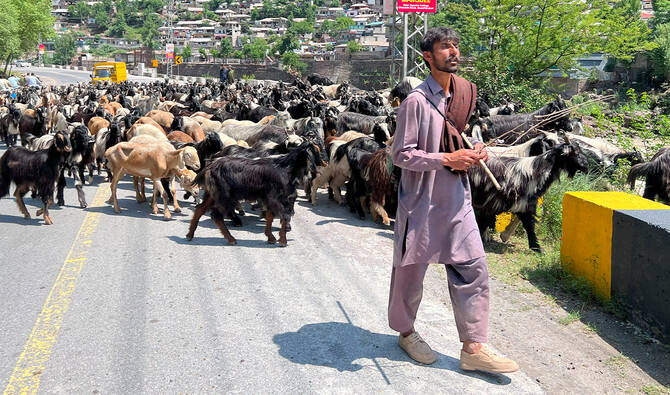

MUZAFFARABAD: Muhammad Jahangir, 35, continuously walked for around four hours to finally find a green patch of land along the banks of Jhelum River, just outside the town of Garhi Dupatta in Azad Kashmir, where his goats could graze, and descended from the road to survey the riverside himself.
While the grass and tree leaves there were barely enough to feed his herd of around 250 goats and a few sheep, Jahangir let out a series of sharp, familiar whistles along with others in his group and the trained animals began moving down the slope to nibble at the patchy grass.
Jahangir hails from the Kashmiri Bakarwal community that comprises nomadic, pastoral people, who are known for raising sheep and goats, in both Pakistan and India-governed parts Kashmir, particularly in the Pir Panjal and Himalayan mountain ranges.
The lives of these Bakarwals revolve around seasonal migrations with their herds, seeking grazing grounds on different altitudes depending on the time of year, but this May a far greater uncertainty loomed ahead in the form of India-Pakistan military incursions.
“We’re coming from Kharian and our destination is Deosai,” Jahangir told Arab News, standing beside his flock a surprise truce between the two countries brokered by the United States (US).
“The situation ahead is said to be tense due to firing. Some of our Bakarwal groups are stuck near Panjkot Mali. We’ll decide whether to move ahead or not depending on the conditions.”
Jahangir and three of his fellows were en route to Deosai, a high-altitude plateau in Pakistan’s northern Gilgit-Baltistan region that is known for its lush-green meadows.
But they were forced to stop because of artillery, drone and missile strikes along the nearby Line of Control (LoC), the de facto border dividing Kashmir between Pakistan and India. Jahangir feared that if the situation continued to remain the same, they might not reach the highlands in time.
“We’ve heard that some people have lost their livestock, though we didn’t see it ourselves. Some families have already turned back from Neelum [valley in Azad Kashmir] and returned,” Jahangir said.
This particular group of nomads set out from Kharian over a week ago, traveling on the Grand Trunk Road and arriving in Muzaffarabad via Murree a resort town on the border of Pakistan’s eastern Punjab province. The four men managed the herd on foot, while their families had already moved ahead on horseback to set up makeshift camps along the way.
Devoid of modern gadgets like smartphones and GPS, these nomads rely on inherited knowledge to assess the direction of the wind, position of stars, and bends of rivers to navigate the challenging terrain, though some of them carry basic feature phones that often have no signals in the mountainous regions.
Once a celebrated lifestyle built on freedom and communion with nature, the nomadic way of living is now increasingly threatened by changing climate patterns, shrinking grazing grounds, and a lack of hospitality from settled communities along their traditional routes.
“People are so cruel [now], they don’t even let us stay near their lands,” said Farooq Ahmed, another nomad.
“If we find a little government land near the river, we rest our animals there, otherwise the locals stop us from going uphill. They say the grass and trees are theirs.”
For generations, these nomads’ migration to Deosai has been about survival — escaping the blistering summer heat of the lowlands and reaching the cool, high pastures where food is abundant and livestock can thrive.
But weeks of tensions between India and Pakistan over an attack in Indian-administered Kashmir, which killed 26 tourists on April 22, turned into a military conflict last week, leaving more than 60 people dead on both sides in four days of cross-border strikes and threatening the centuries-old nomadic way of life in the region.
Although the US-brokered ceasefire between India and Pakistan remains intact, sporadic violations have been reported by locals in Azad Kashmir.
For Ahmed, this truce offers little assurance.
“We just want peace,” he said. “It has become a problem for everyone, every human being is suffering now.”