

Saudi Arabia adds over 1,000 hotel keys as summit opens with major deals

1 / 4
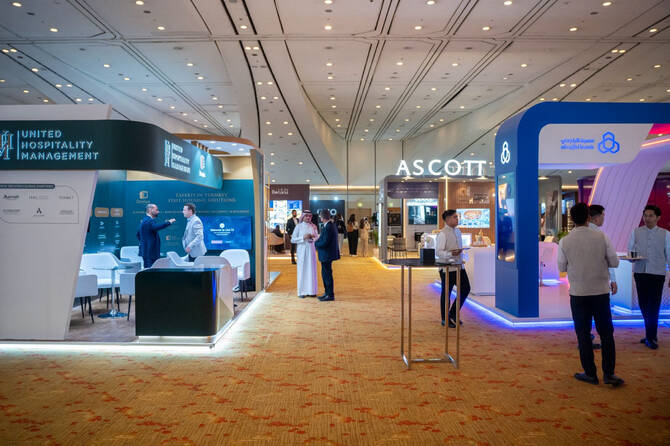
More than 1,000 global tourism leaders, investors, and operators have convened in Riyadh for the Future Hospitality Summit. AN photo by Loai El-Kelawy
2 / 4
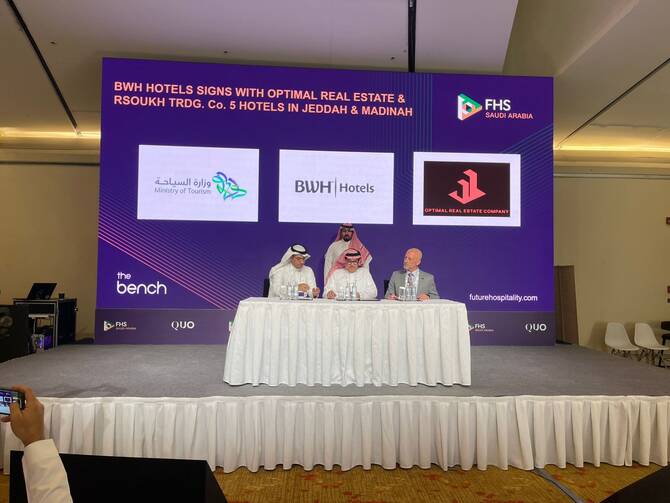
Among the notable announcements was BWH Hotels’ partnership with Optimal Real Estate and Rsoukh Trading Co. to develop five new properties across Jeddah and Madinah. AN photo by Loai El-Kelawy
3 / 4
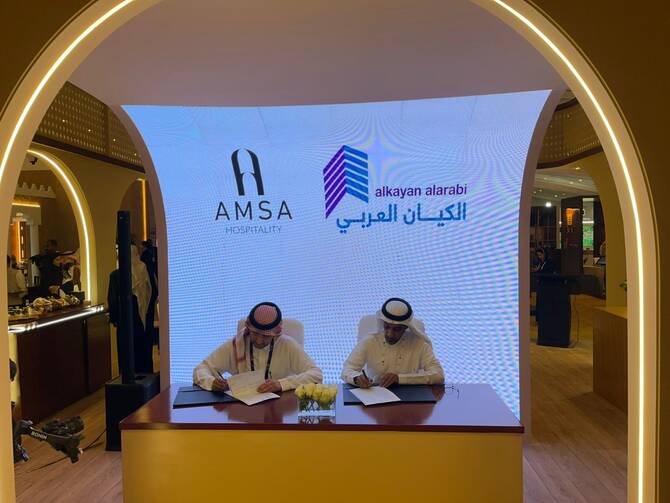
Amsa Hospitality announced a new four-star hotel project in Qassim in collaboration with Alkayan Alarabi. AN photo by Loai El-Kelawy
4 / 4
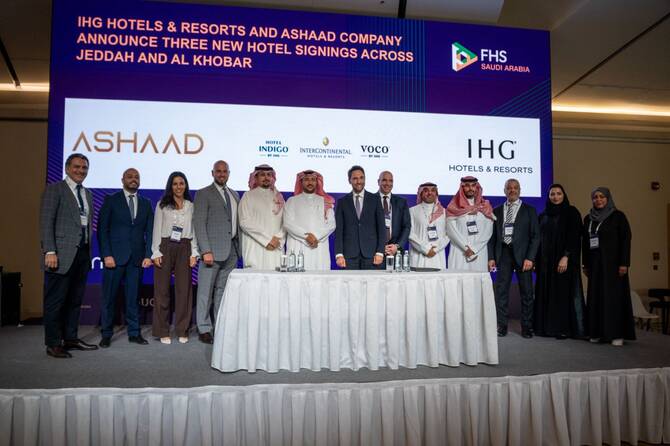
IHG Hotels & Resorts and Ashaad Co. signed an agreement to develop three new hotels in Jeddah and Alkhobar. AN photo by Loai El-Kelawy
Short Url
Updated 11 May 2025
Follow

Saudi Arabia adds over 1,000 hotel keys as summit opens with major deals

RIYADH: Saudi Arabia’s hospitality sector saw a boost on the opening day of the Future Hospitality Summit, with more than 1,000 new hotel keys announced across several high-profile agreements.

Key signings on Sunday included new hotel developments in Jeddah, Madinah, and Qassim, underscoring sustained investor confidence in the Kingdom’s ambitious tourism expansion plans.

Among the notable announcements was BWH Hotels’ partnership with Optimal Real Estate and Rsoukh Trading Co. to develop five new properties across Jeddah and Madinah. The move signals a major step forward in the group’s regional expansion strategy.

“We signed five hotels between Jeddah and Madinah,” said Mujahid Pasha, director of development Middle East at BWH Hotels, in an interview with Arab News on the sidelines of the event.
“The partnership only brings five hotels, but these five hotels represent about 1,000 keys in total,” Pasha added.

The centerpiece of BWH’s announcement is a 540-room Best Western Premier property in Madinah, located just 600 meters from the Prophet’s Mosque.
“This is one of the big hotels we just signed today,” said Pasha. “We talk about an upper, upscale offering, which is our Best Western Premier brand.”

Another highlight is a luxury WorldHotels Elite property on King Road in Jeddah — often referred to as the “Golden Mile” due to its prime location. The development will include 215 guest rooms and approximately 300 office units as part of a broader mixed-use complex.

“WorldHotels is our luxury and high-end offering,” said Pasha. “The King Road doesn’t have any luxury offerings, so we wanted to use that brand.”


The event features panels, investment showcases, and strategic signings shaping the future of hospitality. AN photo by Loai El-Kelawy

Three additional hotels will be introduced under BWH’s SureStay brand—its economy and midscale portfolio—including two SureStay Studios and one SureStay Hotel.

“These brands are not in the region as well. The first in the region will be in Saudi Arabia,” Pasha noted, confirming that two of the SureStay properties will be in Jeddah and one in Madinah.

BWH Hotels, which operates 18 brands globally, is leveraging its diverse portfolio to target a broad range of travelers and budgets.

In another development, Amsa Hospitality announced a new four-star hotel project in Qassim in collaboration with Alkayan Alarabi. The property will be located within the Al-Kayan Avenue mall on Al-Imam Al-Bukhari Road.

“This is a new hotel, newly developed, with 174 keys including suites, meeting rooms, gym, two restaurants, and a spa,” said Amsa CEO Muin Serhan.

Designed to serve both business and leisure travelers, “the hotel is currently under development and is expected to complete development by the end of this year with official operations expected later in the first quarter of next year,” Serhan added.

Rounding out the day’s announcements, IHG Hotels & Resorts and Ashaad Co. signed an agreement to develop three new hotels in Jeddah and Alkhobar, further adding to the Kingdom’s growing hospitality portfolio.

Beyond real estate deals, the summit spotlighted the industry’s growing focus on talent development. Organizers launched the inaugural NextGen Investment Forum, aimed at addressing workforce challenges in the tourism and hospitality sectors.

“For the first time at FHS Saudi, we proudly introduce the NextGen Investment Forum, a new platform dedicated to addressing one of the most critical issues and urgent challenges in our history—investing in our people,” said Jonathan Worsley, chairman and CEO of The Bench, which organizes the hospitality event.

Worsley emphasized the hospitality sector’s global economic impact.
“Hospitality and tourism is a massive industry, a massive force in today’s contribution to global gross domestic product,” he said.
“It’s the world’s third largest economic sector,” Worsley added, citing 357 million jobs worldwide and a $1.1 trillion contribution to global GDP.

According to summit figures, the industry will require 100 million additional jobs over the next five years to meet rising demand. In Saudi Arabia alone, a $110 billion investment in the sector is set to deliver 362,000 hotel rooms by 2030.

“We need an additional 1 million jobs in the Kingdom by 2030,” Worsley stated. “The foundations of sustainable growth must begin with education and training.”

The NextGen forum aims to bridge the gap between education and industry by fostering dialogue on training, investment, and talent retention.
“We’re bridging the gap between academia and what the industry needs—exploring funding and investment opportunities in hospitality education and enhancing the industry’s appeal to retain talent and reduce turnover,” Worsley said.

During a panel discussion on global tourism trends, Harry Theoharis, member of the Hellenic Parliament and candidate for secretary-general of the UN World Tourism Organization, praised Saudi Arabia’s transformation.

“Saudi Arabia’s tourist plans, if anything, are one of the biggest success stories,” he said.
“We’ve seen Saudi Arabia transform itself from a very specific and niche market of religious tourism, which was the staple of Saudi Arabia, to a very vibrant, very energetic, very young-oriented destination attuned to the wills of the young population,” Theoharis added.

More than 1,000 global tourism leaders, investors, and operators have convened in Riyadh for the Future Hospitality Summit, held from May 11–13 at the Mandarin Oriental Al Faisaliah. Centered on the theme “Where Vision Shapes Opportunity,” the event features panels, investment showcases, and strategic signings shaping the future of hospitality in Saudi Arabia and beyond.


Poland expects trade with Saudi Arabia to grow to $10 billion, finance and economy minister tells Arab News

Updated 4 sec ago
Follow

Poland expects trade with Saudi Arabia to grow to $10 billion, finance and economy minister tells Arab News

  • Andrzej Domanski says his country’s companies are looking for reliable partners like Saudi Arabia
  • Highlights opportunities in clean energy, ICT, food security and construction cooperation on Riyadh visit

RIYADH: Saudi Arabia’s pace of transformation, its economic ambition under Vision 2030, and its role as Poland’s biggest Middle Eastern trading partner are driving a new phase in bilateral relations, Andrzej Domanski, Poland’s finance and economy minister, has said.

Speaking to Arab News during a visit to Riyadh on Monday, Domanski discussed how the two nations might expand their trade ties, the sectors where Polish businesses enjoy an edge, and the potential for broadening the bilateral relationship.

“We have better and better economic relations with the Kingdom of Saudi Arabia. We will reach $10 billion in our trade,” Domanski said, describing Saudi Arabia as a “reliable partner” at a time when Polish companies are actively seeking diversification and new markets.

His visit comes as Saudi-Polish economic ties deepen beyond a historically oil-focused relationship into a broader partnership spanning energy transition, technology, construction, food security and potentially defense cooperation.

This evolution mirrors Saudi Arabia’s Vision 2030 diversification drive and Poland’s emergence as one of Europe’s fastest-growing large economies.

Domanski said Riyadh itself offered a powerful visual symbol of Saudi Arabia’s economic momentum.

“I must say that it’s my first visit to Riyadh and I’m really impressed,” he said. “I’m impressed by the pace of development. The thousands of cranes in the city. It is also a proof of how quickly Saudi Arabia is developing.”

Bilateral trade between Saudi Arabia and Poland has expanded rapidly in recent years, driven largely by energy flows. Saudi Arabia is now Poland’s main crude-oil supplier, accounting for roughly 60 percent of Poland’s oil imports.

Trade volumes have risen from about $7 billion in 2022 to around $8.5 billion in 2023, with Domanski predicting the $10 billion mark will soon be reached.

“We are, of course, importing crude oil. But we’d like to together search for new business opportunities for both Saudi and, of course, Polish companies,” he said.

Domanski argued that growth prospects make the country an attractive destination for Saudi investment.

“On our side, we are also doing pretty well. We are the fastest growing large European economy,” he said. “This year we will work in the G20 format. This is because last year we joined the Group of the 20 biggest economies in the world. And we are frankly proud of that.”

Inflation, he added, has fallen sharply. “Inflation went down significantly, 2.5 percent. Very reasonable. A reasonable level. Investment started to pick up,” he said, pitching Poland as a stable European base for Saudi capital.

A recurring theme of Domanski’s visit was the alignment between Poland’s development priorities and Saudi Arabia’s Vision 2030 agenda.

“Our companies, our economy, are fully aligned with the ambitious Vision 2030 that is realized here,” he said.

Energy cooperation remains central, anchored by Saudi Aramco’s stake in the Lotos refinery in Gdansk — the largest Saudi direct investment in Poland — which underpins long-term crude-supply contracts and Poland’s energy-security strategy.

But Domanski stressed that the future lies increasingly in clean energy.

“It’s worth noting that right now Poland is building onshore capabilities, offshore capabilities, solar capabilities. And we are constructing the first Polish nuclear power plant,” he said.

“We want to diversify from coal into nuclear and renewables. And I believe that our Saudi partners could participate in this clean energy transformation of the Polish economy.”

The shift reflects broader cooperation under way between Warsaw and Riyadh on green energy and hydrogen, dovetailing Poland’s decarbonization plans with Saudi Arabia’s push to develop non-oil sectors.

Technology and digital services emerged as one of the most promising areas for expansion, with Poland positioning itself as a provider of high-end IT talent for Saudi Arabia’s digital and AI-driven projects.

“ICT solutions. We have really great companies that provide the best solutions. They are already well recognized in Western European countries. They have their footprint here in Riyadh,” Domanski said.

“Having said that, they still lack scale. So my visit here is also to discuss that kind of business opportunity.”

Polish officials frequently point to the country’s deep pool of programmers and cybersecurity specialists. Warsaw has signaled plans for dozens of Polish firms to establish regional headquarters in Saudi Arabia, particularly in AI, cybersecurity and digital infrastructure.

Domanski underscored Poland’s strengths in specific niches.

“I believe that we are really top class,” he said. “For example, in cybersecurity, we really have companies that are providing the best solutions for smart cities in Western Europe.

“But, I believe there is lots of room for strengthening this presence and the cooperation with Saudi partners.”

Food security is another area where Poland sees scope for joint ventures and long-term cooperation. “We are quite an important food producer,” Domanski said. “We have knowhow. We have land. We have a growing sector.

“And I believe that, for example, through joint ventures with our Saudi partners, we could establish a long lasting cooperation in this sector.”

The construction sector also featured prominently, reflecting the scale and pace of development under way across the Kingdom.

“We have lots of contractors that proved to be very efficient and contractors that keep timelines and realize how it is important to deliver on time,” Domanski said.

“And I believe that here, seeing how quickly Saudi Arabia is developing, those contractors could also help in your development.”

Domanski highlighted the importance of institutional frameworks and regular high-level engagement. During his visit, discussions focused on communication mechanisms and a formal framework for cooperation.

“First of all, we need communication and we need to have a frame for cooperation,” he said.

“So this is why I’m really glad that together with the minister of trade, minister of investment, we were discussing both communication, and we’d like to see each other, invite each other more often, as this is very, very, important.

“And we’d like to set, also, the frame for cooperation. And such a document will be signed today. So we will decide who will be responsible for some particular areas and when we would like some results to be delivered.”

The move builds on existing structures, including the Saudi-Polish Coordination Council and a Saudi-Polish Business Council, as well as a new memorandum of understanding signed in January to strengthen the partnership’s strategic character.

Domanski said he hopes Saudi delegations will soon travel to Poland, including for major economic and reconstruction-focused events.

“I do hope that our friends from Saudi Arabia will join us during our economic congress, which will take place in Katowice in the Silesia region, the most industrialized region of Poland, at the end of June,” he said.

He also highlighted Poland’s role in hosting a major summit on Ukraine.

“We will host the Ukrainian Recovery Conference, which is a truly international event. And we would also love to see our Saudi friends to be there,” he said.

“I’ve invited ministers to participate in those events.”

While his focus remains economic, Domanski did not rule out expanding cooperation into defense, particularly as Poland ramps up military spending and industrial capacity.

“Unfortunately I couldn’t attend,” he said, referring to the World Defense Show currently taking place in Riyadh. “Having said that, it’s worth noting that Poland spends close to 5 percent of our GDP on defense. We intend to build a very strong defense industry in Poland.

“We are, of course, supporting, building a strong defense industry in Europe. But of course, I’m mostly focused on Poland. And therefore I believe that we can provide really, very good solutions for and very good equipment that could be presented here, and hopefully we can develop our cooperation also in this sector.”

For Domanski, Saudi Arabia represents not only Poland’s most important economic partner in the Arab world, but a gateway to diversification and scale.

“Polish companies are getting larger and larger,” he said. “And, of course, are looking for diversification, looking for new markets and for reliable partners like Saudi Arabia.”