

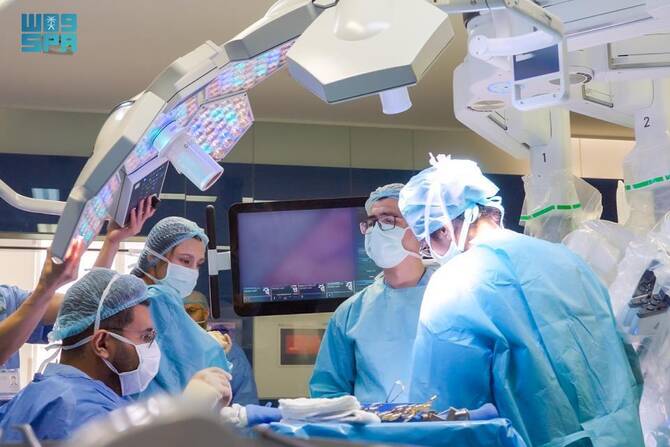
Riyadh hospital performs first pediatric robotic liver transplant

King Faisal Specialist Hospital and Research Centre in Riyadh has performed a liver lobe transplant on a child using an advanced robotic surgical system. (SPA)
Short Url
Updated 11 May 2025
Follow

Riyadh hospital performs first pediatric robotic liver transplant

  • Although procedure was complicated, center’s experience with robotic organ transplants in adults enabled the technology to be adapted

RIYADH: The King Faisal Specialist Hospital and Research Centre in Riyadh has performed a liver lobe transplant on an eight-year-old child using an advanced robotic surgical system, with the patient being discharged after just two weeks.

Although the procedure was complicated due to the child’s small size and limited space for surgical access, the center’s experience with robotic organ transplants in adults enabled the technology to be adapted.

A tailored surgical plan was developed, which involved repositioning the robotic entry points, the Saudi Press Agency reported on Sunday.

Prof. Dieter Broering, executive director of the Organ Transplant Centre of Excellence and lead surgeon, said: “Robotic surgical techniques have traditionally been limited to adults, but we succeeded in adapting them for children, offering exceptional precision and a marked reduction in complications.

“The transplant required redesigning the surgical approach to suit the child’s small body and confined space, which we addressed by meticulously adjusting the entry sites for the robotic tools to ensure maximum safety.”

The operation sets a groundbreaking example for expanding the use of robotic surgery in pediatric care. The technology offers precise control, reduces complications and enhances safety, paving the way for the future development of child-specific robotic surgical systems.

It is the latest milestone that positions King Faisal Centre as a global leader in robotic surgery. The hospital has previously carried out the world’s first fully robotic heart transplant and the first robotic liver transplant.


Striking light pillars phenomenon captivates Northern Borders residents

Updated 23 December 2025
Follow

Striking light pillars phenomenon captivates Northern Borders residents

  • The sight captivated residents and visitors alike

RIYADH: A striking astronomical and optical phenomenon was observed in Saudi Arabia’s Northern Borders Region on Monday, as light pillars, a remarkable natural spectacle, appeared in the sky, drawing the attention of locals and enthusiasts of natural phenomena, the Saudi Press Agency reported.

The sight captivated residents and visitors alike, with the interplay of colors and light making for an extraordinary spectacle.

Astronomy Club member Adnan Khalifa said that a light pillar is an optical phenomenon that occurs in the atmosphere as a vertical column of light extending above or below its source. This effect is caused by the reflection of light on tiny ice crystals suspended in clouds or the air.

He added that the light source can be natural, such as the sun, particularly when near the horizon, or the moon. It can also originate from human-made sources, like streetlights, creating a unique and captivating visual display in the sky.

Abouazza El-Mhamdi, associate professor in the physics and astronomy department at King Saud University’s College of Science, told Arab News: “On Monday evening, residents of the Northern Borders Region near Arar witnessed a rare meteorological event — the vibrant light pillars that illuminated the night sky.

“While appearing like a celestial display, this is not a purely astronomical event involving stars or planets, for example, but rather an atmospheric optical phenomenon triggered by an exceptional drop in temperature and perfect wind stillness,” he said. 

“The display featured towering vertical beams of white, orange and yellow light, created when ground-based light sources reflected off tiny, flat ice crystals suspended in the freezing air, which acted like a collective mirror,” he added. 

“Although these pillars are common in Arctic climates like Canada or Russia, their appearance in Saudi Arabia is a remarkable anomaly, highlighting the unique and intense winter conditions currently affecting the Kingdom’s northern reaches,” the professor said.

Following the inclement weather last week, and as a result of several days of low temperatures, vibrant beams of light shot up into the night sky, creating a stunning display.

The phenomenon, characterized by its colorful vertical light columns, occurs under specific conditions, such as temperatures falling below 0 degrees Celsius, while calm winds are also essential.

The unique ice halo effect forms when moisture in the air condenses into ice crystals, reflecting surrounding lights to create a breathtaking visual display.