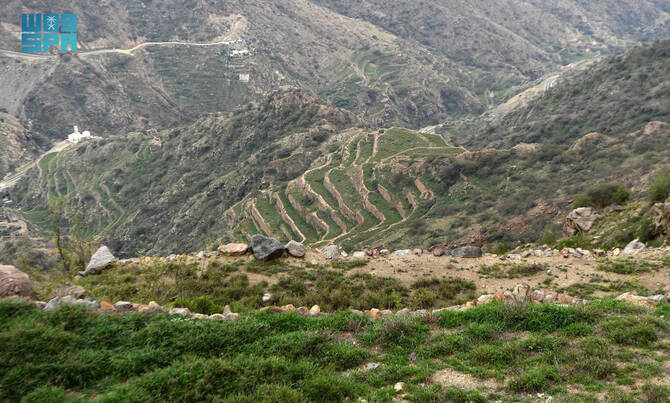
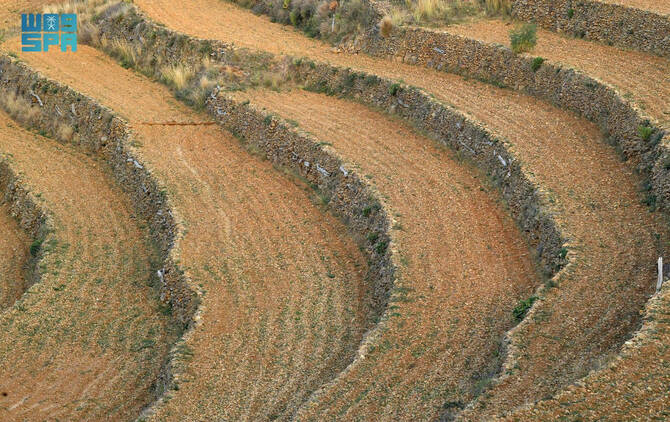


RIYADH: For centuries, the people of Saudi Arabia’s Asir region have cultivated food on steep mountain slopes using stone terracing systems.
They began with the construction of stone retaining walls known locally as “thamayil,” the Saudi Press Agency reported.
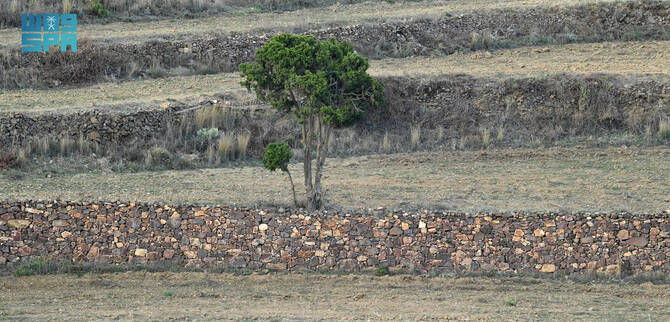
Each individual wall, called “thumalah,” is anchored into bedrock and can rise two to six meters in height.
They serve as critical infrastructure for mountain agriculture by creating level growing surfaces on otherwise impossible terrain.

Each individual wall, called “thumalah,” is anchored into bedrock and can rise two to six meters in height. (SPA)
“The thumalah represents a stone containment system designed to capture sloping mountain terrain,” Ahmed Al-Bariqi, an architectural heritage researcher, said in an interview with the SPA. “After building the stone barrier, the enclosed space is filled with a mixture of clay, soil and rocks to create a flat, arable surface suitable for both farming and habitation.”
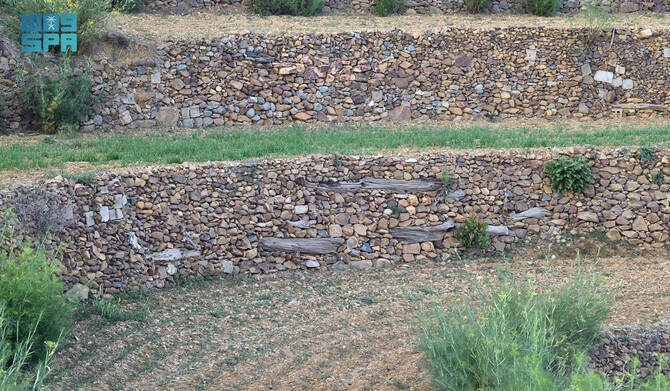
Local builders adapted to their surroundings, often reinforcing these structures with juniper and sidr tree trunks, as well as massive stones to withstand the pressure of heavy seasonal rains.
Water management is equally sophisticated. The “mughayyid” regulates irrigation and controls flooding by channeling water flow between terraced fields.

The “mughayyid” regulates irrigation and controls flooding by channeling water flow between terraced fields. (SPA)
“Ancient builders displayed remarkable engineering precision in the mughayyid’s construction,” Al-Bariqi has said in his book “Antiquities and Heritage in Bariq Governorate.”
He added: “Square or elongated stones formed the base structure, while carefully polished flat stones were placed at the top, precisely leveled to allow water to flow at calculated rates between terraces.”
Positioned at strategic elevations, the mughayyid retains optimal water volumes while preventing destructive flooding that could compromise the entire terrace system.

Terraces were reinforced by stone retaining walls known locally as “thamayil.” (SPA)
These terraces do more than support agriculture. According to Dr. Ghaithan bin Jurais of King Khalid University, they reflect a deep-rooted civilization in Asir dating back thousands of years.
“These structures preserve soil resources, establish clear property boundaries between neighboring farms, and historically served as recognized markers of family and tribal land ownership,” he said.
Together, the thumalah and mughayyid systems stand as a testament to early innovation sustaining life in one of Saudi Arabia’s most challenging landscapes.