

Pakistan says ‘premature’ to speculate if ceasefire will lead to real peace with India

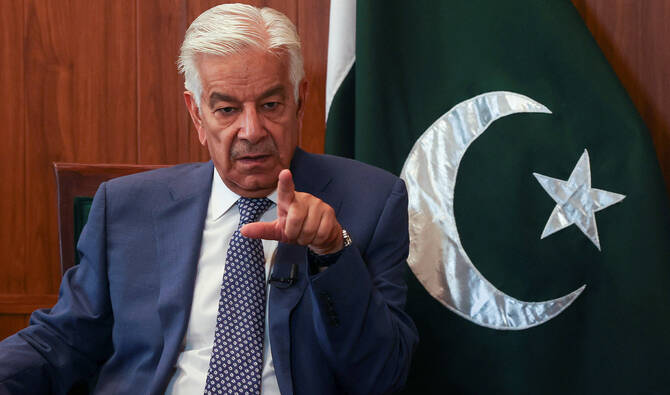
Pakistan's Defence Minister Khawaja Muhammad Asif gestures during an interview with Reuters in Islamabad, Pakistan, on May 8, 2025. (REUTERS/File)
Short Url
Updated 10 May 2025
Follow

Pakistan says ‘premature’ to speculate if ceasefire will lead to real peace with India

  • Pakistani State Minister for Interior Talal Chaudhry tells Arab News “response would be harsh” if India defied ceasefire 
  • Indian Foreign Secretary Vikram Misri says armed forces had been given instructions to “deal strongly” with any violations

ISLAMABAD: Defense Minister Khawaja Asif said on Saturday it was premature to speculate if a US-brokered military ceasefire between Pakistan and India would lead to real peace, as fresh violence was reported on both sides of the de facto border between the two nuclear-armed nations, who vowed retaliation. 

Within hours of the truce announcement, violations were reported from the main cities of Indian-administered Kashmir, as well as in Azad Kashmir on the Pakistani side of the Line of Control, the de facto border that divides the disputed Kashmir region between India and Pakistan.

The reports came after Islamabad and India both announced a sudden stop to a conflict that had seemed to be spiraling alarmingly. The US said they had also agreed to hold talks on a broad range of issues at a neutral site.

Pakistani Minister of State for Interior Talal Chaudhry told Arab News, “the response would be harsh” if India defied the ceasefire agreement. 

Indian Foreign Secretary Vikram Misri said the armed forces had been given instructions to “deal strongly” with any violations.

Pakistani information minister Attaullah Tarar has said there is “no truth” to Indian claims it had violated the ceasefire.

“This is just the beginning, it’s a bit early to speculate,” Asif said in an interview to Geo News when asked if the ceasefire could open a path to real peace. 

“As time passes maybe these types of paths will emerge but at this point it would be premature to pin those kinds of hopes to the problem.”

He added: “When talks begin, maybe some way will be found.”

Earlier in the day, the Indian foreign secretary said the two countries’ military operations’ chiefs had spoken to each other and agreed that all fighting would stop at 5 p.m. Indian time (1130 GMT) without using the word “ceasefire.” The MO chiefs would next speak on May 12, he added. 

But within hours, Reuters said blasts were heard in Srinagar and Jammu in Indian-administered Kashmir and projectiles and flashes were seen in the night sky over Jammu, similar to the events of the previous evening.

Pakistani witnesses and local media channels also reported firing from India into Pakistan in Azad Kashmir.

“BITTER HISTORY”

The ceasefire announcement came after the Pakistan military said early on Saturday India had attacked three bases in Pakistan with missiles, after which it had targeted multiple bases in India in response, including a missile storage site in India’s north.

India said there was limited damage to equipment and personnel at air force stations in the Udhampur, Pathankot, Adampur and Bhuj areas. The military said there were several high-speed missile attacks on several air bases in Indian Punjab, and that India had responded to the attacks.

Saturday’s military confrontation, the worst fighting between the longstanding enemies in decades, followed days of daily clashing since Wednesday through drones and missiles and gunfighting on the Line of control. At least 50 have been killed on both sides.

The latest round of tensions were triggered by a militant attack in Indian-administered Kashmir that killed 26 people on April 22. New Delhi said Islamabad was involved, which denied the allegation and repeatedly said it was willing to participate in a transparent and credible inquiry.

Pakistan and India have a history of bitter relations, having fought two of their three wars over Kashmir, a region split between them, since gaining independence from the former British colonial rule in 1947.

Both nations acquired nuclear weapons in 1998.

– With inputs from Reuters


Islamabad dismisses claims about paying up to 8 percent interest on foreign loans as ‘misleading’

Updated 22 February 2026
Follow

Islamabad dismisses claims about paying up to 8 percent interest on foreign loans as ‘misleading’

  • Pakistan has long relied on external loans to help bridge persistent gaps in public finances and foreign exchange reserves
  • Pakistan’s total external debt, liabilities stand at $138 billion at an overall average cost of around 4 percent, ministry says

KARACHI: Pakistan’s finance ministry on Sunday dismissed as “misleading” claims that the country is paying up to 8 percent interest on external loans, saying the overall average cost of external public debt is approximately 4 percent.

Pakistan has long relied on external loans to help bridge persistent gaps in public finances and foreign exchange reserves, driven largely by a narrow tax base, chronic trade deficits, rising debt-servicing costs and repeated balance-of-payments pressures.

Over the decades, successive governments have turned to multilateral and bilateral lenders, including the International Monetary Fund, the World Bank and the Asian Development Bank, to support budgetary needs and shore up foreign exchange reserves.

The finance ministry on Sunday issued a clarification in response to a “recent press commentary” regarding the country’s external debt position and associated interest payments, and said the figures required contextual explanation to ensure accurate understanding of Pakistan’s external debt profile.

“Pakistan’s total external debt and liabilities currently stand at $138 billion. This figure, however, encompasses a broad range of obligations, including public and publicly guaranteed debt, debt of Public Sector Enterprises (both guaranteed and non-guaranteed), bank borrowings, private-sector external debt, and intercompany liabilities to direct investors. It is therefore important to distinguish this aggregate figure from External Public (Government) Debt, which amounts to approximately $92 billion,” it said.

“Of the total External Public Debt, nearly 75 percent comprises concessional and long-term financing obtained from multilateral institutions (excluding the IMF) and bilateral development partners. Only about 7 percent of this debt consists of commercial loans, while another 7 percent relates to long-term Eurobonds. In light of this composition, the claim that Pakistan is paying interest on external loans ‘up to 8 percent’ is misleading.

The overall average cost of External Public Debt is approximately 4 percent, reflecting the predominantly concessional nature of the borrowing portfolio.”

With respect to interest payments, public external debt interest outflows increased from $1.99 billion in Fiscal Year (FY) 2022 to $3.59 billion in FY2025, representing an increase of 80.4 percent, not 84 percent as reported. In absolute terms, interest payments rose by $1.60 billion over this period, not $1.67 billion, it said.

According to the State Bank of Pakistan’s records, Pakistan’s total debt servicing payments to specific creditors during the period under reference were as follows: the IMF received $1.50 billion, of which $580 million constituted interest; Naya Pakistan Certificates payments totaled $1.56 billion, including $94 million in interest; the Asian Development Bank received $1.54 billion, including $615 million in interest; the World Bank received $1.25 billion, including $419 million in interest; and external commercial loans amounted to nearly $3 billion, of which $327 million represented interest payments.

“While interest payments have increased in absolute terms, this rise cannot be attributed solely to an expansion in the debt stock,” the ministry said. “Although the overall debt stock has increased slightly since FY2022, the additional inflows have primarily originated from concessional multilateral sources and the IMF’s Extended Fund Facility (EFF) under the ongoing IMF-supported program.”

Pakistan secured a $7 billion IMF bailout in Sept. 2024 as part of Prime Minister Shehbaz Sharif’s efforts to stabilize the South Asian economy that narrowly averted a default in 2023. The government has since been making efforts to boost trade and bring in foreign investment to consolidate recovery.

“It is also important to note that the increase in interest payments reflects prevailing global interest rate dynamics. In response to the inflation surge of 2021–22, the US Federal Reserve raised the federal funds rate from 0.75-1.00 percent in May 2022 to 5.25–5.50 percent by July 2023. Although rates have since moderated to around 3.75 percent, they remain significantly higher than 2022 levels,” the finance ministry said.

“The government remains committed to prudent debt management, transparency, and the continued strengthening of Pakistan’s macroeconomic stability,” it added.