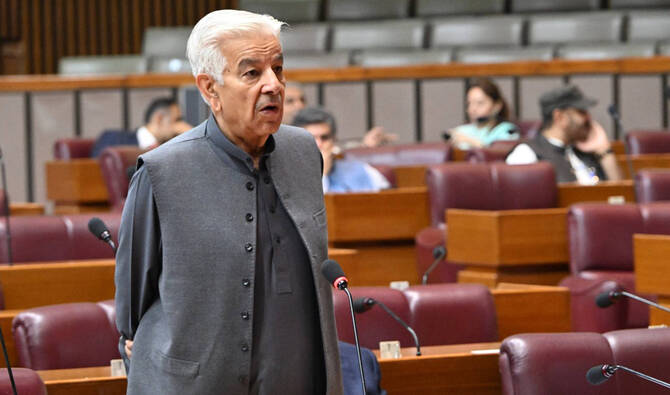
ISLAMABAD/NEW DELHI: Pakistan’s defense minister said on Saturday that no meeting of the top military and civil body overseeing the country’s nuclear arsenal had been scheduled following a military operation against India earlier in the day.
Pakistan’s military said earlier that the prime minister had called on the authority to meet. The information minister did not respond immediately to a request for comment.
The worst fighting between the nuclear-armed rivals since 1999 has killed dozens of people on both sides and led to repeated calls for de-escalation from the United States and the G7 group of rich countries.
“This thing that you have spoken about (nuclear option) is present, but let’s not talk about it — we should treat it as a very distant possibility, we shouldn’t even discuss it in the immediate context,” Pakistan Defense Minister Khawaja Asif told ARY TV.
“Before we get to that point, I think temperatures will come down. No meeting has happened of the National Command Authority, nor is any such meeting scheduled.”
US Secretary of State Marco Rubio called Pakistan’s Army Chief General Asim Munir and India’s foreign minister, Subrahmanyam Jaishankar, urging both sides to de-escalate and “re-establish direct communication to avoid miscalculation.”
“India’s approach has always been measured and responsible and remains so,” Jaishankar said on X after the call with Rubio.
Pakistan’s foreign minister, Mohammad Ishaq Dar, told local television that if India stops here then “we will consider to stop here.”
Indian media reported that Indian and Pakistani officials had spoken on Saturday.
The Indian military said regarding Pakistan’s military attacks on Saturday that “all hostile actions have been effectively countered and responded appropriately.”
“The Pakistan military has been observed to be moving their troops into forward areas, indicating offensive intent to further escalate the situation,” Indian Wing Commander Vyomika Singh told a press conference.
“Indian armed forces remain in a high state of operational readiness. Indian armed forces reiterate their commitment to non-escalation, provided it is reciprocated by the Pakistan military.”
STRIKES, COUNTER STRIKES
Pakistan early on Saturday said it had targeted multiple bases in India including a missile storage site in India’s north, in response to prior attacks by the Indian military.
India said there was limited damage to equipment and personnel at air force stations at the Udhampur, Pathankot, Adampur and Bhuj areas. The military said there were several high-speed missile attacks on several air bases in Punjab, and that India had responded to the attacks.
Five civilians were killed in the attacks in the Jammu region of Indian-administered Kashmir, regional police said.
Pakistan said that, before its offensive, India had fired missiles at three air bases, including one close to the capital, Islamabad, but Pakistani air defenses intercepted most of them.
Analysts and diplomats have long feared that conflict between the arch-rivals could escalate into the use of nuclear weapons, in one of the world’s most dangerous and most populated nuclear flashpoint regions.
Locked in a longstanding dispute over Kashmir, the two countries have engaged in daily clashes since Wednesday when India launched strikes inside Pakistan on what it called “terrorist infrastructure.” Pakistan vowed to retaliate.
Pakistan’s information minister said in a post on X that Saturday’s military operation was named “Operation Bunyanun Marsoos.” The term is taken from the Qur'an and means a firm, united structure.
Sounds of explosions were reported in India’s Srinagar and Jammu, where sirens sounded, a Reuters witness said.
“India through its planes launched air-to-surface missiles ... Nur Khan base, Mureed base and Shorkot base were made targets,” Pakistan military spokesman Lt. Gen. Ahmed Sharif Chaudhry said in a late-night televised statement.
India has said its strikes on Wednesday, which started the latest clashes between the countries, were in retaliation for a deadly attack on Hindu tourists in Indian Kashmir last month.
Pakistan denied India’s accusations that it was involved in the tourist attack. Since Wednesday, the two countries have exchanged cross-border fire and shelling, and sent drones and missiles into each other’s airspace.


Pakistan minister denies nuclear body meeting after offensive launched on India
https://arab.news/zpkd2
Pakistan minister denies nuclear body meeting after offensive launched on India

- Since Wednesday both sides have carried out strikes, counter strikes
- US secretary of State Rubio calls both sides for de-escalation, direct talks

Pakistan rules out military operation in northwestern Tirah Valley
- Residents in the northwestern Tirah Valley fled their homes this month fearing a military operation against militants
- Khawaja Asif says army conducting intelligence-based operations in area, migration “routine” practice due to harsh cold
ISLAMABAD: Defense Minister Khawaja Asif on Tuesday clarified that the military was not conducting a military operation in the northwestern Tirah Valley, saying that the ongoing residents’ migration from the area was a routine practice due to the harsh cold in the area during the winter season.
The defense minister’s clarification came as residents of Tirah Valley in Pakistan’s northwestern Khyber Pakhtunkhwa (KP) province bordering Afghanistan fled their homes this month, fearing a planned military operation by the army against militants, particularly the Tehreek-e-Taliban Pakistan (TTP) group.
Pakistan’s information ministry on Sunday issued a clarification that the armed forces were not involved in the “depopulation” of the valley. It pointed to a notification from the provincial Khyber Pakhtunkhwa Relief, Rehabilitation and Resettlement Department in December which demanded the release of funds, reportedly Rs4 billion [$14.24 million], for the voluntary movement of people from Tirah Valley.
Speaking to reporters at a news conference alongside Information Minister Attaullah Tarar and Special Assistant to the PM for Information and KP Affairs Ikhtiar Wali Khan, Asif said the last military operation in the area was conducted several years ago. He said the military had decided that intelligence-based operations (IBOs) were more effective than military operations as they resulted in lower civilian casualties.
“So over a long period of time, the army gave up [military] operation in favor of IBOs,” Asif said. “For many years this practice has been continuing. Hence, there is no question of an operation there.”
The defense minister described the migration of residents from Tirah Valley as a “routine” practice that has been taking place since decades due to the freezing cold in the winter season.
He criticized the provincial government, led by the Pakistan Tehreek-e-Insaf (PTI) party for not serving the people of the area, accusing it of not building any schools, hospitals, or police stations in Tirah Valley.
Asif said around 400-500 TTP members lived in the valley with their families, alleging that hemp was being harvested there on over 12,000 acres of land. He said that while hemp is also used for medicinal and construction purposes, its dividends were going to militants and politicians.
“All of this hemp is harvested there and the dividends from it either go to the people associated with politics or the TTP,” the minister said.
“We have initiated the process to stop this so that the people benefit from this harvest and so that schools and hospitals are constructed there.”
The minister said that a district-level jirga or tribal council met representatives of the KP government on Dec. 11, 24 and 31 to decide matters related to the residents’ migration in the area.
Holding up the KP Relief, Rehabilitation and Resettlement Department notification, Asif said:
“In the presence of this notification, in the presence of this tribal council and in the presence of all of these things, where do you see the army?“
The minister accused the provincial government of deflecting its “failures” in the province to the armed forces or to a military operation that did not exist.
The migration has exposed tensions between the provincial government and the military establishment over the use of force in the region.
KP Law Minister Aftab Alam Afridi said earlier this month that the provincial government will not allow a military operation to take place in the area, arguing that past military campaigns had failed to deliver lasting stability.


