SEOUL, South Korea: South Korea’s embattled conservative party has taken the unprecedented step of nullifying its primary and replacing presidential candidate Kim Moon Soo with former Prime Minister Han Duck-soo just one week after Kim’s selection, deepening internal turmoil ahead of the June 3 presidential by-election.
Saturday’s move by the People Power Party’s leadership, which Kim denounced as an “overnight political coup,” underscores the desperation and disarray within the party following the ouster of former President Yoon Suk Yeol over his ill-fated attempt to impose martial law in December.
Kim, a staunch conservative and former labor minister under Yoon, was named the PPP’s presidential candidate on May 3 after winning 56.3 percent of the primary vote, defeating a reformist rival who had criticized Yoon’s martial law. But the PPP’s leadership, dominated by Yoon loyalists, has spent the past week pressuring Kim to step aside and back Han, whom they believe stands a stronger chance against liberal Democratic Party frontrunner Lee Jae-myung.
Han served as acting president after Yoon was impeached by the legislature in December and officially removed by the Constitutional Court in April. He resigned from office May 2 to pursue a presidential bid, arguing his long public service career qualifies him to lead the country amid growing geopolitical uncertainty and trade challenges intensified by the policies of US President Donald Trump.
After failed talks between Han and Kim to unify their candidacies, the PPP’s emergency committee canceled Kim’s nomination in the early hours of Saturday and officially registered Han as a party member and its new presidential candidate.
The replacement still requires confirmation through an all-party vote Saturday and approval by the party’s national committee Sunday, which is the deadline for candidates to register with the election authorities.
Han in a message issued through the party claimed “if we unite, we can surely win.”
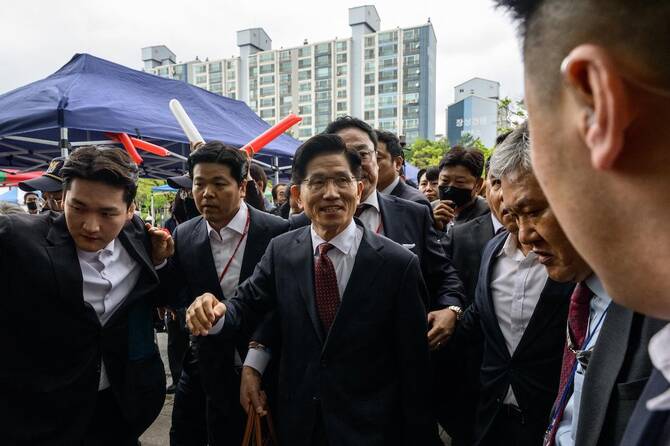
Speaking at a news conference, Kim lamented “democracy in our party died” and vowed to take unspecified legal and political steps, but it remained unclear whether any realistic path existed to restore his candidacy without the party’s cooperation.
Kim had opposed the legislature’s impeachment of Yoon on Dec. 14, though he said he disagreed with Yoon’s decision to declare martial law on Dec. 3. Kim had gained popularity among hard-line PPP supporters after he solely defied a Dec. 11 demand by an opposition lawmaker that all Cabinet members stand and bow in a gesture of apology for Yoon’s martial law enactment at the Assembly.
Han and Kim have lagged well behind Lee in recent opinion polls. Lee, who spearheaded the Democrats’ efforts to oust Yoon, ridiculed the PPP efforts to switch candidacies, telling reporters Thursday, “I have heard of forced marriages but never heard of forced unity.”
Lee has long cultivated an image as an anti-establishment figure capable of tackling South Korea’s entrenched inequality and corruption. However, critics view him as a populist who fuels division and vilifies opponents, warning that his leadership could further polarize the country.
He currently faces five trials for corruption and other criminal charges. If he becomes president, those trials likely will stop because of special presidential immunity from most criminal charges.


![]()

South Korean conservative party moves to switch presidential candidates as election turmoil deepens
Short Url
https://arab.news/chx8w
South Korean conservative party moves to switch presidential candidates as election turmoil deepens
- The replacement still requires confirmation through an all-party vote Saturday and approval by the party’s national committee Sunday
- Han and Kim have lagged well behind Lee in recent opinion polls. Lee, who spearheaded the Democrats’ efforts to oust Yoon


Latest updates


© 2026 SAUDI RESEARCH & PUBLISHING COMPANY, All Rights Reserved And subject to Terms of Use Agreement.