SAN FRANCISCO: The Republican administration must halt much of its dramatic downsizing of the federal workforce, a California judge ordered Friday.
Judge Susan Illston in San Francisco issued the emergency order in a lawsuit filed by labor unions and cities last week, one of multiple legal challenges to Republican President Donald Trump’s efforts to shrink the size of a federal government he calls bloated and expensive.
The temporary restraining order directs numerous federal agencies to halt acting on the president’s workforce executive order signed in February and a subsequent memo issued by the Department of Government Efficiency and the Office of Personnel Management.
The order, which expires in 14 days, does not require departments to rehire people. Plaintiffs asked that the effective date of any agency action be postponed and that departments stop implementing or enforcing the executive order, including taking any further action.
They limited their request to departments where dismantlement is already underway or poised to be underway, including at the the US Department of Health and Human Services, which announced in March it will lay off 10,000 workers and centralize divisions.
Illston, who was nominated to the bench by former President Bill Clinton, a Democrat, said at a hearing Friday the president has authority to seek changes in the executive branch departments and agencies created by Congress.
“But he must do so in lawful ways,” she said. “He must do so with the cooperation of Congress, the Constitution is structured that way.”
Trump has repeatedly said voters gave him a mandate to remake the federal government, and he tapped billionaire Elon Musk to lead the charge through DOGE.
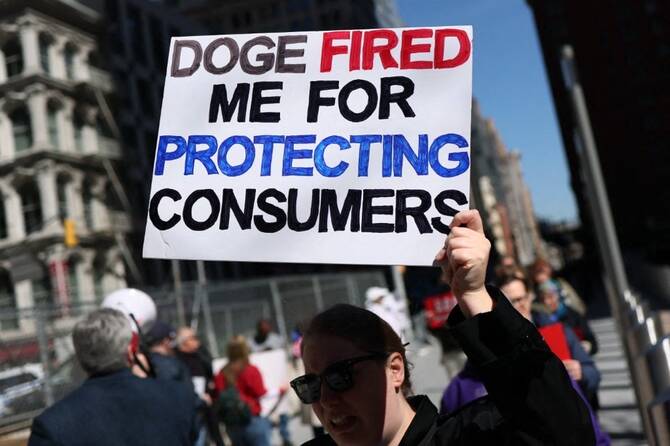
Tens of thousands of federal workers have been fired, left their jobs via deferred resignation programs or have been placed on leave as a result of Trump’s government-shrinking efforts. There is no official figure for the job cuts, but at least 75,000 federal employees took deferred resignation, and thousands of probationary workers have already been let go.
Lawyers for the government argued Friday that the executive order and memo calling for large-scale personnel reductions and reorganization plans provided only general principles that agencies should follow in exercising their own decision-making process.
“It expressly invites comments and proposals for legislative engagement as part of policies that those agencies wish to implement,” Eric Hamilton, a deputy assistant attorney general, said of the memo. “It is setting out guidance.”
But Danielle Leonard, an attorney for plaintiffs, said it was clear that the president, DOGE and OPM were making decisions outside of their authority and not inviting dialogue from agencies.
“They are not waiting for these planning documents” to go through long processes, she said. “They’re not asking for approval, and they’re not waiting for it.”
The temporary restraining order applies to departments including the departments of Agriculture, Energy, Labor, Interior, State, Treasury and Veteran Affairs.
It also applies to the National Science Foundation, Small Business Association, Social Security Administration and Environmental Protection Agency.
Some of the labor unions and nonprofit groups are also plaintiffs in another lawsuit before a San Francisco judge challenging the mass firings of probationary workers. In that case, Judge William Alsup ordered the government in March to reinstate those workers, but the US Supreme Court later blocked his order.
Plaintiffs include the cities of San Francisco, Chicago and Baltimore; labor group American Federation of Government Employees; and nonprofit groups Alliance for Retired Americans, Center for Taxpayer Rights and Coalition to Protect America’s National Parks.


![]()

Judge pauses much of Trump administration’s massive downsizing of federal agencies
Short Url
https://arab.news/jfm73
Judge pauses much of Trump administration’s massive downsizing of federal agencies
- The order, which expires in 14 days, does not require departments to rehire people


Latest updates


© 2026 SAUDI RESEARCH & PUBLISHING COMPANY, All Rights Reserved And subject to Terms of Use Agreement.