Pakistan and India agree to ceasefire, US says will hold talks at ‘neutral site’

1 / 2
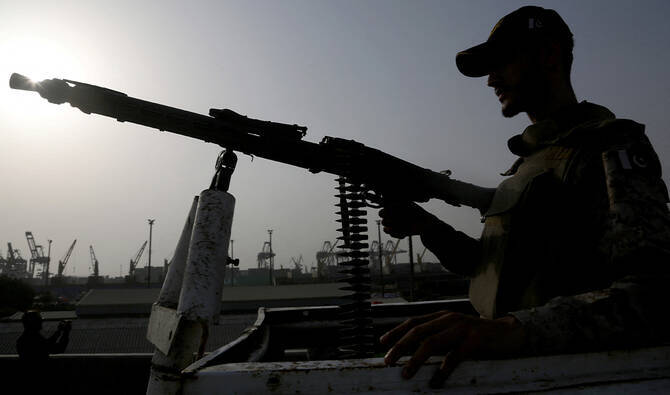
A paramilitary trooper mans a gun atop a vehicle as he keeps guard during a media tour of the Karachi Port, Pakistan, May 9, 2025. (Reuters/File)
2 / 2
Indian paramilitary soldiers with a sniffer dog patrol at a marketplace in Srinagar on May 10, 2025. (AFP)
Short Url
Updated 10 May 2025
Follow

Pakistan and India agree to ceasefire, US says will hold talks at ‘neutral site’

  • US secretary of state says two countries also agreed to talks on ‘broad set of issues at a neutral site’
  • Announcement comes after Pakistan and India launched attacks on each other early morning Saturday

ISLAMABAD/NEW DELHI: Pakistan and India both confirmed on Saturday they had agreed to a ceasefire after President Donald Trump said the US had mediated late night talks between the nuclear-armed South Asian nations on the brink of an all-out war.

The announcement came after the Pakistan military said early on Saturday India had attacked three bases in Pakistan with missiles, after which it had targeted multiple bases in India in response, including a missile storage site in India’s north. India said there was limited damage to equipment and personnel at air force stations in the Udhampur, Pathankot, Adampur and Bhuj areas.

The military said there were several high-speed missile attacks on several air bases in Indian Punjab, and that India had responded to the attacks.

Five civilians were killed in attacks in the Jammu region of Indian-administered Kashmir, regional police said.

“Pakistan and India have agreed to a ceasefire with immediate effect. Pakistan has always strived for peace and security in the region, without compromising on its sovereignty and territorial integrity,” Pakistani Deputy Prime Minister Ishaq Dar 
wrote on X.

The Indian ministry of external affairs also confirmed the ceasefire deal in a briefing. 

Separately, Trump said: “After a long night of talks mediated by the United States, I am pleased to announce that India and Pakistan have agreed to a FULL AND IMMEDIATE CEASEFIRE. Congratulations to both Countries on using Common Sense and Great Intelligence.”

US secretary of state Marco Rubio said the two countries had also agreed to talks on a "broad set of issues at a neutral site."

Earlier on Saturday, Pakistani and Indian officials had both separately said they would consider de-escalation if the other nation reciprocated. 

Through this week, allies and friends like Saudi Arabia, China, Iran and Qatar have offered mediation and urged restraint. The Group of Seven (G7) major countries called on India and Pakistan to engage in direct dialogue while the US government said it had offered assistance in starting “constructive talks.”

Saturday’s military confrontation, the worst fighting between the longstanding enemies in decades, followed days of daily clashing since Wednesday through drones and missiles and gunfighting on the Line of control, the de facto border that divides the disputed Kashmir region between them. At least 50 have been killed on both sides.

The latest tensions were triggered by a militant attack in Indian-administered Kashmir that killed 26 people on April 22. New Delhi said Islamabad was involved, which denied the allegation and repeatedly said it was willing to participate in a transparent and credible inquiry.

Pakistan and India have a history of bitter relations, having fought two of their three wars over Kashmir, a region split between them, since gaining independence from the former British colonial rule in 1947.

Both nations acquired nuclear weapons in 1998.


Italian PM pledges to deepen cooperation with African states

Updated 4 sec ago
Follow

Italian PM pledges to deepen cooperation with African states

  • The plan, launched in 2024, aims to promote investment-led cooperation rather than traditional aid

ADDIS ABABA: Italy pledged to deepen cooperation with African countries at its second Italy-Africa summit, the first held on African soil, to review projects launched in critical sectors such as energy and infrastructure during Italy’s first phase of the Mattei Plan for Africa.

The plan, launched in 2024, aims to promote investment-led cooperation rather than traditional aid.

Italy’s Prime Minister Giorgia Meloni addressed dozens of African heads of state and governments in Ethiopia’s capital, Addis Ababa, and reiterated that a successful partnership would depend on Italy’s “ability to draw from African wisdom” and ensure lessons are learned.

“We want to build things together,” she told African heads of state.  “We want to be more consistent with the needs of the countries involved.”

Ethiopian Prime Minister Abiy Ahmed said Italy had provided Africa with a gateway to Europe through these partnerships.

“This is a moment to move from dialogue to action,” he said. 

“By combining Africa’s energetic and creative population with Europe’s experience, technology, and capital, we can build solutions that deliver prosperity to our continents and beyond.”

After the Italy-Africa summit concluded, African leaders remained in Addis Ababa for the annual African Union Summit.

Kenyan writer and political analyst Nanjala Nyabola said tangible results from such summits depend on preparations made by countries.

African governments often focus on “optics instead of actually making summits a meaningful engagement,” she said.

Instead of waiting for a list of demands, countries should “present the conclusions of an extended period of mapping the national needs” and engage in dialogue to determine how those needs can be met.

Since it was launched two years ago, the Mattei Plan has directly involved 14 African nations and has launched or advanced around 100 projects in crucial sectors, including energy and climate transition, agriculture and food security, physical and digital infrastructure, healthcare, water, culture and education, training, and the development of artificial intelligence, according to the Italian government.