Pakistan PM condemns Indian strikes on civilians, praises Saudi push for de-escalation

1 / 2
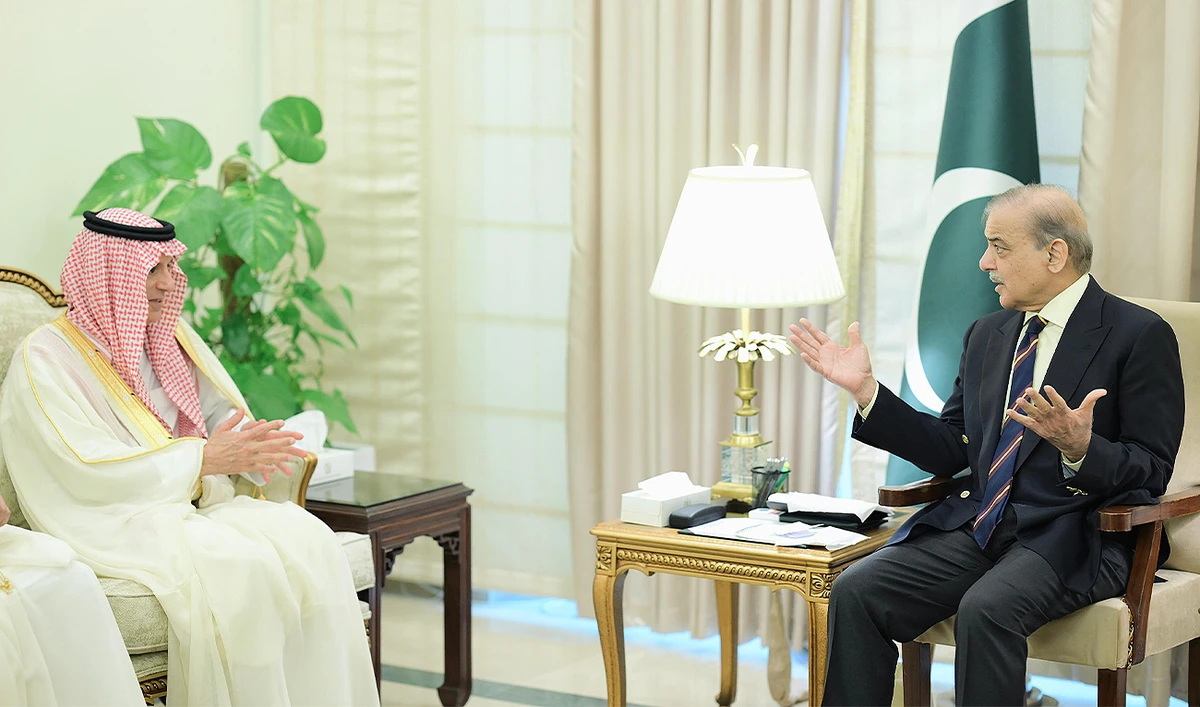
Pakistan Prime Minister Shehbaz Sharif (right) meets Saudi Minister of State for Foreign Affairs Adel Al-Jubeir in Islamabad, Pakistan, on May 9, 2025. (Government of Pakistan)
2 / 2
Pakistan's Deputy Prime Minister Ishaq Dar (right) receives Saudi Minister of State for Foreign Affairs Adel Al-Jubeir in Islamabad, Pakistan, on May 9, 2025. (Ministry of Foreign Affairs)
Short Url
Updated 10 May 2025
Follow

Pakistan PM condemns Indian strikes on civilians, praises Saudi push for de-escalation

KARACHI: Prime Minister Shehbaz Sharif on Friday condemned India’s missile and drone strikes against Pakistan that killed civilians this week while appreciating Saudi diplomatic efforts to de-escalate tensions with its nuclear neighbor in a meeting with the Kingdom’s Minister of State for Foreign Affairs Adel Al-Jubeir.

The Saudi minister’s daylong visit follows India’s military strikes inside Pakistan in response to a gun attack in the disputed Kashmir region that left 26 tourists dead, with New Delhi blaming Islamabad for the incident, though Pakistani authorities have repeatedly denied any involvement.

With the two archrivals teetering on the edge of a full-scale war, the United States announced on Thursday that Secretary of State Marco Rubio had discussed regional de-escalation with Saudi officials.

The same day, Al-Jubeir made a surprise stop in New Delhi for talks with Indian officials before arriving in Pakistan on Friday.

“While discussing the prevailing situation in South Asia [with the visiting dignitary], the Prime Minister strongly condemned India’s missile and drone strikes against Pakistan that had resulted in the martyrdom of scores of innocent civilians, including women and children, as well as damage to civilian infrastructures,” said a statement issued by his office after the meeting.

“He said Pakistan was fully determined to defend its sovereignty and territorial integrity, in accordance with Article 51 of the UN Charter,” it added. “He appreciated the Kingdom’s diplomatic efforts to de-escalate the situation and bring peace in the region.”

Sharif conveyed warm regards to Salman bin Abdulaziz and Crown Prince Mohammed bin Salman and expressed satisfaction at the positive trajectory of Pakistan-Saudi relations.

He also maintained that India’s “unprovoked and unjustified acts of aggression” had violated Pakistan’s sovereignty and territorial integrity and seriously endangered regional peace and stability. 

The statement said Al-Jubeir offered condolences over the loss of civilian lives and said the Kingdom was “deeply concerned” about the current situation in South Asia.

He reiterated Saudi Arabia’s call for de-escalation and the peaceful resolution of disputes between Pakistan and India in accordance with international law.

Saudi Arabia and Pakistan share close diplomatic and strategic relations.

The Kingdom has extended significant support to Pakistan during prolonged economic challenges faced by Islamabad in recent years, including external financing and assistance with International Monetary Fund (IMF) loan programs.

Saudi Arabia has also contributed to global peacemaking efforts by hosting talks and mediating prisoner exchanges between Russia and Ukraine.

China’s top diplomat to visit Somalia on Africa tour

Updated 6 sec ago
Follow

China’s top diplomat to visit Somalia on Africa tour

  • Stop in Mogadishu provides diplomatic boost after Israel became the first country to formally recognize breakaway Somaliland
  • Tour focusses on Beijing's strategic trade ​access across eastern and southern Africa
BEIJING: China’s top diplomat began his annual New Year tour of Africa on Wednesday, focusing on strategic trade ​access across eastern and southern Africa as Beijing seeks to secure key shipping routes and resource supply lines.
Foreign Minister Wang Yi will travel to Ethiopia, Africa’s fastest-growing large economy; Somalia, a Horn of Africa state offering access to key global shipping lanes; Tanzania, a logistics hub linking minerals-rich central Africa to the Indian Ocean; and Lesotho, a small southern African economy squeezed by US trade measures. His trip this year runs until January 12.
Beijing aims to highlight countries it views as model partners of President Xi Jinping’s flagship “Belt and Road” infrastructure program and to expand export markets, particularly in young, increasingly ‌affluent economies such ‌as Ethiopia, where the IMF forecasts growth of 7.2 percent this year.
China, ‌the ⁠world’s ​largest bilateral ‌lender, faces growing competition from the European Union to finance African infrastructure, as countries hit by pandemic-era debt strains now seek investment over loans.
“The real litmus test for 2026 isn’t just the arrival of Chinese investment, but the ‘Africanization’ of that investment. As Wang Yi visits hubs like Ethiopia and Tanzania, the conversation must move beyond just building roads to building factories,” said Judith Mwai, policy analyst at Development Reimagined, an Africa-focussed consultancy.
“For African leaders, this tour is an opportunity to demand that China’s ‘small yet beautiful’ projects specifically target our industrial gaps, ⁠turning African raw materials into finished products on African soil, rather than just facilitating their exit,” she added.
On his start-of-year trip in 2025, ‌Wang visited Namibia, the Republic of Congo, Chad and Nigeria.
His visit ‍to Somalia will be the first by a Chinese foreign minister since the 1980s and is ‍expected to provide Mogadishu with a diplomatic boost after Israel became the first country to formally recognize the breakaway Republic of Somaliland, a northern region that declared itself independent in 1991.
Beijing, which reiterated its support for Somalia after the Israeli announcement in December, is keen to reinforce its influence around the Gulf of Aden, the entrance ​to the Red Sea and a vital corridor for Chinese trade transiting the Suez Canal to Europe.
Further south, Tanzania is central to Beijing’s plan to secure access to Africa’s ⁠vast copper deposits. Chinese firms are refurbishing the Tazara Railway that runs through the country into Zambia. Li Qiang made a landmark trip to Zambia in November, the first visit by a Chinese premier in 28 years.
The railway is widely seen as a counterweight to the US and European Union-backed Lobito Corridor, which connects Zambia to Atlantic ports via Angola and the Democratic Republic of the Congo.
By visiting the southern African kingdom of Lesotho, Wang aims to highlight Beijing’s push to position itself as a champion of free trade. Last year, China offered tariff-free market access to its $19 trillion economy for the world’s poorest nations, fulfilling a pledge by Chinese President Xi Jinping at the 2024 China-Africa Cooperation summit in Beijing.
Lesotho, one of the world’s poorest nations with a gross domestic product of just over $2 billion, ‌was among the countries hardest hit by US President Donald Trump’s sweeping tariffs last year, facing duties of up to 50 percent on its exports to the United States.