

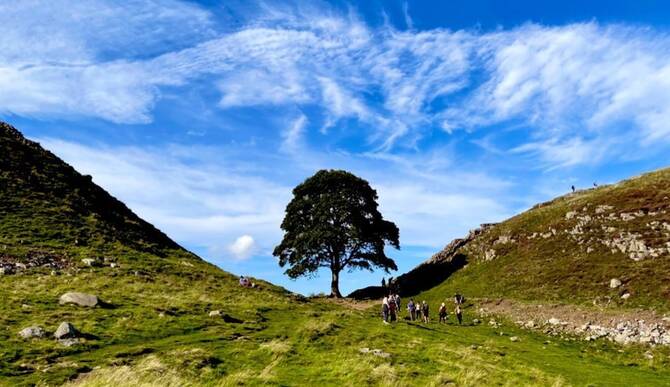
Two men found guilty of chopping down iconic UK tree

A jury at Newcastle Crown Court found former friends Daniel Graham, 39, and Adam Carruthers, 32, guilty of criminal damage for the 2023 felling of the tree at Sycamore Gap. (X/@Brycchan)
Short Url
Updated 09 May 2025
Follow

Two men found guilty of chopping down iconic UK tree

  • The tree at Sycamore Gap had stood for nearly 200 years next to Hadrian’s Wall, a UNESCO World Heritage site in northern England
  • The tree was so striking it featured in the 1991 Hollywood film “Robin Hood: Prince of Thieves“

LONDON: An English court found two men guilty on Friday of the “deliberate and mindless” felling of one of the UK’s most iconic trees, an incident that sparked national outrage.

A jury at Newcastle Crown Court found former friends Daniel Graham, 39, and Adam Carruthers, 32, guilty of criminal damage for the 2023 felling of the tree at Sycamore Gap.

It had stood for nearly 200 years next to Hadrian’s Wall, a UNESCO World Heritage site in northern England. The tree was so striking it featured in the 1991 Hollywood film “Robin Hood: Prince of Thieves.”

They were convicted after around five hours of deliberation on two counts of criminal damage: to the sycamore and to the Roman wall, which was damaged when the tree fell on it.

Reacting to the verdict, the National Trust conservation body said the “needless felling” of the tree had “shocked people around the country and overseas, demonstrating the powerful connection between people and our natural heritage.

“It was felt particularly deeply here in the north east of England where the tree was an emblem of the region and the backdrop to many personal memories,” said a spokesperson.

Prosecutors had told the court that the two men used a chainsaw to cut down the tree. It was, they said, “an act of deliberate and mindless criminal damage,” which they filmed on Graham’s phone and shared with others.

Speaking after the conviction, Northumbria Police’s Kevin Waring said: “We often hear references made to mindless acts of vandalism, but that term has never been more relevant than today.

“At no point have the two men given an explanation for why they targeted the tree — and there never could be a justifiable one,” he added.

Graham has “been in custody for his own protection after an episode in December,” his lawyer Chris Knox told court on Friday.

The pair drove to the site near Hexham in Graham’s Range Rover and felled the tree on the night of September 27, 2023, slicing through the trunk in “a matter of minutes,” said prosecutor Richard Wright.

“Having completed their moronic mission, the pair got back into the Range Rover and traveled back toward Carlisle” where they lived, he added.

A video of the act recovered from Graham’s phone was shared by the two men with “the unmistakable sound of a chainsaw, and a tree falling,” said Wright.

The next day, in a voice message from Graham to Carruthers, Graham said “it’s gone viral. It is worldwide. It will be on ITV news tonight,” he added.

“They are loving it, they’re revelling in it. This is the reaction of the people that did it. They still think it’s funny, or clever, or big,” said the prosecutor.

Gale Gilchrist, from the Crown Prosecution Service North, said that “in just under three minutes, Graham and Carruthers ended its (the tree’s) historic legacy in a deliberate and mindless act of destruction.

“We hope our community can take some measure of comfort in seeing those responsible convicted today,” she added.

The pair were jointly charged with causing £622,191 ($832, 821) of criminal damage to the tree and £1,144 of damage to Hadrian’s Wall, an ancient Roman fortification stretching from northwest to northeast England.

The two men have been remanded in custody — Carruthers for his own protection. They will be sentenced on July 15.

The sycamore was a symbol of northeast England and a key attraction photographed by millions of visitors over the years, winning the Woodland Trust’s Tree of the Year in 2016.

Efforts are under way to see if it can be regrown from its stump or seeds.

The National Trust, which owns the wall and the tree, said it has grown 49 saplings from the sycamore’s seeds, which will be planted this winter at sites across the UK.


In southeast Pakistan, Ramadan brings Hindus and Muslims closer

Updated 10 March 2026
Follow

In southeast Pakistan, Ramadan brings Hindus and Muslims closer

MITHI: Partab Shivani, a Hindu in Muslim-majority Pakistan, has fasted on and off during Ramadan for years, but this time is different as he practices abstinence for the entire holy month.
Every year, he and his friends in the southeastern city of Mithi arrange iftar, when Muslims break their daily fast, to foster peace and solidarity between the two religions.
“I believe we need to promote interfaith harmony. First, we are humans — religions came later,” Shivani, a 48-year-old social activist, told AFP, adding that he also reads the teachings of the Buddha.
“His message is about peace and ending war. Peace can spread through solidarity and by standing with one another. Distance only widens the gap between people,” he added.
Ninety-six percent of Pakistan’s 240 million people are Muslim. Just two percent are Hindu, most of them living in rural areas of Sindh province where Mithi is located.
In Mithi itself, most of the 60,000 inhabitants are Hindu.
Many of the city’s Hindus also observe Ramadan and iftar has become a social gathering where people from both faiths happily participate.
“This has been a wonderful tradition of ours for a very long time,” said Mir Muhammad Buledi, a 51-year-old Muslim friend who attended Shivani’s iftar gathering.
“It is a beautiful example of harmony between the two communities.”
Like brothers
Discrimination against minorities runs deep in Pakistan.
Following the end of British rule in South Asia in 1947, the subcontinent was partitioned into mainly Hindu India and Muslim-majority Pakistan.
That triggered widespread religious bloodshed in which hundreds of thousands were killed and millions displaced.
According to the Human Rights Commission of Pakistan, freedom of religion or belief is under constant threat, with religiously motivated violence and discrimination increasing yearly.
State authorities, often using religious unrest for political gain, have failed to address the crisis, the independent non-profit says.
But such tensions are absent in Mithi.
“I am a Hindu but I keep all the fasts during this month,” said Sushil Malani, a local politician. “I feel happy standing with my Muslim brothers.
“We celebrate Eid together as well. This tradition in the region is very old.”
Restaurants and tea stalls are closed across Pakistan during Ramadan.
Ramesh Kumar, a 52-year-old Hindu man who sells sweets and savoury items outside a Muslim shrine, keeps his push cart covered and closed until iftar.
“There is no discrimination among us if someone is Muslim or Hindu. I have been seeing this since my childhood that we all live together like brothers,” he said.
Muslim shrine, Hindu caretaker
Locals say Mithi’s peaceful religious coexistence can be traced to its remote location, emerging from the sand dunes of the Tharparkar desert, which borders the modern Indian state of Rajasthan.
Cows — considered sacred in Hinduism — roam freely in Mithi city, as they do in neighboring India.
At two Sufi Muslim shrines in the middle of the city, Hindu families arrange meals, bringing fruit, meals and juices for their Muslim neighbors to break their fasts.
“We respect Muslims,” said Mohan Lal Malhi, a Hindu caretaker of one of the shrines.
Mohan said his parents and elders taught him to respect people regardless of religion or color, and the traditions pass from one generation to the next.
Local residents said both communities consider their social relationships more important than their religious identity.
“You will see a (Sikh) gurdwara, a mosque, and a shrine standing side by side here,” Mohan said. “The atmosphere of this area teaches humanity.”