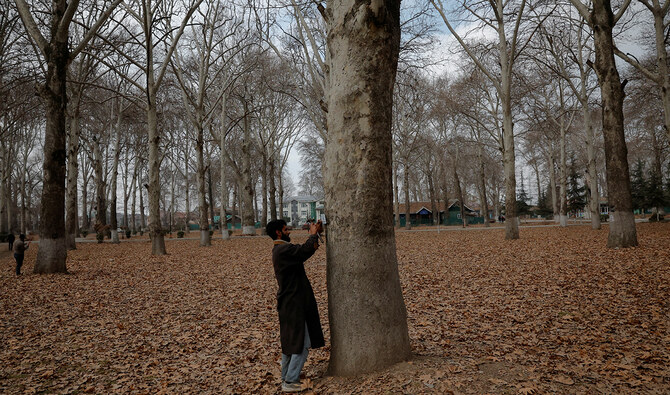
SRINAGAR: Authorities in Indian-administered Kashmir are geo-tagging thousands of ‘Chinar’ trees to create a comprehensive database for their management and help conserve them amid threats from rising urbanization, road-widening projects and diseases.
The trees are a cultural and ecological symbol of the restive northern territory, which is claimed in full by India and Pakistan and ruled in part by both, but hundreds of them have been lost over the last few decades.
Under the geo-tagging process, QR codes are attached to each surveyed tree, recording information about 25 characteristics, including its geographical location, health, age, and growing patterns, enabling conservationists to track changes and address risk factors.
The public can also scan the code to access the details, Syed Tariq, the head of the project, told Reuters.
“We have geo-tagged nearly 29,000 trees, but we still have more small-sized trees that haven’t been tagged... These will be tagged in due course,” Tariq said.
The Chinar trees take around 150 years to reach their full size of up to 30 meters (100 ft) in height with a girth of 10 to 15 meters (30 to 50 ft) at ground level.
The oldest Chinar in the region lies on the outskirts of the city of Srinagar and is around 650 years old.
“We are using a USG-based (ultrasonography-based) gadget capable of determining risk levels without human intervention. The gadget will assess risk factors, eliminating the need for manual evaluation,” Tariq said.
The portion of Kashmir under India’s control was roiled by violence for decades as militants fought security forces, but the conflict has eased in recent years, leading to a gradual rise in development projects and tourism.
Indian Prime Minister Narendra Modi visited Kashmir last week to inaugurate a tunnel and, during the event, said that numerous road and rail connectivity projects in the region would be completed in the coming days.


![]()

India turns to geo-tagging to conserve Kashmir’s iconic ‘Chinar’ trees
Short Url
https://arab.news/g4h37
India turns to geo-tagging to conserve Kashmir’s iconic ‘Chinar’ trees
- The trees are a cultural and ecological symbol of the restive northern territory
- The trees face threats from rising urbanization, road-widening projects, diseases
Latest updates






© 2026 SAUDI RESEARCH & PUBLISHING COMPANY, All Rights Reserved And subject to Terms of Use Agreement.