BANGKOK: India’s missile and bomb strikes on targets in Pakistan and Azad Kashmir have spiked tensions between the two nuclear-armed neighbors, with Pakistan’s leader calling the attacks an act of war.
Claims on exactly what was hit and where have differed widely, with neither India nor Pakistan releasing many specific details.
Making the ongoing conflict even more confusing, the Internet has been “flooded with disinformation, false claims, and manipulated photos and videos,” the Soufan Center think tank said in a research note Friday.
“This information warfare is compounded by both sides’ commitment to save face,” it said.
Still, some information can be gleaned from official statements and paired with what is known to gain greater insight into the clash:
Pakistan says it shot down 5 Indian planes involved in the attack
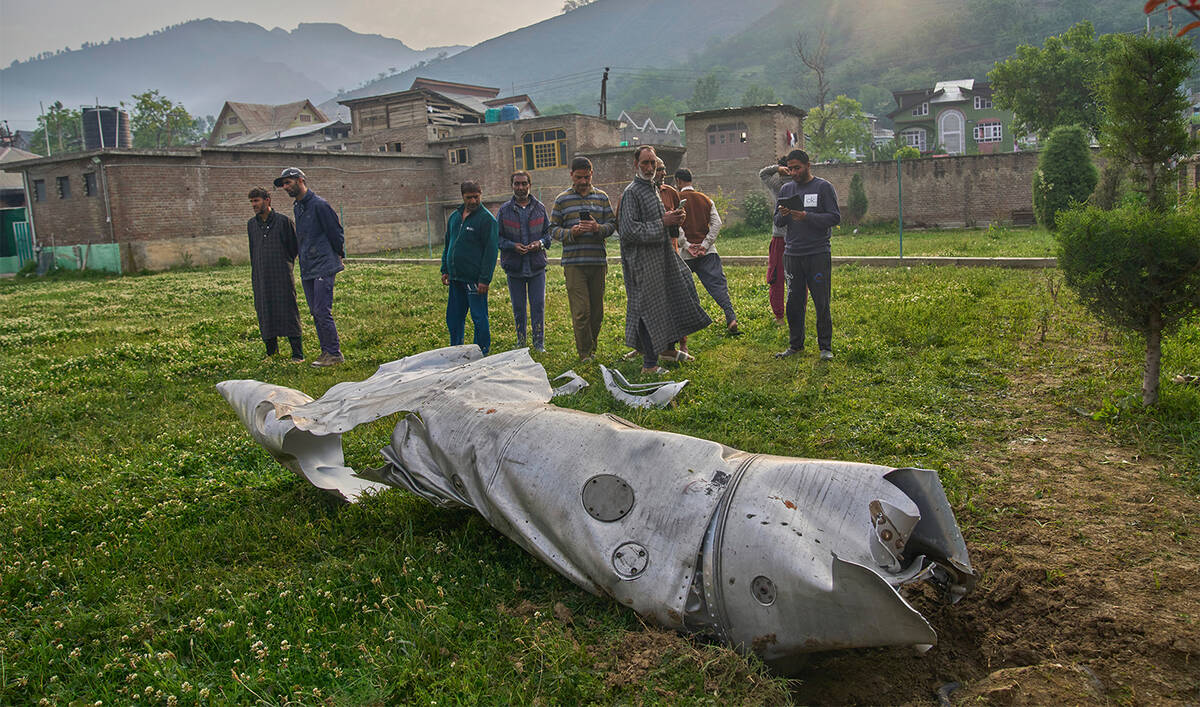
People look at a fuel tank of an aircraft in Wuyan, near Srinagar, on May 7, 2025. (AFP)
Hours after India’s attack early Wednesday, in retaliation for last month’s massacre of tourists in Indian-controlled Kashmir, Pakistan’s military spokesperson Lt. Gen. Ahmed Sharif claimed that the Pakistan air force had shot down five Indian attack aircraft: three French-made Rafales, a Russian-made SU30MKI and a Russian-made MiG-29.
He said that Pakistan’s air force suffered no casualties, and that all of its aircraft returned safely to base.
Pakistan’s Prime Minister Shehbaz Sharif repeated the claim, saying that the Pakistan air force had the opportunity to shoot down 10 Indian planes, but exercised restraint and downed only the five that had fired on Pakistani targets.
He told Parliament that overall 80 Indian planes had been involved in the attack.
India, meantime, has not acknowledged any losses, though debris from three aircraft came down in at least three areas.
Did it happen that way?
India does have all three types of jets among its more-than 700 combat capable fighter aircraft, according to the International Institute for Strategic Studies’ Military Balance report.
All three aircraft are fighters with the capability of carrying bombs or missiles for ground attacks.
Pakistan and India have both said that their planes did not leave their home airspace, suggesting that if Pakistan’s account is accurate, rather than a dogfight in the skies over Kashmir, Pakistani pilots fired multiple air-to-air missiles over a long distance to take down Indian planes.
Presuming India fired back, even though Pakistan said none of its planes were hit, the aerial skirmish would have been quite the show. But there have been no eyewitness reports of it or video to emerge on social media.
What is known for sure is that Indian planes were in the air and attacked at least nine targets, and that debris from three has been found.
It’s also plausible that Pakistan used surface to air missiles to hit Indian planes — which the war in Ukraine has shown to be very effective and would not have meant risking any of its own planes.
Pakistan has a wide range of such missiles, primarily Chinese-made.
Test of Chinese tech?
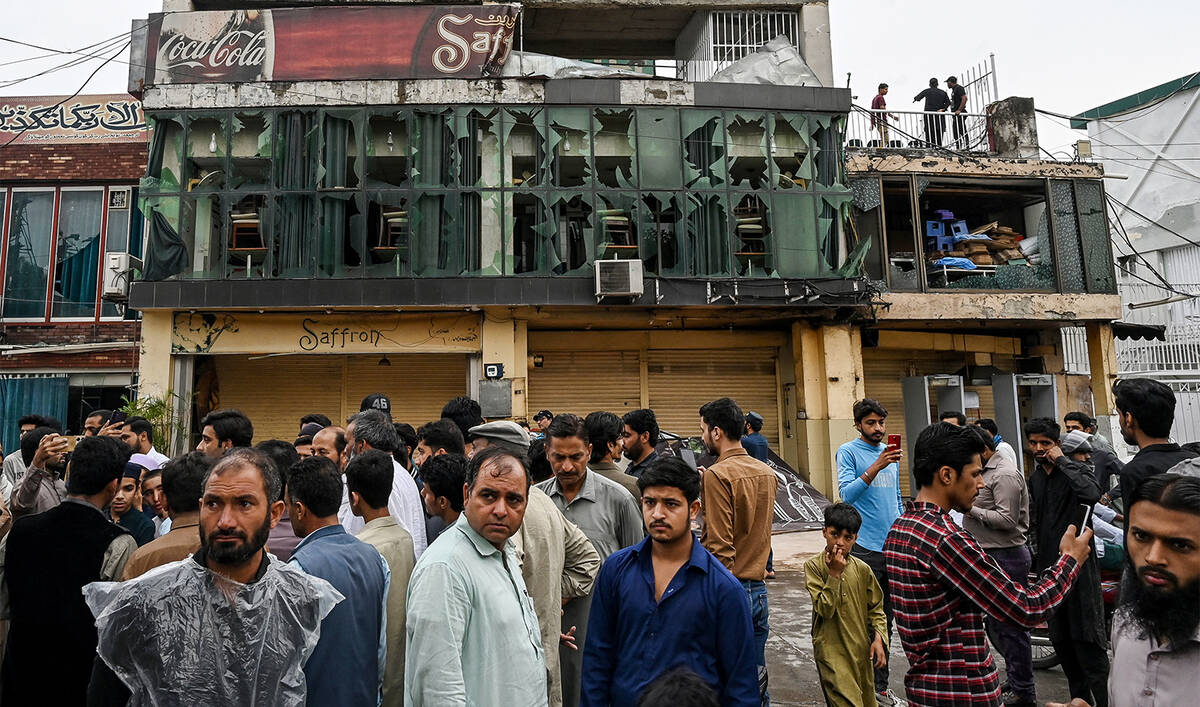
People gather in front of the shattered glasses of a restaurant outside the Rawalpindi cricket stadium after an alleged drone was shot down in Rawalpindi on May 8, 2025. (AFP)
Pakistan’s air force includes American-made F-16s, the French Mirage, and the new Chinese-built J-10C, as well as the Chinese JF-17, which was developed jointly with Pakistan.
In addition to American air-to-air missiles, Pakistan also has several Chinese products in its arsenal, including the PL-12 and PL-15, both of which can be used to fire at targets beyond visual range.
Pakistan’s Foreign Minister Ishaq Dar told lawmakers it was the J-10C that shot down the Indian aircraft, raising the likelihood that Chinese-built missiles were also employed.
“It’s interesting that Pakistan is saying it is using Chinese jets that it has imported from China to shoot down Indian aircraft,” said Lisa Curtis, director of the Indo-Pacific security program at the Center for a New American Security, a Washington think tank.
In 2019, during the rivals’ previous military confrontation, “it was a Pakistani F-16 provided by the United States that was used to shoot down an Indian aircraft,” Curtis said in a conference call. “It’s interesting to see that Pakistan is relying more on its Chinese equipment than it did six years ago.”
The news convinced traders with shares in AVIC Chengdu Aircraft, which builds both the J-10C and J-17, to post large gains Wednesday and Thursday on the Shenzhen Stock Exchange.
Meanwhile, the stock of Dassault Aviation, the maker of the Rafale jet, which is among those Pakistan claims to have shot down, dropped sharply on Wednesday on the Paris Stock Exchange, though had recovered by close on Thursday.
What else is known?
India hasn’t talked about what assets were involved in the attacks. The Indian Defense Ministry said that the strikes targeted at least nine sites “where terrorist attacks against India have been planned.”
Pakistan, meantime, has said 31 civilians were killed, including women and children, in Pakistan-administered Kashmir and the country’s Punjab province, and that buildings hit included two mosques.
India did show video of eight of the strikes at a briefing on Wednesday. four in Pakistan-controlled Kashmir and four in Pakistan.
Both sides have talked about missile strikes, but it was clear from the video that bombs were also dropped on some targets, possibly from drones. In addition to claiming the five Indian aircraft shot down, Pakistan also said it downed an unspecified number of drones on Wednesday.
Indian officials said the strikes were precision attacks, and from the videos shown, it did appear that specific areas of installations were targeted with individual missiles or bombs, rather than widespread areas.
What happened next?
India sent multiple attack drones into Pakistan on Thursday, with Pakistan claiming to have shot down 29 of them.
The drones were identified as Israeli-made Harop, one of several in India’s inventory.
One drone damaged a military site near the city of Lahore and wounded four soldiers, and another hit the city of Rawalpindi, which is right next to the capital Islamabad., according to the Pakistani army.
India did not deny sending drones, but the Defense Ministry said its armed forces “targeted air defense radars and systems” in several places in Pakistan, including Lahore. It did not comment on the claims of 29 being shot down.
India similarly did not comment on Pakistani claims to have killed 50-60 soldiers in exchanges along the Line of Control, though it did say one of its soldiers was killed by shelling on Wednesday.
Pakistani Information Minister Attaullah Tarar, meantime, denied Indian accusations that Pakistan had fired missiles toward the Indian city of Amritsar, saying in fact an Indian drone fell in the city.