

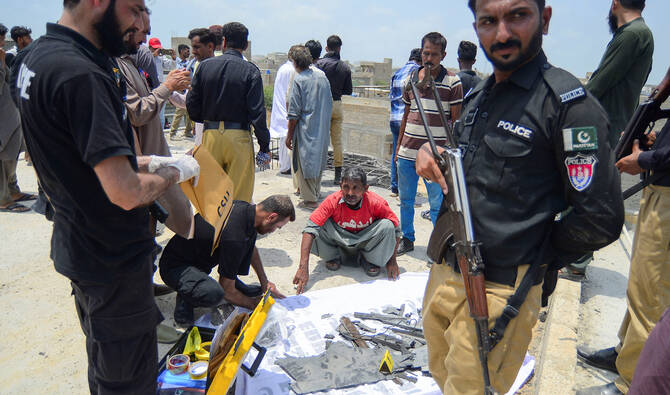

ISLAMABAD: Deputy Prime Minister Ishaq Dar on Thursday described New Delhi’s accusations that Pakistan had tried to carry out strikes inside India overnight as a “big lie,” after India said it had “neutralized” Islamabad’s attempts to target military targets with drones and missiles.
Fighting has escalated between the nuclear-armed South Asian neighbors since Wednesday when India struck multiple locations in Pakistan in response to a deadly April 22 attack targeting tourists in Indian-administered Kashmir that New Delhi blames on its neighbor.
Pakistan, which denies any link to the Kashmir violence, said it had shot down five Indian fighter jets in retaliation. Thursday brought more violence as Pakistan said it had downed 29 Israeli-manufactured Harop drones launched from India overnight and New Delhi said Islamabad had launched an air attack using “drones and missiles” before it retaliated to destroy an air defense system in Lahore.
“Today, a politically based and motivated story was issued that last night Pakistan attacked different Indian military installations and military areas. It’s a big lie. It’s a very big lie,” Dar, who is also the country’s foreign minister, told reporters.
He said India had “concocted” the story to justify attempting to carry out waves of drone attacks inside Pakistan.
“What they did today [sending drones], from Islamabad to South Pakistan till Karachi, in at least two dozen places, is shameful, regretful and condemnable,” Dar added.
The foreign minister’s press conference followed a statement by India’s defense ministry that said Pakistan on Thursday morning “attempted to engage a number of military targets ... using drones and missiles,” which were “neutralized” by air defense systems.
New Delhi said areas targeted included sites in Indian-administered Jammu and Kashmir, and India’s Punjab state, including the key cities of Amritsar, Ludhiana, Chandigarh, as well as Bhuj in Gujarat state.
“The debris of these attacks is now being recovered from a number of locations,” it added.
The defense ministry said in retaliation, its military had “targeted air defense radars and systems at a number of locations in Pakistan,” saying the “response has been in the same domain, with the same intensity, as Pakistan.”
It added that it had been “reliably learnt that an air defense system at Lahore has been neutralized.”
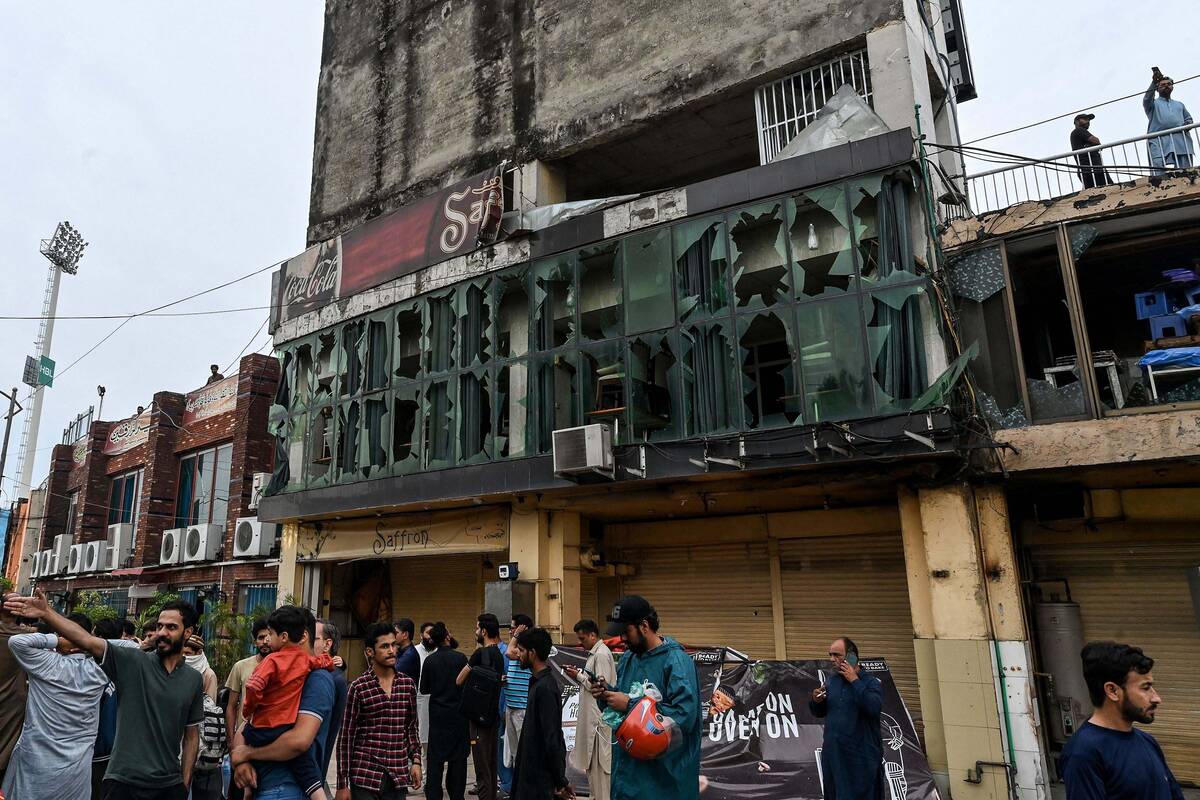
People gather in front of the shattered glasses of a restaurant outside the Rawalpindi cricket stadium after an alleged drone was shot down in Rawalpindi on May 8, 2025. (AFP)
Dar, and military spokesman Lt. Gen. Ahmed Sharif Chaudhry, have both rejected the claim.
“29 drones so far have been neutralized,” Chaudhry said at the press conference alongside Dar.
“Only one managed to partially engage its target for which it came. Some equipment was damaged and four soldiers were injured.”
He said three civilians had been killed and four injured during the exchange.
The conflict between India and Pakistan has been confined in recent decades mostly to the disputed mountainous region of Kashmir. But the air strikes on Wednesday morning, which also hit the towns of Bahawalpur and Muridke in the heart of the country, and the drone incursions into some of the country’s largest cities on Thursday, were seen in Islamabad as a major escalation.
One drone was shot down over the garrison city of Rawalpindi, home to the Pakistan army’s heavily fortified headquarters.
One drone hit a military target near Lahore, the capital and largest city of the province of Punjab, and the second-largest city in Pakistan after Karachi.
Other places where drones were neutralized were Gujranwala, Chakwal, Attock, Bahawalpur, Miano, Chor and near Karachi, which the country’s largest city and commercial capital.
India has also accused Pakistan of having “increased the intensity of its unprovoked firing across the Line of Control using mortars and heavy caliber artillery” across the de facto border that divides Kashmir between the two nations.
India said the number of people who had been killed by Pakistani firing since the escalation of violence on Wednesday had risen to 16, including three women and five children.
Speaking in parliament, Pakistani Information Ministers said Pakistan had killed 40-50 Indian soldiers and destroyed a brigade headquarters along the Line of Control. The claims could not be independently verified and India has not commented on it.
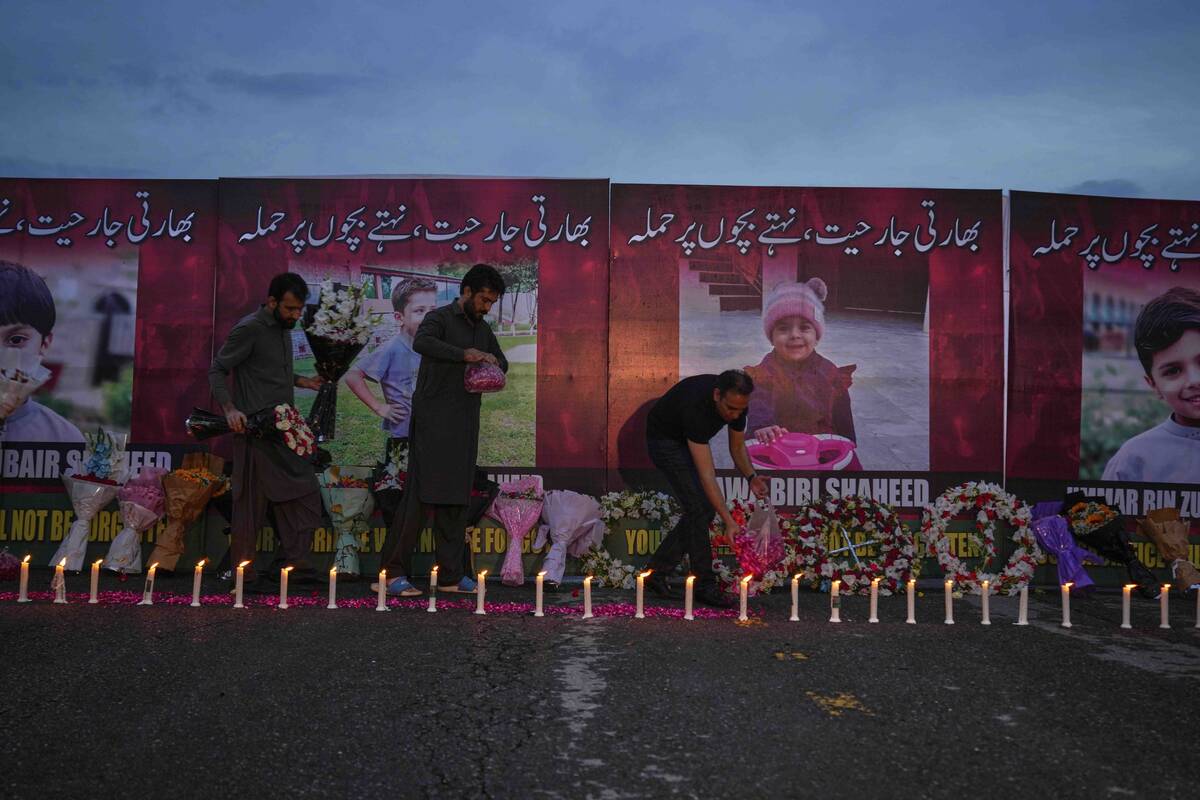
Workers place candles and flowers prior to a candle light vigil for children, who were killed in the Indian missile strikes, in Islamabad, Pakistan on May 8, 2025. (AP)
India and Pakistan have fought three wars in the past, two of them over Kashmir, which they both claim in full but rule in part.
Since April 22, they have intensified firing and shelling across the Line of Control.
For decades India has accused Pakistan of supporting militants in attacks on Indian interests, especially in Indian-administered Kashmir. Pakistan denies such support and in turn accuses India of backing separatist and other insurgents in Pakistan, which New Delhi denies.
With inputs from AFP and Reuters


