

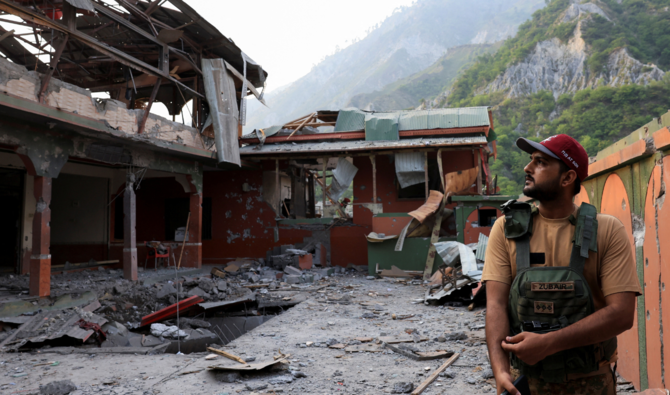

KOTLI, Azad Kashmir: A convoy of journalists escorted by the Pakistani military and officials traveled through the scenic but tense roads of Azad Jammu and Kashmir (AJK) this week, arriving in the afternoon in Kotli, where an Indian strike on a mosque on Wednesday early morning had killed two people.
The usually bustling city stood silent, its shops shuttered, roads empty and anxious residents watching from a distance.
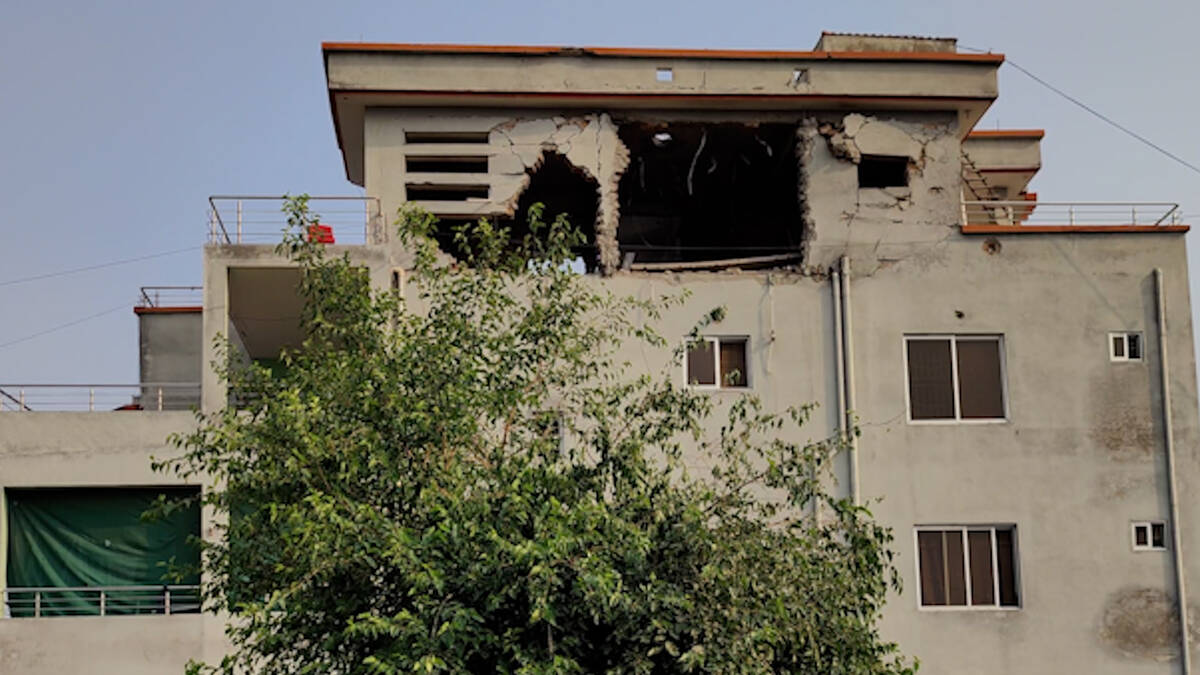
A building damaged by Indian airstrike pictured on May 7, 2025 in Azad Kashmir. (AN Photo)
Amid the most intense military flare-up between nuclear-armed India and Pakistan in decades, New Delhi said it had struck nine “terrorist infrastructure” sites in Pakistan and AJK early Wednesday. AJK is the part of the disputed Kashmir valley administered by Pakistan while Jammu and Kashmir is a region administered by India.
India described Wednesday’s strikes as retaliation for an April 22 attack in its part of Kashmir that killed 26 tourists. Delhi attributed that attack to Pakistan, a claim Islamabad has repeatedly denied.
Pakistani authorities said six locations were hit across the country during Indian strikes, resulting in 31 deaths and 57 injuries. The Pakistan army spokesperson said the military responded by downing five Indian aircraft.
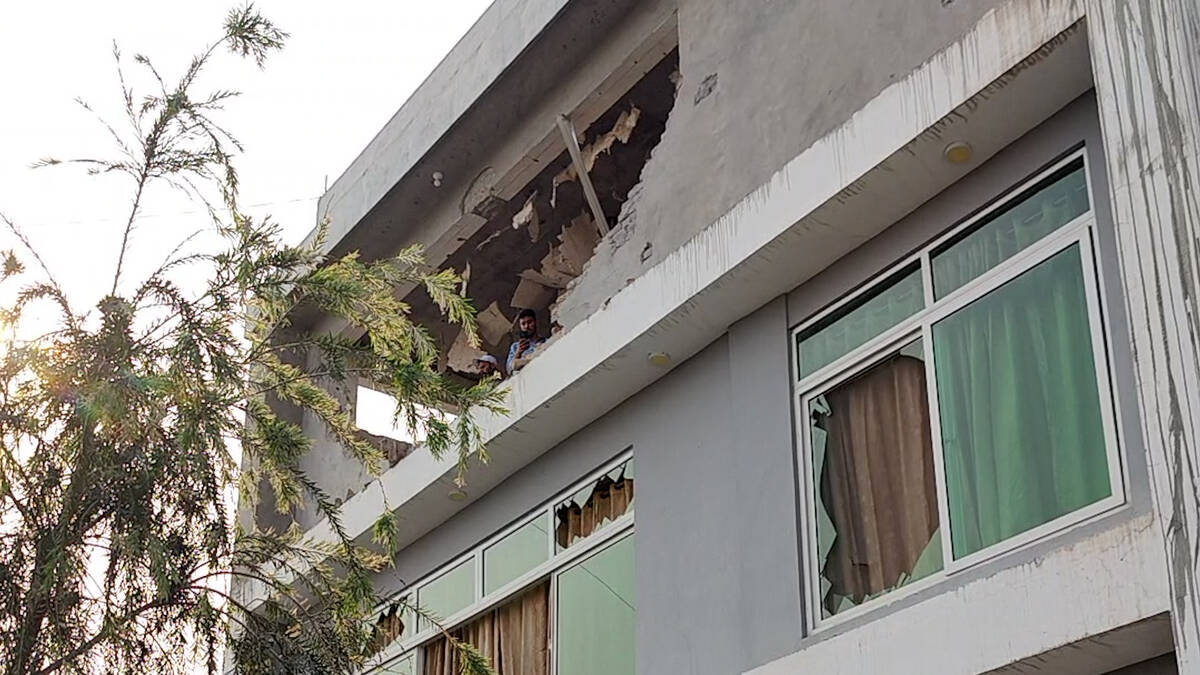
A building damaged by Indian airstrike pictured on May 7, 2025 in Azad Kashmir. (AN Photo)
“It [the attack] happened after 12:30 a.m. on [Wednesday], when people were asleep and were jolted awake by the sound of the blasts,” Dawood Ahmed, a local resident, told Arab News near the mosque in Kotli that was hit by Indian strikes.
“It happened so suddenly, and people were so terrified that they rushed out of their homes with their children ... We thought a major attack had occurred and that Kotli had been surrounded.”
Ahmed said the Nakial sector on the Line of Control (LoC), the restive de facto border separating the Pakistani and Indian sides of Kashmir, was about 22 kilometers from the area.
“So, we are not used to regular firing or skirmishes,” he added. “This was something entirely new for us.”
Asked about the Indian claim that it had targeted a militant facility, Ahmed said the building was just a mosque. No one lived there and it was occupied only when the imam came to lead prayers.
Arab News could not independently verify this.
“PLACE OF WORSHIP”
Nasir Rafiq, the area’s deputy commissioner, said a house located next to the mosque was also hit by the Indian strikes.
“Two people, a 19-year-old girl and a 12-year-old boy, both siblings, were killed in the attack, and two others were injured including a woman and her son,” he told Arab News, standing in front of the destroyed house and mosque.
He said the siblings, both students, had come from the nearby Nakial town. The elder sister was attending university and the younger brother was in school.
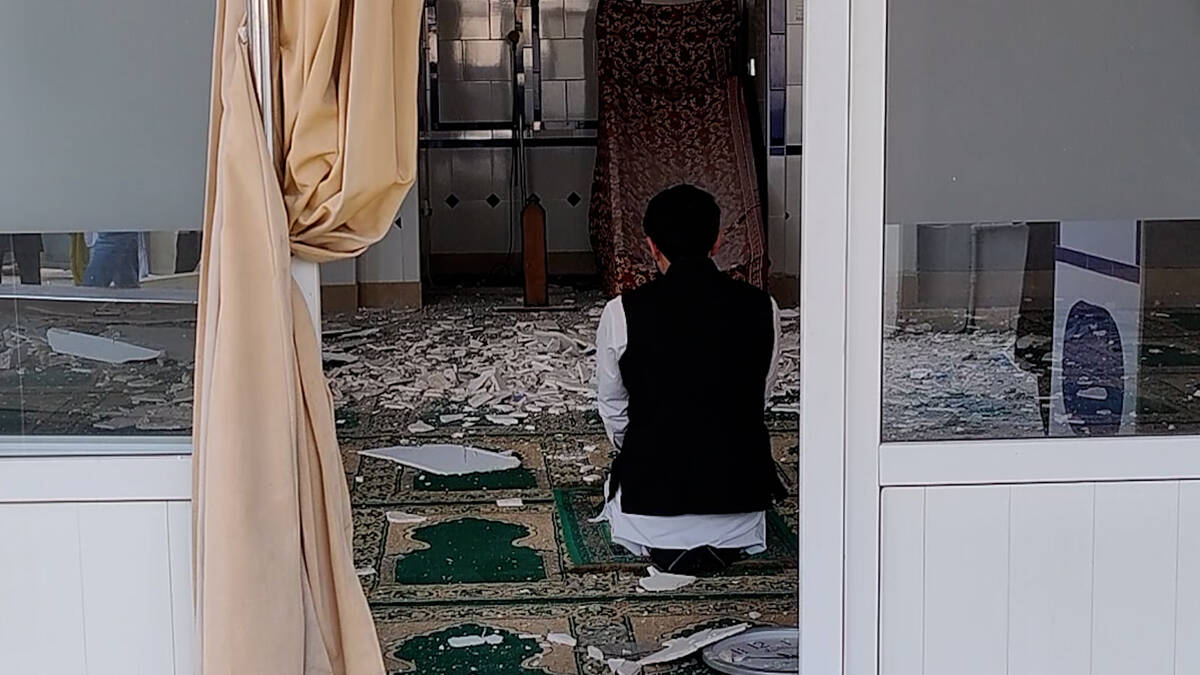
A man worships inside a mosque damaged by Indian airstrikes in Kotli, Azad Kashmir, pictured on May 7, 2025. (AN Photo)
As the media delegation remained at the site, more residents gathered, listening closely to the conversations between journalists and locals.
Dr. Mazhar Iqbal Tahir, head of a local hospital, said the blast was so massive that staff couldn’t immediately understand what had happened.
“We immediately imposed emergency [at the hospital] and called all doctors and health care professionals,” he told Arab News.
Tahir said the hospital treated the injured, but both siblings had died before they were brought in.
Umar Farooq, a local university professor, said Kotli was one of the most populated cities in AJK and far from the LoC, questioning how India could have bombed such a place.
“There is no military target here, there is no paramilitary target here, and this is the question that I am raising,” he told Arab News.
“Just take a look around,” he said, gesturing toward the mosque. “This is a place of worship. India is the signatory of the Geneva Conventions and other international humanitarian agreements. Still they have done this to us.”


