PANAMA: The new US ambassador to Panama on Thursday reassured its citizens that an agreement signed by the two countries last month does not permit the return of American military bases.
US President Donald Trump’s repeated threats to “take back” control of the Panama Canal from what he calls excessive Chinese influence has caused alarm in the Central American nation.
The agreement signed by Trump’s defense secretary, Pete Hegseth, and President Jose Raul Mulino’s administration allows US military personnel to deploy to Panamanian-controlled bases along the canal for training, exercises and “other activities.”
“Nowhere” does the agreement “talk about opening military bases,” Trump’s ambassador, Kevin Cabrera, told a news conference.
This agreement “will strengthen our cooperation against drug trafficking and protect the canal,” which the United States built and controlled until 1999, he added.
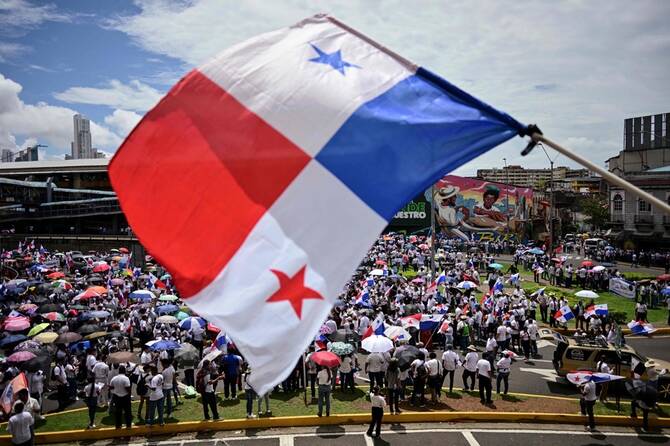
The recent deal has sparked protests from Panamanians who oppose any perceived infringement of their country’s sovereignty after a 1989 US invasion to depose then-leader General Manuel Noriega.
Cabrera said that “false” information was being spread about the agreement “for political reasons.”
Mulino on Thursday ruled out canceling the pact, which he said did not allow “any form” of US military base in his country.
“There is no cession of territory here,” he told a news conference.

US envoy reassures Panamanians about contentious military deal
https://arab.news/65ze2
US envoy reassures Panamanians about contentious military deal
- The agreement allows US military personnel to deploy to Panamanian-controlled bases along the canal
26 Doctors without Borders workers remain unaccounted for in South Sudan a month after attacks
- A hospital in the town of Lankien was bombed by government forces, MSF said
- “We have lost contact with them amid ongoing insecurity”
NAIROBI: More than two dozen Doctors Without Borders workers remain unaccounted for a month after attacks in South Sudan, the medical charity said.
Two facilities belonging to the group, known by French acronym MSF, were attacked on Feb. 3 in Jonglei State, northeast of the capital, Juba, where violence has displaced an estimated 280,000 people since December.
A hospital in the town of Lankien was bombed by government forces, MSF said, while another medical facility in the town of Pieri was raided by “unknown assailants.” Both were located in opposition-held areas.
Staff working at the two facilities fled alongside much of the local population into deeply rural areas where armed clashes and aerial bombardments were ongoing.
MSF said in a statement on Monday that “26 of 291 of our colleagues working in Lankien and Pieri remain unaccounted for.
“We have lost contact with them amid ongoing insecurity,” it said.
The lack of communication with its staff could be linked to the limited network connectivity in much of the state. Staff members who had been contacted described “destruction, violence and extreme hardships.”
Fighting escalated sharply in December, when opposition forces captured a string of government outposts in north central Jonglei. In January, the government responded with a counteroffensive that recaptured most of the area it had lost.
Displaced people in Akobo, an opposition-held town near the Ethiopian border, described horrific violence by government fighters. Many described not being able to find food or water as they walked for days to reach safety.
The attacks on MSF facilities in Lankien and Pieri are part of an uptick in violence on humanitarian staff, supplies and infrastructure, aid groups say. MSF facilities have been attacked 10 times in the last 12 months.
“This violence has taken an unbearable toll not only on health care services, but on the very people who kept them running,” said Yashovardhan, MSF head of mission in South Sudan, who only uses one name.
“Medical workers must never be targets,” he said. “We are deeply concerned about what has happened to our colleagues and the communities we serve.”


