Panama wants ‘respectful’ ties with US amid canal threats

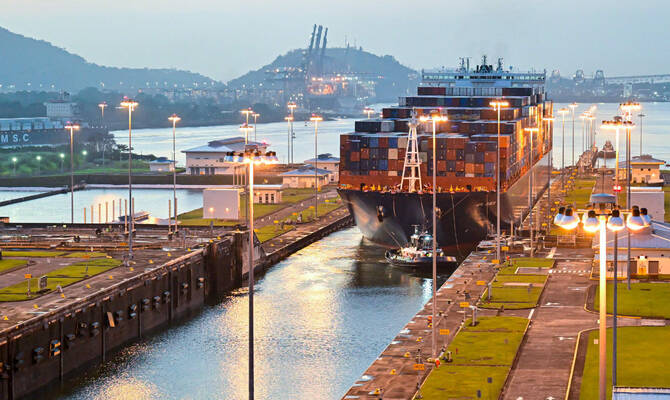
A cargo ship transits through Panama Canal Cocoli locks in Panama City. The Panama Canal announced on April 4, 2025, that it will open a tender to build an 80 km pipeline to transport fuel between the Caribbean and the Pacific in an attempt to diversify its business. (AFP/File)
Short Url
Updated 06 April 2025
Follow

Panama wants ‘respectful’ ties with US amid canal threats

  • The United States and China are the two biggest users of the Panama Canal, which handles five percent of global maritime trade, giving it vital economic and geostrategic importance

PANAMA CITY: Panama hopes to maintain a “respectful” relationship with the United States, even as President Donald Trump has repeated threats to retake the Panama Canal, Foreign Minister Javier Martinez-Acha said Saturday.
His comments came ahead of a visit next week by US Defense Secretary Pete Hegseth, a trip made more urgent against the backdrop of Trump’s threats and his allegations of Chinese interference in the canal.
“We discussed illegal migration, organized crime, drug trafficking and (other issues),” Martinez-Acha wrote on X of a call Friday with US Deputy Secretary of State Christopher Landau. “It was a cordial and constructive exchange.”
“I reiterated that all cooperation from Panama will take place under the framework of our constitution, our laws, and the Canal Neutrality Treaty,” he wrote. “Relations with the US must remain respectful, transparent and mutually beneficial.”
The US State Department said Landau had “expressed gratitude for Panama’s cooperation in halting illegal immigration and working with the United States to secure a nearly 98 percent decrease in illegal immigration through the Darien jungle,” an arduous path northward followed by many migrants.
The two officials also discussed the sale last month by the Hong Kong company CK Hutchison to giant US asset manager BlackRock of its concession in ports at either end of the Panama Canal, Martinez-Acha added.
Panama’s comptroller has been conducting an audit of Hutchison since January.
Landau “recognized Panama’s actions in curbing malign Chinese Communist Party influence,” the State Department said.
The deal was set to close on April 2 but has been held up as Chinese regulators pursue an investigation.
The United States and China are the two biggest users of the Panama Canal, which handles five percent of global maritime trade, giving it vital economic and geostrategic importance. It was inaugurated by the United States in 1914 and has been in Panamanian hands since 1999.


Bolivia and Israel to restore ties severed over the war in Gaza

Updated 10 December 2025
Follow

Bolivia and Israel to restore ties severed over the war in Gaza

  • Paz's government eased visa restrictions on American and Israeli travelers last month
  • The Bolivian foreign ministry said its top diplomat would meet his Israeli counterpart in Washington later Tuesday to discuss the revival of bilateral ties

LA PAZ, Bolivia: Bolivia's new right-wing government said Tuesday that it would restore diplomatic relations with Israel, the latest sign of the dramatic geopolitical realignment underway in the South American country that was once among the most vocal critics of Israeli policies toward Palestinians.
The Bolivian foreign ministry said its top diplomat would meet his Israeli counterpart in Washington later Tuesday to discuss the revival of bilateral ties, which Bolivia's previous left-wing government severed two years ago over Israel's devastating campaign against Hamas in Gaza.
Bolivia said the effort came as part of a new foreign policy strategy under conservative President Rodrigo Paz aimed at “rebuilding Bolivia's international prestige, opening new economic opportunities and strengthening alliances that directly benefit the country and our citizens abroad."
Bolivian Foreign Minister Fernando Aramayo is in the midst of a whirlwind trip to Washington for meetings with American officials as his government works to warm long-chilly relations with the United States and unravel nearly two decades of hard-line, anti-Western policies under the Movement Toward Socialism, or MAS, party that left Bolivia economically isolated and diplomatically allied with China, Russia and Venezuela.
Paz's government eased visa restrictions on American and Israeli travelers last month.
In announcing his expected meeting with Aramayo on Monday, Israeli Foreign Minister Gideon Saar thanked Bolivia for scrapping Israeli visa controls and said he spoke to Paz after the center-right senator's Oct. 19 election victory to express “Israel’s desire to open a new chapter” in relations with Bolivia.
Paz entered office last month, ending the dominance of the MAS party founded by Evo Morales, the charismatic former coca-growing union leader who became Bolivia's first Indigenous president in 2006. Not long after taking power, Morales sent Israel's ambassador packing and cozied up to Iran over their shared enmity toward the U.S. and Israel.
When protests over Morales' disputed 2019 reelection prompted him to resign under pressure from the military, a right-wing interim government took over and restored full diplomatic relations with the U.S. and Israel as it sought to undo many of Morales’ popular policies.
But 2020 elections brought the MAS party back to power with the presidency of Luis Arce, who in 2023 once again cut ties with Israel in protest over its military actions in Gaza.
Other left-wing Latin American countries, like Chile and Colombia, soon made similar moves, recalling their ambassadors and joining South Africa’s genocide case against Israel before the United Nations’ highest judicial body.