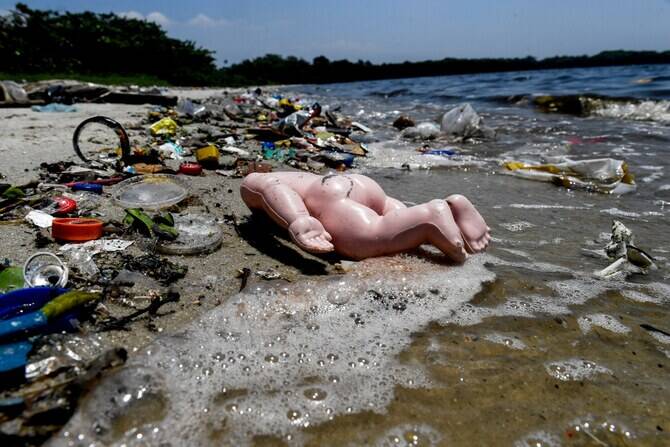
Greenpeace Denmark launches fake tourism ad to highlight pollution

Discover a dying sea or cycle through protected natural areas covered in asphalt? A tourism campaign by Greenpeace's Danish branch seeks to highlight environmental pollution in the Nordic country. (AFP/File)
Short Url
Updated 08 May 2025
Follow

Greenpeace Denmark launches fake tourism ad to highlight pollution

  • “We are inviting Europeans to discover the wonders of Denmark’s agricultural landscape,” Fromberg told
  • Greenpeace believes that Denmark has repeatedly violated the EU Water Framework Directive

COPENHAGEN: Discover a dying sea or cycle through protected natural areas covered in asphalt? A tourism campaign by Greenpeace’s Danish branch seeks to highlight environmental pollution in the Nordic country.
“Through the campaign, which is available on social networks as well as on billboards in Brussels and Warsaw, we are inviting Europeans to discover the wonders of Denmark’s agricultural landscape,” Christian Fromberg, head of agriculture and nature at Greenpeace Denmark, told AFP Thursday.
With a tone of sarcasm Fromberg went on to describe the sights: “Here we find asphyxiated seas littered with mysterious brown sludge, car parks and golf courses that are in officially protected natural areas.”
In the Scandinavian country, which prides itself on being a leader in the combating climate change, human activities, particularly waste from agriculture, have suffocated marine ecosystems.
The equivalent of 7,500 square kilometers (2,896 square miles) of the waters around the country, or 17 percent of the surface area of mainland Denmark, has been affected by deoxygenation, leading to the disappearance of marine flora and fauna, according to the Danish Environmental Protection Agency.
“The campaign is a cry for help to the European Union to enforce the environmental regulations systematically violated by the Danish government,” Fromberg said.
Greenpeace believes that Denmark, which takes over the presidency of the European Union in July, has repeatedly violated the EU Water Framework Directive, which requires member states to implement measures to ensure healthy aquatic ecosystems.
“The current government will not take the necessary measures to revitalize our seas and protect our environment,” Fromberg said.
At the same time, a broad majority of Danish politicians have agreed to introduce a carbon tax on livestock farming by 2030.
Denmark has also committed to make agriculture greener, aiming to reduce nitrogen emissions by 13,780 tons a year by 2027.


France’s homeless wrap up to survive at freezing year’s end

Updated 2 sec ago
Follow

France’s homeless wrap up to survive at freezing year’s end

PARIS: In the biting cold, homeless friends Danish and Sylvain walked briskly in the dark toward a hot meal distribution point, rubbing their hands together, their huge backpacks weighing down on their shoulders.
“If you stop, the cold seeps into your bones. As long as we’re walking, we’re producing heat,” said 50-year-old Danish, a Pakistani who asked to withhold his surname to avoid embarrassing his France-based family.
Temperatures in France have dropped in recent weeks and are expected to hover around zero in many areas on New Year’s Eve.
Several French regions including Paris have increased shelter beds to help the homeless, but reports have already emerged of some appearing to have frozen to death.
Sylvain, 52, said he and his companion checked the weather forecast on their phones every night to best prepare.
The Frenchman, who also did not want to give his surname to protect his three children, said he wore six layers on his chest — a t-shirt, a jumper, a fleece, a waistcoat and two jackets.
“The trick is to let air between the layers. If it’s too tight, there’s not much isolation,” he said.
He also wears tights and two pairs of socks, and he tops it all off with a beanie, a cap and a furry hat with flaps.
“You lose heat through the top of your head,” he said.
Neither he, nor his companion Danish, drink alcohol, he said.
“It makes you numb so you don’t know when you’re cold, and you can slip away during the night,” Sylvain said.

- ‘Sleep without fear’ -

This winter has already proven deadly.
A homeless man was found lifeless in a Paris street on Sunday, likely having frozen to death, a police source said. He had been staying in a nearby shelter.
On Christmas day, a 35-year-old homeless person was found dead in the northern city of Reims, a prosecutor said.
There are no recent official figures on homelessness in France. But the Housing Foundation, a charity, estimates 350,000 people do not have a permanent home — including 20,000 who sleep rough nationwide. Many in Paris are undocumented migrants.
More than 900 people without a home died throughout the year in 2024, on average aged 47, according to a charity called Dead in the Street.
Paris authorities say they have set up emergency shelters in sports halls and schools to help during the cold wave, while charities too have added beds to their facilities.
At a charity-run shelter in Paris, which provides bedding for more than 370 people on seven floors, volunteers have been handing out hot meals.
Nakunzi Fumiasuca, a 36-year-old from the Democratic Republic of Congo, said he had been living in a tent until he was offered a bed.
“Here I can sleep without fear,” he said.
Taha Nouri, a 32-year-old who arrived in France from Libya in 2021, came after the charity brought him in, telling him he could stay for a week.
“I was able to have a shower, eat well, see a doctor and get medicine,” he said.
But Danish and Sylvain say their calls to a hotline to request shelter never go through.
Instead they have been sleeping rough in one of the main train stations in Paris — always trying to watch out that no one steals their blanket.
“When you have one stolen and it’s cold, it’s a disaster,” said Sylvain. “Your only option is to ride the night bus around Paris until dawn.”

- ‘Time stopped’ -

Danish said he came to France with his father three decades ago and was working as a waiter, but ended up in the street after a dispute with his boss three months ago.
“I’m deeply ashamed sometimes,” he said. “I don’t want my family to see me like this.”
Sylvain said he worked as a cleaner for 15 years before a painful separation from his wife in 2022 pushed him into the street.
When he left, his three children were eight, 12 and 16, he said.
“Time stopped,” he said.
He speaks to them on the phone every week, but tells them he is “staying with a friend.”
Until they can find a solution, the two men plan their lives around the capital’s free food distributions.
Keeping clean is difficult as public bathrooms are often closed or out of hot water, Sylvain said.
But Danish insisted they do their best with cold water.
Sometimes there are good surprises. Last week, a charity handed Sylvain what he said was “a real present.”
“It had everything: a hat, toothpaste, cotton buds and even perfume — not the cheap kind,” he said.
But at the weekend, Sylvain said, he had to rip out two teeth himself to stop a throbbing toothache.
“I gave them a good yank and now it’s sorted,” he said.