

PSX sees largest single-day decline in its history on escalation in India-Pakistan conflict

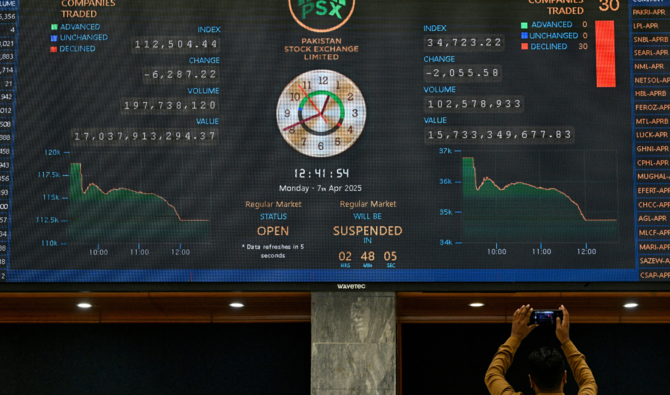
A stock broker records video on his phone during a trading session at the Pakistan Stock Exchange (PSX) as index plummeted amid a global market crash, in Karachi on April 7, 2025. (AFP/ file)
Short Url
Updated 08 May 2025
Follow

PSX sees largest single-day decline in its history on escalation in India-Pakistan conflict

  • Record-breaking 6,482-point plunge on Thursday stunned Pakistan Stock Exchange, which closed at 103,527
  • Market crash followed as army said it had neutralized 25 drones launched by India, with four troopers injured

KARACHI: A record-breaking 6,482-point plunge on Thursday stunned the Pakistan Stock Exchange (PSX), marking the largest single-day decline in the index’s history as investors feared escalation amid an ongoing standoff between India and Pakistan.

The bloodbath comes as Pakistan and India indulged in the worst fighting between them in decades this week, with India striking multiple locations in Pakistan on Wednesday after a deadly April 22 attack targeting tourists in Indian-administered Kashmir that New Delhi blames on its neighbor. 

Pakistan, which denies any link to the Kashmir violence, said it had shot down five Indian fighter jets in retaliation. Thursday brought more violence as Pakistan said it had downed 25 drones from India overnight and New Delhi said it “neutralized” Pakistani attempts to strike military targets with drones and missiles.

“The market crash followed alarming geopolitical developments after ISPR Director General Lt Gen Ahmed Sharif Chaudhry announced that Pakistani forces had neutralized 25 drones sent by India,” Topline Securities said in its daily market review.

“He also confirmed that four army personnel were injured after one drone managed to partially strike a military target, despite the majority being intercepted.”

The statement sent shockwaves through financial markets, triggering widespread panic selling as investors rushed to offload positions, leading to a broad-based decline across sectors.

Pakistan’s benchmark KSE-100 Index started the day with a 1.7 percent rally but turned bearish and slumped as much as eight percent after reports of India’s drone strikes triggered panic selling at the bourse.

The stock gauge, bullish otherwise, ended the day with a 5.89 percent decline to 103,526, according to PSX data. 

The selling pressure came largely from leveraged investors, Shahid Ali Habib, the chief executive officer at Arif Habib Ltd., told Arab News.

“Pakistan’s stocks are under pressure as it now seems that Pakistan will also go on to respond [to India] and that response will also escalate further,” he said. 

“It’s not going to end actually soon and the escalation is happening.”

However, Habib said he expected a “sharp rebound” for Pakistan’s stocks once a third party like the US or longtime ally China mediated and defused the conflict.

The renewed geopolitical tension has caused Pakistan’s market to fall about 12 percent from April 23 to May 8.

The latest conflict with India is a setback for Prime Minister Shehbaz Sharif’s effort to revive the country’s debt-ridden economy through increasing revenues and exports with the help of an International Monetary Fund’s $7 billion reforms-oriented loan program.

Pakistan assesses EU-India trade deal as industry warns $9 billion exports at risk

Updated 5 sec ago
Follow

Pakistan assesses EU-India trade deal as industry warns $9 billion exports at risk

  • Textile exporters say India’s tariff-free EU access erodes Pakistan’s GSP+ advantage
  • Analysts urge lower energy costs as commerce ministry meets to assess impact

KARACHI: Pakistan’s government is assessing the impact of a newly signed free trade agreement between India and the European Union, as industry leaders and economists warn the deal could sharply undermine Pakistan’s exports unless production costs, particularly energy tariffs, are urgently reduced.

Officials at the commerce ministry and leading trade bodies held multiple meetings in Islamabad on Wednesday to evaluate how the EU-India agreement may affect Pakistan’s access to European markets, a key destination for the country’s textile and apparel exports.

“There is a meeting scheduled today [Jan.28] to discuss the issue,” a commerce ministry official told Arab News on condition of anonymity, saying the government would be better placed to respond once consultations concluded on the impact of the EI-India FTA. 

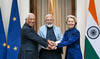
The agreement, which India’s Prime Minister Narendra Modi described as the “mother of all trade deals,” grants Indian exporters sweeping tariff-free access to the EU, Pakistan’s second-largest export market. European Commission President Ursula von der Leyen said the deal created a free trade zone of two billion people.

For Pakistan, the concern is that the deal erodes its long-standing tariff advantage under the EU’s Generalized Scheme of Preferences Plus (GSP+), which has allowed duty-free access for many Pakistani exports in return for commitments on labor rights, human rights and governance.

“The European Union is a critical market for Pakistan’s exports,” said Kamran Arshad, chairman of the All Pakistan Textile Mills Association (APTMA), the country’s largest textile trade body.

He said the EU’s 27 member states buy about $8.8 billion, or 27.2 percent, of Pakistan’s total exports and nearly $7 billion, or 39 percent, of its textile shipments each year.

Under GSP+, Pakistan currently enjoys duty-free access on around 66 percent of EU tariff lines, while Indian textile and apparel products previously faced duties of up to 12 percent.

“This dynamic has now fundamentally changed,” Arshad said, adding that India has secured immediate duty-free access on 100 percent of its textile and apparel tariff lines under the new agreement.

“India has become significantly more competitive in the EU market, effectively neutralizing and, in several segments, overtaking Pakistan’s existing GSP+ advantage,” he said.

“NARROW ADVANTAGE“

The shift comes at a fragile moment for Pakistan’s exports. After rising 5 percent to $32.1 billion last fiscal year, exports fell 9 percent to $15.2 billion in the first half of the current year through December, according to Pakistan Bureau of Statistics data.

Analysts say Pakistan’s competitiveness gap is being widened not only by tariff changes, but also by higher domestic production costs.

“The EU-India FTA will have a definite impact on Pakistan’s textile exports to the EU,” said Shankar Talreja, head of research at Karachi-based Topline Securities Ltd.

“Pakistani companies’ competitive advantage to compete against a giant like India needs to be restored in the form of regionally aligned energy tariffs and policy certainty,” he said.

Muhammad Waqas Ghani, head of research at JS Global Capital, said Pakistan’s advantage over India had already been narrow.

“With the FTA now in effect, Pakistan risks losing this already narrow comparative advantage, particularly as India’s higher value addition and stronger vertical integration enhance its competitiveness,” he told Arab News.

Industry executives echoed those concerns. 
Musadaq Zulqarnain, chairman of Interloop Holdings — one of Pakistan’s largest textile exporters supplying global brands such as Nike, Adidas, H&M, Marks & Spencer and Zara — said higher energy costs were the sector’s biggest handicap.

“The real problem for us is the cost of production,” Zulqarnain told Arab News from Faisalabad, Pakistan’s main textile hub. “Because of this, the entire textile industry is suffering.”

He said industrial electricity tariffs in Pakistan were 25–30 percent higher than those faced by regional competitors, adding that electricity prices should fall below 8–10 rupees per unit to remain competitive.

In Islamabad, an APTMA delegation also briefed Finance Minister Muhammad Aurangzeb on the impact of rising input costs and shifting global trade dynamics.

“The government is actively reviewing various issues affecting the cost of doing business for export-oriented industries,” the finance ministry said in a statement, citing Aurangzeb.

Former commerce minister Gohar Ejaz warned that preferential access alone could no longer sustain exports.

“The decision must be taken today, $9 billion exports to EU and 10 million jobs are at risk,” Ejaz said in a post on X.