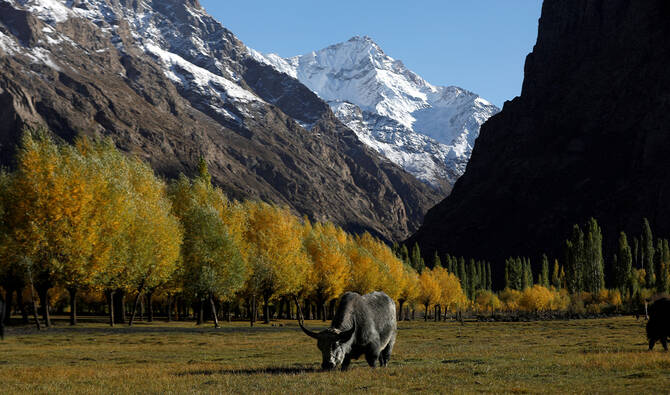
KHAPLU, Gilgit-Baltistan: Over 100 yaks have been killed after a mysterious disease broke out in the high-altitude pasture of Shimshal Pamir, local residents said on Wednesday, as officials confirmed the situation and said a medical team had been dispatched for rescue.
Located at 3,100 meters above sea level, Shimshal is the highest settlement in Pakistan’s northern Hunza region and the last village before the country’s border with China.
“A disease broke out in the pasture of Shimshal and so far more than 100 yaks were killed,” Azam Khan, the general secretary of the Shimshal Nature Trust (SNT), a community representative organization in the valley, told Arab News over the phone.
“Many yaks are ill,” he continued. “We farmers are facing huge economic losses. My two young yaks, worth Rs400,000 [$1,423], were also killed due to this disease.”
“Shimshal valley is home to more than 1,600 people,” he continued. “We rely on tourism and livestock farming to make ends meet. Yak raising is a favorite and profitable hobby for our villagers.”
Khan urged the government to take immediate measures to save the animals.
Naimat Karim, another farmer from the valley, said three of his yaks were killed by the disease.
“Agriculture and livestock farming are our profession. Out of five yaks, I have lost three … This is a financial setback,” he added.
Khuzaima Anwar, the deputy commissioner for Hunza district, confirmed the development, saying a veterinary medical team had been dispatched to the area.
“Our team is on its way to the Shimshal pasture,” he said. “They will diagnose the disease and treat the animals. Once the medical team returns, we will be in a better position to explain the situation.”
Speaking to Arab News, Dr. Shehzad Arif, a deputy director at the Gilgit-Baltistan Livestock and Dairy Development Department, said it would take at least three days for the team to reach the Shimshal pastures.
“We received information from the local community on May 5 about the death of yaks in the high-altitude pasture,” he said. “So we formed a team and dispatched them with essential medicines to the area the next day.”
“As far as our information goes, 108 yaks have died in the valley while 80 are ill,” he added.
He refused to speculate about the disease, saying the team would provide more accurate information.
“Yak is the backbone of the economy for the people living in the Karakorum-Himalaya mountain ranges of Gilgit-Baltistan,” Shakoor Ali, head of the Zoology Department at Public School Skardu, told Arab News.
“Yak is rightly known as the coconut of animals, as it provides food in the form of milk and meat, clothing from its hides and wool, and shelter from the tents made out of its hair. Almost all parts of the yak’s body have cultural, economic, medicinal, and religious value,” he continued, adding that Shimshal valley herders would face immense livelihood challenges without them.


![]()

Deadly disease kills over 100 yaks in Pakistan’s northern Shimshal pasture in Hunza
Short Url
https://arab.news/wx278
Deadly disease kills over 100 yaks in Pakistan’s northern Shimshal pasture in Hunza
- Local farmers report huge financial losses as many yaks in the area have fallen ill
- GB authorities say veterinary team has been sent with medicines to treat the animals
Latest updates


© 2026 SAUDI RESEARCH & PUBLISHING COMPANY, All Rights Reserved And subject to Terms of Use Agreement.