


Global temperatures stuck at near-record highs in April: EU monitor

1 / 3
This photo taken on July 6, 2024 shows an aerial view of a partially submerged Guanyin temple in floodwaters in the swollen Yangtze River, in Ezhou, in central China's Hubei province. (AFP)
2 / 3
Embers glow at night as the Basin Fire burns in the Sierra National Forest in Fresno County, California, on June 26, 2024. (AFP)
3 / 3
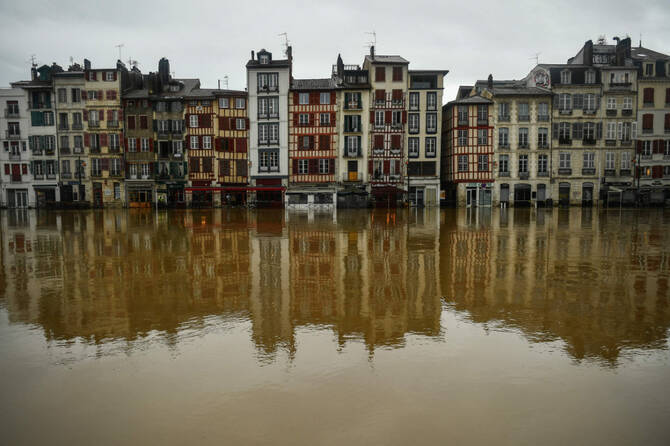
This photograph shows buildings next the flooding of the river La Nive in Bayonne, south-western France on October 17, 2024. (AFP)
Short Url
Updated 08 May 2025
Follow

Global temperatures stuck at near-record highs in April: EU monitor

  • Burning fossil fuels largely blamed for global warming that has made extreme weather disasters more frequent and intense
  • Scientists say the current period is likely to be the warmest the Earth has been for the last 125,000 years

PARIS: Global temperatures were stuck at near-record highs in April, the EU’s climate monitor said on Thursday, extending an unprecedented heat streak and raising questions about how quickly the world might be warming.
The extraordinary heat spell was expected to subside as warmer El Niño conditions faded last year, but temperatures have stubbornly remained at record or near-record levels well into this year.
“And then comes 2025, when we should be settling back, and instead we are remaining at this accelerated step-change in warming,” said Johan Rockstrom, director of the Potsdam Institute for Climate Impact Research.
“And we seem to be stuck there. What this is caused (by) — what is explaining it — is not entirely resolved, but it’s a very worrying sign,” he told AFP.
In its latest bulletin, the Copernicus Climate Change Service said that April was the second-hottest in its dataset, which draws on billions of measurements from satellites, ships, aircraft and weather stations.

All but one of the last 22 months exceeded 1.5 degrees Celsius above pre-industrial levels, the warming limit enshrined in the Paris agreement, beyond which major and lasting climate and environmental changes become more likely.


Many scientists believe this target is no longer attainable and will be crossed in a matter of years.
A large study by dozens of pre-eminent climate scientists, which has not yet been peer reviewed, recently concluded that global warming reached 1.36C in 2024.
Copernicus puts the current figure at 1.39C and projects 1.5C could be reached in mid 2029 or sooner based on the warming trend over the last 30 years.
“Now it’s in four years’ time. The reality is we will exceed 1.5 degrees,” said Samantha Burgess of the European Center for Medium-Range Weather Forecasts, which runs Copernicus.
“The critical thing is to then not latch onto two degrees, but to focus on 1.51,” the climate scientist told AFP.
Julien Cattiaux, a climate scientist at the French research institute CNRS, said 1.5C “would be beaten before 2030” but that was not a reason to give up.
“It’s true that the figures we’re giving are alarming: the current rate of warming is high. They say every 10th of a degree counts, but right now, they’re passing quickly,” he told AFP.
“Despite everything, we mustn’t let that hinder action.”


This photograph shows a general view of the Atacama Desert covered by flowers in Copiapo, Chile, taken on July 10, 2024. (AFP)

Scientists are unanimous that burning fossil fuels has largely driven long-term global warming that has made extreme weather disasters more frequent and intense.
But they are less certain about what else might have contributed to this persistent heat event.
Experts think changes in global cloud patterns, airborne pollution and Earth’s ability to store carbon in natural sinks like forests and oceans, could be factors also contributing to the planet overheating.
The surge pushed 2023 and then 2024 to become the hottest years on record, with 2025 tipped to be third.


Smoke pours from the exhaust pipes on a truck on November 05, 2019 in Miami, Florida. (AFP)

“The last two years... have been exceptional,” said Burgess.
“They’re still within the boundary — or the envelope — of what climate models predicted we could be in right now. But we’re at the upper end of that envelope.”
She said that “the current rate of warming has accelerated but whether that’s true over the long term, I’m not comfortable saying that,” adding that more data was needed.
Copernicus records go back to 1940 but other sources of climate data — such as ice cores, tree rings and coral skeletons — allow scientists to expand their conclusions using evidence from much further into the past.
Scientists say the current period is likely to be the warmest the Earth has been for the last 125,000 years.


AI reshaping the battle over the narrative of Maduro’s US capture

Updated 7 sec ago
Follow

AI reshaping the battle over the narrative of Maduro’s US capture

  • Since the US captured Venezuelan leader Nicolas Maduro in early January, pictures and videos chronicling the events have been crowded out by those generated with artificial intelligence
CARACAS: Since the US captured Venezuelan leader Nicolas Maduro in early January, pictures and videos chronicling the events have been crowded out by those generated with artificial intelligence, blurring the lines between fiction and reality.
The endless stream of content ranges from comedic memes to dramatic retellings.
In one, a courtroom illustration of Maduro in a New York courthouse springs to life and announces: “I consider myself a prisoner of war.”
In another, an AI-generated Maduro attempts to escape a US prison through an air duct, only to find himself in a courtroom with US President Donald Trump, where they dance with a judge and an FBI agent to a song by American rapper Ice Spice.
Maduro was captured alongside his wife Cilia Flores during US strikes in the Venezuelan capital of Caracas on January 3.
They have since been taken to a prison in New York where they are being held on drug trafficking charges.
While some have celebrated Maduro’s ouster, the “Chavismo” movement he leads — named after his predecessor Hugo Chavez — has worked to reframe what his fall means for Venezuela’s future.
- ‘ Confuse, combat, and silence’ -
Leon Hernandez, a researcher at Andres Bello Catholic University, told AFP that with AI’s rapid creation of content, we see development of “disinformation labs” that flood social media platforms.
“There were things that circulated that were not real during the capture (of Maduro), and things that circulated which were real that generated doubt,” Hernandez said.
“That was the idea: to create confusion and generate skepticism at the base level by distorting certain elements of real things.”
The goal, he added, is for the content to overwhelm audiences so they cannot follow it.
Even legacy media such as the Venezuelan VTV television channel are in on it, with the broadcaster playing an AI-animated video narrated by a child recounting Maduro’s capture.
“AI has become the new instrument of power for autocrats to confuse, combat, and silence dissent,” said Elena Block, a professor of political communication and strategy at the University of Queensland in Australia.
- ‘Greatest threat to democracy’ -
Block pointed out the use of cartoons, specifically, had been a medium of propaganda used in both authoritarian and democratic states.
Long before his arrest, Maduro was depicted as the illustrated superhero “Super Bigote” or “Super Mustache,” donning a Superman-like suit and fighting monsters like “extremists” and the “North American empire.”
The cartoon’s popularity spawned toys that have been carried by Maduro’s supporters during rallies advocating for his return.
And much like his predecessor, Maduro continued a practice of “media domination” to stave off traditional media outlets from airing criticism of Chavismo.
“With censorship and the disappearance or weakening of news media, social media has emerged as one of the only spaces for information,” Block said.
Maduro is not the only leader to use AI propaganda — Trump has frequently posted AI-generated pictures and videos of himself with “antagonistic, aggressive, and divisive language.”
“These digital and AI tools end up trivializing politics: you don’t explain it, you diminish it,” Block said. “AI today is the greatest threat to democracy.”