China’s BYD, Tsingshan scrap plans for Chile lithium plants as prices plunge

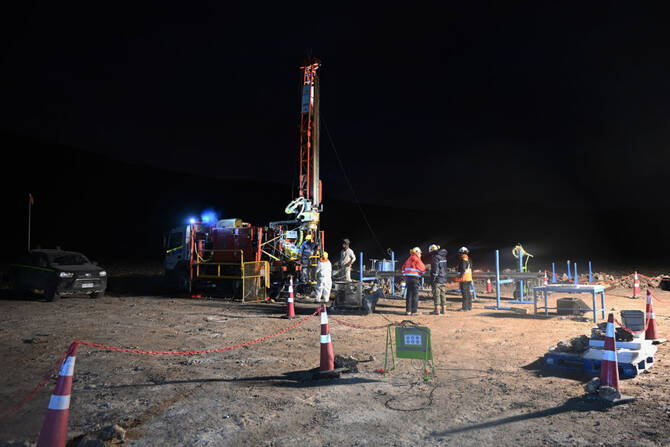
Workers operate a drilling rig at the Aguilar salt flat, located in the Andean mountain range of the Atacama Region, Chile, on May 16, 2024. (AFP)
Short Url
Updated 08 May 2025
Follow

China’s BYD, Tsingshan scrap plans for Chile lithium plants as prices plunge

  • Retreat a blow to Chile’s aim to develop more domestic processing of lithium
  • Chile is the world’s no. 2 producer of the key metal for electric vehicle batteries

SANTIAGO: Chinese automaker BYD and metals group Tsingshan are backing out of multi-million dollar plans to build lithium cathode plants in Chile, the country’s economic development agency said on Wednesday.
The retreat by the two huge Chinese companies is a blow to Chile’s aim to develop more domestic processing of lithium, a key metal for electric vehicle batteries. Chile is the world’s no. 2 lithium producer.
Both projects were hit by plunging lithium prices, said government economic development agency Corfo, which in 2023 had tapped BYD and Tsingshan for a preferential lithium price deal as part of its efforts to spur investment in Chile.
“The companies selected by Corfo have been affected in their investment decisions by the global market conditions, which have shown a sharp drop in prices,” Corfo said in a statement.
Tsingshan told Reuters it has withdrawn plans for a $233 million project to produce 120,000 metric tons of lithium iron phosphate (LFP). Chile’s national assets ministry told Reuters that BYD filed an intent to withdraw its plans in January.
BYD, the world’s biggest maker of electric cars, declined to comment. BYD last year flagged delays to a planned $290 million plant, which was expected to produce 50,000 metric tons per year of LFP for cathodes.
Chilean newspaper Diario Financiero first reported the scrapped investments.
Chile’s effort in 2018 to encourage lithium-related investments via a pricing deal also fell apart. Chilean chemical company Molymet, China’s Sichuan Fulin Transportation Group Co. , and a joint venture between Korean firms Posco and Samsung for various reasons withdrew their plans.
Tsingshan and BYD would have had access to preferential prices of lithium produced by Chilean miner SQM through 2030, a timeframe that Corfo said also may have influenced the withdrawal of the projects.
In addition, Corfo said Tsingshan had wanted to assign the project development to a unit of the company that had not participated in the bidding process, which Corfo said was not possible.
Corfo last week opened a second bidding process for a similar scheme, this time to provide a purchasing deal with US lithium producer Albemarle through 2043 for companies that commit to lithium-related projects.
Albemarle and the selected investors will be able to use an “alternative form” to determine a price agreement, Corfo said.


Philippines eyes closer cooperation on advanced defense tech with UAE

Updated 58 min 40 sec ago
Follow

Philippines eyes closer cooperation on advanced defense tech with UAE

  • Philippine-UAE defense agreement is Manila’s first with a Gulf country
  • Philippines says new deal will also help modernize the Philippine military

MANILA: The Philippines is seeking stronger cooperation with the UAE on advanced defense technologies under their new defense pact — its first such deal with a Gulf country — the Department of National Defense said on Friday.

The Memorandum of Understanding on Defense Cooperation was signed during President Ferdinand Marcos Jr.’s visit to Abu Dhabi earlier this week, which also saw the Philippines and the UAE signing a comprehensive economic partnership agreement, marking Manila’s first free trade pact with a Middle Eastern nation.

The Philippines-UAE defense agreement “seeks to deepen cooperation on advanced defense technologies and strengthen the security relations” between the two countries, DND spokesperson Assistant Secretary Arsenio Andolong said in a statement.

The MoU “will serve as a platform for collaboration on unmanned aerial systems, electronic warfare, and naval systems, in line with the ongoing capability development and modernization of the Armed Forces of the Philippines,” he added.

It is also expected to further military relations through education and training, intelligence and security sharing, and cooperation in the fields of anti-terrorism, maritime security, and peacekeeping operations.

The UAE’s Ministry of Foreign Affairs has described security and defense as “very promising fields” in Philippine-UAE ties, pointing to Abu Dhabi being the location of Manila’s first defense attache office in the Middle East.

The UAE is the latest in a growing list of countries with defense and security deals with the Philippines, which also signed a new defense pact with Japan this week.

“I would argue that this is more significant than it looks on first read, precisely because it’s the Philippines’ first formal defense cooperation agreement with a Gulf state. It signals diversification,” Rikard Jalkebro, associate professor at the Anwar Gargash Diplomatic Academy in Abu Dhabi, told Arab News.

“Manila is widening its security partnerships beyond its traditional circles at a time when strategic pressure is rising in the South China Sea, and the global security environment is (volatile) across regions.”

Though the MoU is not an alliance and does not create mutual defense obligations, it provides a “framework for the practical stuff that matters,” including access, training pathways, procurement discussions and structured channels” for security cooperation, he added.

“For the UAE, the timing also makes sense, seeing that Abu Dhabi is no longer only a defense buyer; it’s increasingly a producer and exporter, particularly in areas like UAS (unmanned aerial systems) and enabling technologies. That opens a new lane for Manila to explore capability-building, technology transfer, and industry-to-industry links,” Jalkebro said.

The defense deal also matters geopolitically, as events in the Middle East and the Indo-Pacific region have ripple effects on global stability and commerce.

“So, a Philippines–UAE defense framework can be read as a pragmatic hedge, strengthening resilience and options without formally taking sides,” Jalkebro said.