

KAUST develops lithium-extraction technique that could boost Saudi Arabia’s battery industry

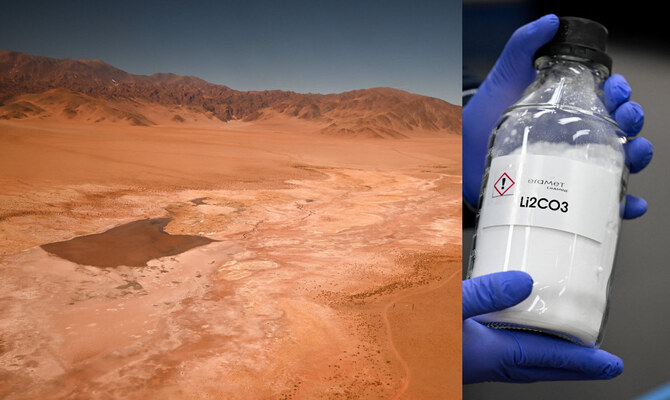
This combination image shows an aerial view of an Eramine lithium extraction area in Salta province, Argentina, (left) and a bottle containing a sample of lithium carbonate in a laboratory of the Eramine lithium extraction. Like Argentina, Saudi Arabia has vast sources rich in lithium. (AFP photos)
Short Url
Updated 18 January 2025
Follow

KAUST develops lithium-extraction technique that could boost Saudi Arabia’s battery industry

  • Technology makes industrial-scale lithium extraction possible, KAUST finds
  • Lithium essential for batteries in electric vehicles, computers, smartphones

RIYADH: Scientists at Saudi Arabia’s King Abdullah University of Science and Technology have developed a new technology that could turn the Kingdom into a leading producer of lithium, the state institution has said.

In a news release posted on its website recently, KAUST said the “innovative technology,” which involves the direct extraction of lithium from brine in oilfields and seawater, is described in a study published in the latest issue of the journal Science.

Lithium is an essential metal for the production of batteries now widely used for electric vehicles, computers and smartphones. Global demand for lithium is expected to increase to more than 5 million tonnes in 2030 from about 750,000 tonnes in 2020, according to KAUST.

Lithium is said to be present in oilfields and seawater but at low concentrations and difficult to extract in useful quantities.

But the KAUST research team led by Prof. Zhiping Lai said the new technology makes extraction possible on an industrial scale.

“Accessing lithium in brine can expand the availability of lithium worldwide by several hundreds of billions of (tonnes) and may transition Saudi Arabia from a major importer to producer of this highly sought-after element,” Lai explained in the study.

The method also achieves extraction without introducing any pollutants or additives, he said.

Saudi Arabia is thought to have plenty of sources rich in lithium in its surrounding seas and oil fields, considering that brine and seawater are estimated to contain over 10,000 times more lithium than conventional lithium reserves.

Lihytech, a KAUST startup founded by Lai and his colleague Prof. Kuo-Wei (Andy) Huang, who also contributed to the study, aims to bring the technology from laboratory to market, the university stated.

The startup has received an initial investment of $6 million from the Saudi mining company Ma’aden and the KAUST Innovation Fund.

Lihytech and Aramco announced last year a partnership in which the international conglomerate is providing brine from its oilfields to test the technology’s lithium-extraction capabilities.


Experimental farm in Al-Lith looks into future of Saudi Arabian agriculture

Updated 01 February 2026
Follow

Experimental farm in Al-Lith looks into future of Saudi Arabian agriculture

  • Research initiative reflects strategic transformation

JEDDAH: An experimental farm in Saudi Arabia’s Al-Lith Governorate is one of the research initiatives reflecting the strategic transformation taking place in the Kingdom’s agricultural sector.

The farm uses highly efficient, sustainable production models that combine scientific research with commercial application, contributing to strengthening the country’s food security system and the sustainability of water resources.

Located in the Ghumaiqa Center on an area of about 10 hectares, the cutting-edge farm is a testing platform for modern agricultural technologies that tackle the challenge of water scarcity.

The farm includes developed open fields and modern greenhouses, supported by smart irrigation encompassing drip and sprinkler irrigation alongside surface and subsurface technologies.

All the systems operate via smart controls that enable the monitoring of water consumption and ensure improved efficiency, thereby achieving a balance between agricultural production and water conservation.

The farm also uses treated and diluted low-salinity seawater.

It aims to diversify agricultural water sources, reduce reliance on freshwater, and open new horizons for agriculture in coastal and semi-arid environments.

The project represents a promising investment opportunity in the field of smart agriculture, enabling the development of commercially scalable production models, particularly for high-value vegetables and fruits, while reducing operational costs associated with water and energy, enhancing the economic feasibility of future agricultural projects.

In addition, the project contributes to transferring and localizing agricultural expertise, supporting local food supply chains, and creating an attractive environment for agricultural investment.

This aligns with Sustainable Development Goals and enhances the efficiency of the private sector in adopting innovative agricultural solutions.

Yahya bin Abdulrahman Al-Mahabi, the director of the Ministry of Environment, Water and Agriculture office in Al-Lith Governorate, told the Saudi Press Agency that the project represented the future of agriculture in the Kingdom.

He explained that the vision was based on investing in technology, enhancing the return on water per unit, and integrating scientific research with investment opportunities.

Al-Mahabi spoke of the experimental farm as a modern, scalable and replicable model applicable in several regions of the Kingdom, particularly in coastal environments.

Al-Mahabi highlighted the Ministry of Environment, Water and Agriculture’s commitment to supporting distinctive projects that contributed to achieving food security while developing rural areas and enhancing agricultural production efficiency, in line with the objectives of the Kingdom’s Vision 2030.