Palestinians in razed West Bank hamlet vow to stay

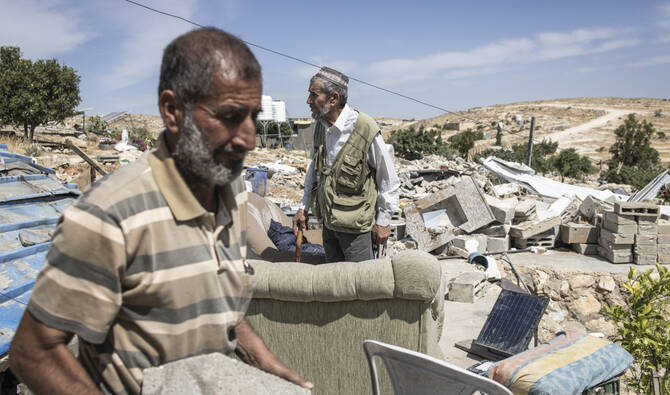
Palestinians stand on the rubble of a demolished building in the village of Khallet Al-Dabaa in the occupied West Bank on May 6, 2025, after Israeli forces destroyed ninety-five percent of all the houses displacing around one hundred people. (AFP)
Short Url
Updated 07 May 2025
Follow

Palestinians in razed West Bank hamlet vow to stay

  • Residents of Khallet Al-Dabaa and other hamlets in the West Bank’s Masafer Yatta region have for years contended with violence from Israeli settlers and repeated demolitions

KHALLET AL-DABAA, Palestinian Territories: Standing in the rubble of what used to be his home, Palestinian farmer Haitham Dababseh cleared stones to make space for a tent after Israeli army bulldozers destroyed his village in the occupied West Bank.

Residents of Khallet Al-Dabaa and other hamlets in the West Bank’s Masafer Yatta region have for years contended with violence from Israeli settlers and repeated demolitions.

But the bulldozers that descended on Khallet Al-Dabaa on Monday carried out “the biggest demolition we’ve ever had,” said Dababseh, razing to the ground the hamlet that is home to about 100 Palestinians.

Israeli forces “came here in the past; they demolished three times, four times,” the 34-year-old farmer said, but never entirely destroyed a hamlet this size in Masafer Yatta.

“I just have my clothes. Everything I have is under the rubble.”

Behind him, his 86-year-old father struggled to move the house’s former door out of the way so that they can set up their shelter.

Khallet Al-Dabaa is one of several villages featured at length in the Oscar-winning documentary “No Other Land,” recounting the struggles of the Palestinian residents of the area in the West Bank’s south.

Several of the communities shown in the documentary have experienced settler attacks or army demolitions since it won an Academy Award in March.

Several years after occupying the West Bank in 1967, the Israeli army had declared Masafer Yatta a restricted firing zone.

Israeli forces regularly demolish structures that the military authorities say were built illegally in the area, where about 1,100 Palestinians live across several hamlets.

“Enforcement authorities of the Civil Administration dismantled a number of illegal structures that were built in a closed military zone in the South Hebron Hills,” the Israeli military said in a statement on the Khallet Al-Dabaa demolition.

“The enforcement actions were carried out after the completion of all required administrative procedures and in accordance with the enforcement priority framework previously presented to the Supreme Court,” it added.

Some residents, and many of their ancestors, once lived in caves in the rocky terrain to escape the area’s stifling summer heat, and built houses with stone and other materials after the Israeli firing zone designation in the 1970s.


Syrian army declares Daesh-linked camp ‘closed security zone’

Updated 6 sec ago
Follow

Syrian army declares Daesh-linked camp ‘closed security zone’

  • Al-Hol is the largest camp for suspected Daesh relatives
  • A military source said the army’s measure aimed to control security around the camp

DAMASCUS: Syria’s army announced Friday that a camp housing suspected relatives of Daesh group fighters was closed to the public, a measure a military source said was meant to bolster security around the facility.
Earlier this month, the army entered the vast Al-Hol camp after the withdrawal of the Kurdish-led Syrian Democratic Forces (SDF).
In a statement Friday, it said the area was a “closed security zone.”
Located in a desert region of Hasakah province, Al-Hol is the largest camp for suspected Daesh relatives and is home to some 24,000 people, mostly women and children, including 6,200 foreigners.
A military source told AFP the army’s measure aimed to control security around the camp and maintain order within it.
Some camp residents fled during the “security vacuum” between when the SDF withdrew and the army took control, two former employees of organizations working at the site told AFP last week.
In recent days, new reports emerged of attempts to flee the camp.
In the latest issue of its official Al-Naba publication — translated by the SITE monitoring group — Daesh called on supporters to free women held captive in Al-Hol.
In 2014, Daesh swept across Syria and Iraq, committing massacres and forcing women and girls into sexual slavery, but backed by a US-led coalition, the Kurdish-led SDF ultimately defeated the militants in Syria five years later.
The SDF went on to jail thousands of suspected militants and detain tens of thousands of their relatives in camps.
When the Syrian army took control of the camp, most humanitarian organizations withdrew, and aid has only been trickling in since.
The Save the Children charity warned on Friday that the humanitarian situation in the camp was “rapidly deteriorating as food, water and medicines run dangerously low.”
After Syrian government forces advanced against Kurdish forces, Washington said it would transfer 7,000 Daesh suspects, previously held by Syrian Kurdish fighters, to Iraq.
The transfer is still underway.