

Palestinians in razed West Bank hamlet vow to stay

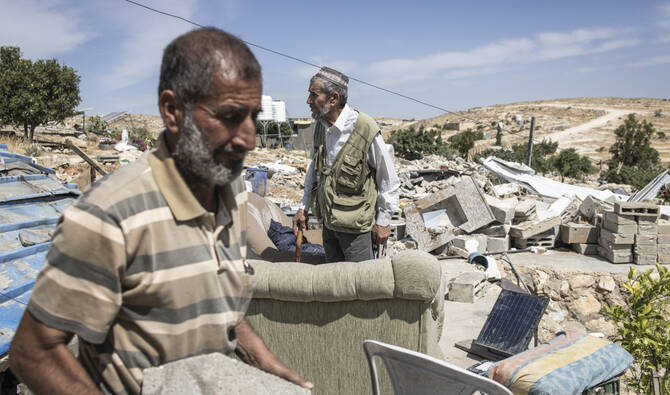
Palestinians stand on the rubble of a demolished building in the village of Khallet Al-Dabaa in the occupied West Bank on May 6, 2025, after Israeli forces destroyed ninety-five percent of all the houses displacing around one hundred people. (AFP)
Short Url
Updated 07 May 2025
Follow

Palestinians in razed West Bank hamlet vow to stay

  • Residents of Khallet Al-Dabaa and other hamlets in the West Bank’s Masafer Yatta region have for years contended with violence from Israeli settlers and repeated demolitions

KHALLET AL-DABAA, Palestinian Territories: Standing in the rubble of what used to be his home, Palestinian farmer Haitham Dababseh cleared stones to make space for a tent after Israeli army bulldozers destroyed his village in the occupied West Bank.

Residents of Khallet Al-Dabaa and other hamlets in the West Bank’s Masafer Yatta region have for years contended with violence from Israeli settlers and repeated demolitions.

But the bulldozers that descended on Khallet Al-Dabaa on Monday carried out “the biggest demolition we’ve ever had,” said Dababseh, razing to the ground the hamlet that is home to about 100 Palestinians.

Israeli forces “came here in the past; they demolished three times, four times,” the 34-year-old farmer said, but never entirely destroyed a hamlet this size in Masafer Yatta.

“I just have my clothes. Everything I have is under the rubble.”

Behind him, his 86-year-old father struggled to move the house’s former door out of the way so that they can set up their shelter.

Khallet Al-Dabaa is one of several villages featured at length in the Oscar-winning documentary “No Other Land,” recounting the struggles of the Palestinian residents of the area in the West Bank’s south.

Several of the communities shown in the documentary have experienced settler attacks or army demolitions since it won an Academy Award in March.

Several years after occupying the West Bank in 1967, the Israeli army had declared Masafer Yatta a restricted firing zone.

Israeli forces regularly demolish structures that the military authorities say were built illegally in the area, where about 1,100 Palestinians live across several hamlets.

“Enforcement authorities of the Civil Administration dismantled a number of illegal structures that were built in a closed military zone in the South Hebron Hills,” the Israeli military said in a statement on the Khallet Al-Dabaa demolition.

“The enforcement actions were carried out after the completion of all required administrative procedures and in accordance with the enforcement priority framework previously presented to the Supreme Court,” it added.

Some residents, and many of their ancestors, once lived in caves in the rocky terrain to escape the area’s stifling summer heat, and built houses with stone and other materials after the Israeli firing zone designation in the 1970s.


Israeli airstrikes pound areas north of Litani River as tensions with Hezbollah escalate

Updated 5 sec ago
Follow

Israeli airstrikes pound areas north of Litani River as tensions with Hezbollah escalate

  • Raids day after Tel Aviv signaled possible resumption of strikes, accusing Lebanon of ‘not moving fast enough’
  • US President Donald Trump says Hezbollah ‘must be completely disarmed’

BEIRUT: Israeli airstrikes on Friday hit several areas north of the Litani River, a day after Israel signaled it could resume its attacks on Hezbollah after claiming the Lebanese army was “not moving fast enough” and that the Iran-backed group was “rebuilding its military system.”

The raids struck multiple locations across the Iqlim Al-Tuffah region, the heights of Jabal Al-Rihane, and the towns of Mlikh and Aaramta in the Jezzine District, as well as the area around Qal’at Meiss between Ansar and Al-Zrariyah. Strikes on the Tabna area, on the outskirts of Al-Baisariyah in the Sidon–Zahrani district, cut the road linking nearby villages.

Airstrikes also hit the valley between Kafroue and Aazze in the Nabatieh District, the outskirts of Ain Al-Tineh, and Jabal Machghara in Western Bekaa, while Israeli warplanes flew at low altitude over the south, reaching the airspace of Baalbek, northern Bekaa, and the surrounding villages.

Israeli army spokesperson Avichay Adraee claimed that Israel’s forces had targeted a “training compound” of the Radwan Force of Hezbollah allegedly used to conduct training for its members “in order to plan and carry out terrorist plots against army forces and the citizens of the state of Israel. The terrorist operatives were undergoing shooting training and qualification in the use of various combat means.”

Adraee added that the Israeli army struck “buildings and military facilities (used) for storing weapons” belonging to Hezbollah, and suggested that attacks were likely to continue.

Political writer Ali Al-Amin told Arab News: “The areas targeted by the Israeli airstrikes on Friday had previously been targeted repeatedly, but these areas are valleys and closed spaces belonging to the party, extending from the south to the Western Bekaa, and everyone knows that they contain bases and armament centers.”

Al-Amin added that Hezbollah “is currently living (in) an unprecedented moment of weakness. Iran, on the other hand, is facing a renewed predicament, confronting internal protests at a moment of external pullback, which means that whether Hezbollah hands over its weapons or does not hand them over, it is in a state of exposure at a time of a major imbalance.”

The end of 2025 marked the deadline Lebanon committed to for the state’s monopoly of arms south of the Litani River. On Jan. 8, its first session of the year, the Cabinet is expected to hear the Lebanese army’s report announcing the completion of its mission, preceding the second phase which covers the southern area up to the Awali River. Prime Minister Nawaf Salam said the country remained committed to meeting the deadline.

An official political source confirmed to Arab News: “The army commander will present his report and the military institution will continue its mission. There will be no postponement.”

Hezbollah’s Secretary-General Naim Qassem said in a statement: “Hezbollah’s disarmament is a US-Israeli project targeting Lebanon and its sovereignty and independence, even if it is marketed under the banner of exclusive state control of arms.”

He added that the demand for control of weapons amid “continued Israeli attacks means that you are not working in Lebanon’s interest, but in Israel’s interest.”

On Thursday, following his meeting with Israeli Prime Minister Benjamin Netanyahu, US President Donald Trump said that Hezbollah “has been behaving badly” and “must be completely disarmed,” adding that “the Lebanese government is at a little bit of a disadvantage” with the group.

Asked whether Israel should strike Hezbollah in Lebanon due to the group’s refusal to disarm, Trump replied: “We’re going to see about that.”

Sirens sounded in Baram in Western Galilee in Israel on Friday morning, and a missile was launched toward a target in Upper Galilee, exploding in the north near the Lebanese towns of Maroun Al-Ras and Yaroun. Israeli Army Radio later reported that it had been a false alarm and the “suspect was a flock of birds.”