

UN experts demand action to avert ‘annihilation’ of Palestinians in Gaza

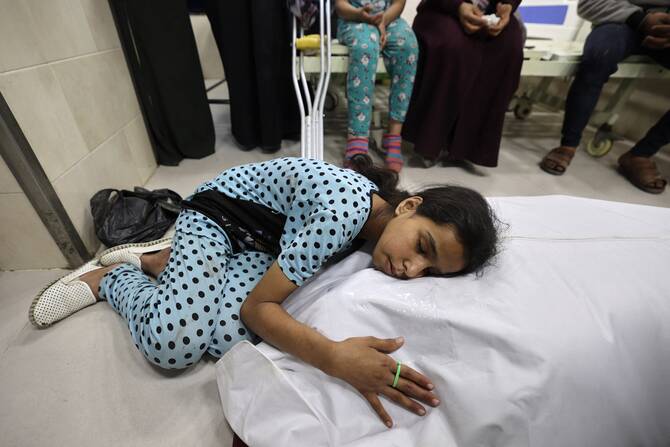
A Palestinian girl mourns over the shrouded body of her mother, killed in an Israeli strike, ahead of her funeral at Al-Awda Hospital at the Nuseirat refugee camp in the central Gaza Strip, May 7, 2025. (AFP)
Short Url
Updated 07 May 2025
Follow

UN experts demand action to avert ‘annihilation’ of Palestinians in Gaza

  • UN experts said Israel’s actions in Gaza 'follow alarming, documented patterns of genocidal conduct'

GENEVA: Countries are at a moral crossroads over the conflict in Gaza, UN experts warned Wednesday, urging action to halt the violence and avoid “the annihilation of the Palestinian population” in the territory.
A two-month ceasefire in the war collapsed in March, with Israel resuming intense strikes and calling up tens of thousands of reservists for an expanded offensive in the Gaza Strip.
“The decision is stark: remain passive and witness the slaughter of innocents or take part in crafting a just resolution,” dozens of United Nations-appointed independent experts said in a statement, urging the world to avert the “moral abyss we are descending into.”
An Israeli official said the expanded offensive in the Gaza Strip would entail the “conquest” of the Palestinian territory.
The experts, who are mandated by the UN Human Rights Council but who do not speak on behalf of the United Nations, said Israel’s actions in Gaza “follow alarming, documented patterns of genocidal conduct.”

While states debate terminology — is it or is it not genocide? — Israel continues its relentless destruction of life in Gaza

Experts mandated by the UN Human Rights Council

Israel flatly rejects such charges.
The experts, including Francesca Albanese, the special rapporteur on the rights situation in the Palestinian territories, said that “while states debate terminology — is it or is it not genocide? — Israel continues its relentless destruction of life in Gaza.”
“No one is spared — not the children, persons with disabilities, nursing mothers, journalists, health professionals, aid workers, or hostages,” the experts said.
They highlighted the devastating impact of Israel’s blockade on Gaza.
“Food and water have been cut off for months, inducing starvation, dehydration, and disease, which will result in more deaths becoming the daily reality for many,” the statement read.
Israel’s statements about the conflict, they said, “showcase a clear intent to wield starvation as a weapon of war.”
The experts highlighted the responsibility of other countries to end the bloodshed, saying that “the world is watching.”
Countries continuing to support Israel, especially militarily but also politically, they said, risk “complicity in genocide and other serious international crimes.”


Syrian troops, Kurdish forces poised on front lines as truce deadline looms

Updated 10 sec ago
Follow

Syrian troops, Kurdish forces poised on front lines as truce deadline looms

  • One-week deadline extension is possible, officials say
  • US mediators want to firm up ceasefire, see SDF integrate
QAMISHLI, Syria: Syrian troops and Kurdish forces were massed on opposing sides of front lines in northern Syria on Saturday, as the clock ticked down to an evening deadline that would determine whether they resume fighting or lay down their arms.
Neighboring Turkiye, as well as some officials in Syria, said late on Friday that the deadline could be extended.
Government troops have seized swathes of northern and eastern territory in the last two weeks from the Kurdish-led Syrian Democratic Forces in a rapid turn of events that has consolidated President Ahmed Al-Sharaa’s rule.
Sharaa’s forces were approaching a last cluster of Kurdish-held cities in the northeast earlier this week when he abruptly announced a ceasefire, giving the SDF until Saturday night to come up with a plan to ‌integrate with Syria’s ‌army.
Culmination of a year of rising tensions
As the deadline approached, ‌SDF ⁠forces also reinforced ‌their defensive positions in the cities of Qamishli, Hasakah and Kobani for a possible fight, Kurdish security sources said.
Syrian officials and SDF sources said it was likely the Saturday deadline would be extended for several days, possibly up to a week.
“Extending the ceasefire for a little longer may come onto the agenda,” said Hakan Fidan, the foreign minister of Turkiye, which is the strongest foreign backer of Sharaa’s government and sees the SDF as an arm of the outlawed Kurdistan Workers Party, or PKK.
The possible showdown in northern Syria is the culmination of ⁠rising tensions over the last year.
Sharaa, whose forces toppled longtime ruler Bashar Assad in late 2024, has vowed to bring all of ‌Syria under state control — including SDF-held areas in the northeast.
But Kurdish ‍authorities who have run autonomous civilian and military institutions ‍there for the last decade have resisted joining up with Sharaa’s Islamist-led government.
After a year-end deadline ‍for the merger passed with little progress, Syrian troops launched an offensive this month.
US, France caution Sharaa on Kurds, sources say
They swiftly captured two key Arab-majority provinces from the SDF, bringing key oil fields, hydroelectric dams and some facilities holding Islamic State fighters and affiliated civilians under government control.
The US has been engaging in shuttle diplomacy to establish a lasting ceasefire and facilitate the integration of the SDF — once Washington’s main partner in Syria — into the state led by its new US-favored ally, Sharaa.
Senior officials from the ⁠United States and France, which has also been involved in talks, have urged Sharaa not to send his troops into remaining Kurdish-held areas, diplomatic sources said.
They fear that renewed fighting could lead to mass abuses against Kurdish civilians. Government-affiliated forces killed nearly 1,500 people from the Alawite minority and hundreds of Druze people in sectarian violence last year, including in execution-style killings.
Amid the instability in the northeast, the US military has been transferring hundreds of detained fighters from the Daesh group from Syrian prisons across the border into Iraq.
Iraq’s Foreign Minister Fuad Hussein told the EU’s foreign policy chief, Kaja Kallas, in a phone call on Saturday that Baghdad should not bear the “security and financial burdens” of the transfer of IS prisoners alone, the Iraqi foreign ministry said in a statement.
Turkiye’s Fidan, speaking on broadcaster NTV late on Friday, cited these transfers as possibly necessitating ‌an extension to the Saturday deadline.