

European leaders, aid groups criticize Israeli aid plans for Gaza

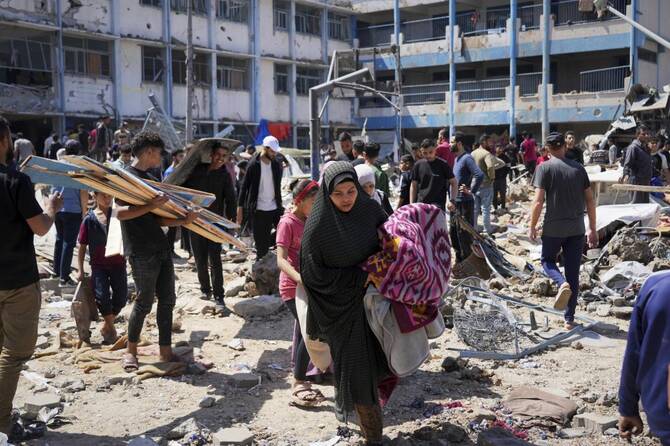
Palestinians collect belongings from a school used as a shelter by displaced residents that was hit twice on Tuesday, killing more than 25 people, in Bureij, central Gaza Strip, May 7, 2025. (AP)
Short Url
Updated 07 May 2025
Follow

European leaders, aid groups criticize Israeli aid plans for Gaza

  • European Union foreign ministers meeting in Warsaw will discuss EU-Israel relations on Thursday following a request by Dutch Foreign Minister Caspar Veldkamp

JERUSALEM/GENEVA: European leaders and aid groups have criticized Israeli plans to take over distribution of humanitarian aid in Gaza and use private companies to get food to families after two months in which the military has prevented supplies entering the Strip.
Israel has given few details of its aid plans, which are part of an expanded operation announced on Monday that could include seizing the entire Palestinian enclave.
For now, the blockade will continue until a large-scale displacement of people from northern and central areas of Gaza to the south, where a specially designated area protected by the Israeli military will be cleared near the southern city of Rafah, Israeli officials have said.
They said those entering the zone will be vetted by Israeli forces to ensure that supplies do not reach Hamas, with what aid agencies have described as special “hubs” to handle distribution by private contractors.
Israel has cleared around a third of the territory to create “security zones” and the aid policy, combined with plans for moving much of the population to the south, have reinforced fears that the overall intention is full occupation.
UN agencies, aid groups and European leaders condemned Israel’s plans, calling for the aid blockade to be lifted and for supplies to be distributed by humanitarian organizations that are not party to the conflict.
The European Union said humanitarian aid “must never be politicized or militarised,” echoing concerns expressed by leaders including Germany’s newly elected Chancellor Friedrich Merz and French President Emmanuel Macron, who said the situation in Gaza was “the worst we’ve ever seen.”
European Union foreign ministers meeting in Warsaw will discuss EU-Israel relations on Thursday following a request by Dutch Foreign Minister Caspar Veldkamp, the EU’s Foreign Policy Chief Kaja Kallas told reporters on Wednesday.
The letter in which Veldkamp made the request, seen by Reuters, stated that relations between the EU and Israel must align with human rights and democratic values under the EU-Israel Association Agreement.
“In my view, the humanitarian blockade is a violation of Israel’s obligations under International Humanitarian Law and thereby of ... the Association Agreement,” Veldkamp wrote.
UN humanitarian agency OCHA said on Tuesday that what Israel was proposing was “the opposite of what is needed.” However, aid officials have also said they have limited insight into the plan, on which they have only been briefed verbally.

Aid distribution 
Aid officials have frequently accused Israel of deliberately disregarding the complexity of aid distribution in an environment such as Gaza, laid waste by 19 months of a war that has destroyed much of its infrastructure and displaced almost all of its 2.3 million population several times.
Jan Egeland, secretary general of the Norwegian Refugee Council, said on the social media platform X that it was “totally wrong” for one party in a conflict to be distributing aid.
“This new Israeli aid plan is both totally insufficient to meet the needs in Gaza, and a complete breach of all humanitarian principles,” he said.
Israel has accused agencies including the United Nations of allowing large quantities of aid to fall into the hands of Hamas, which it accuses of seizing supplies intended for civilians and using them for its own forces.
“If Hamas continues to steal the aid from the people as well as earning money from it, the war will continue forever,” Foreign Minister Gideon Saar said in a statement.
However, aid agencies say the plan would compel a transfer of civilians from the north to the south, contributing to conditions that could lead to them being forced out of Gaza permanently.
Israeli hard-liners have made no secret of their desire to see the Palestinian population moved out of Gaza, with politicians including Finance Minister Bezalel Smotrich declaring the plan would result in a full occupation of Gaza.
An earlier Israeli plan, known as the General Eiland plan, foresaw severe restrictions on aid to Gaza as a way of choking off supplies to Hamas, and Israeli hard-liners have often harked back to that.
Many Palestinians believe Israel’s ultimate aim is to use aid as leverage to force them to leave and to occupy Gaza.
In Ramallah in the Israeli-occupied West Bank, Palestinian Prime Minister Mohammad Mustafa denounced what he described as international silence and inaction.
“Do not let the besieged children of Gaza starve to death,” he said.


Syrian army pushes into Aleppo district after Kurdish groups reject withdrawal

Updated 10 January 2026
Follow

Syrian army pushes into Aleppo district after Kurdish groups reject withdrawal

  • Two Syrian security officials told Reuters the ceasefire efforts had failed and that the army would seize the neighborhood by force

ALEPPO, Syria: The Syrian army said it would push into the last Kurdish-held district of Aleppo ​city on Friday after Kurdish groups there rejected a government demand for their fighters to withdraw under a ceasefire deal.
The violence in Aleppo has brought into focus one of the main faultlines in Syria as the country tries to rebuild after a devastating war, with Kurdish forces resisting efforts by President Ahmed Al-Sharaa’s Islamist-led government to bring their fighters under centralized authority.
At least nine civilians have been killed and more than 140,000 have fled their homes in Aleppo, where Kurdish forces are trying to cling on to several neighborhoods they have run since the early days of the war, which began in 2011.

HIGHLIGHTS

• Standoff pits government against Kurdish forces

• Sharaa says Kurds are ‘fundamental’ part of Syria

• More than 140,000 have fled homes due to unrest

• Turkish, Syrian foreign ministers discuss Aleppo by phone

ِA ceasefire was announced by the defense ministry overnight, demanding the withdrawal of Kurdish forces to the Kurdish-held northeast. That would effectively end Kurdish control over the pockets of Aleppo that Kurdish forces have held.

CEASEFIRE ‘FAILED,’ SECURITY OFFICIALS SAY
But in a statement, Kurdish councils that run Aleppo’s Sheikh Maksoud and Ashrafiyah districts ‌said calls to leave ‌were “a call to surrender” and that Kurdish forces would instead “defend their neighborhoods,” accusing government forces ‌of intensive ⁠shelling.
Hours ​later, the ‌Syrian army said that the deadline for Kurdish fighters to withdraw had expired, and that it would begin a military operation to clear the last Kurdish-held neighborhood of Sheikh Maksoud.
Two Syrian security officials told Reuters the ceasefire efforts had failed and that the army would seize the neighborhood by force.
The Syrian defense ministry had earlier carried out strikes on parts of Sheikh Maksoud that it said were being used by the Kurdish-led Syrian Democratic Forces (SDF) to launch attacks on the “people of Aleppo.” It said on Friday that SDF strikes had killed three army soldiers.
Kurdish security forces in Aleppo said some of the strikes hit a hospital, calling it a war crime. The defense ministry disputed that, saying the structure was a large arms depot and that it had been destroyed in the resumption of strikes on Friday.
It ⁠posted an aerial video that it said showed the location after the strikes, and said secondary explosions were visible, proving it was a weapons cache.
Reuters could not immediately verify the claim.
The SDF is ‌a powerful Kurdish-led security force that controls northeastern Syria. It says it withdrew its fighters from ‍Aleppo last year, leaving Kurdish neighborhoods in the hands of the Kurdish ‍Asayish police.
Under an agreement with Damascus last March the SDF was due to integrate with the defense ministry by the end of 2025, ‍but there has been little progress.

FRANCE, US SEEK DE-ESCALATION
France’s foreign ministry said it was working with the United States to de-escalate.
A ministry statement said President Emmanuel Macron had urged Sharaa on Thursday “to exercise restraint and reiterated France’s commitment to a united Syria where all segments of Syrian society are represented and protected.”
A Western diplomat told Reuters that mediation efforts were focused on calming the situation and producing a deal that would see Kurdish forces leave Aleppo and provide security guarantees for Kurds who remained.
The diplomat ​said US envoy Tom Barrack was en route to Damascus. A spokesperson for Barrack declined to comment. Washington has been closely involved in efforts to promote integration between the SDF — which has long enjoyed US military support — and Damascus, with which the ⁠United States has developed close ties under President Donald Trump.
The ceasefire declared by the government overnight said Kurdish forces should withdraw by 9 a.m. (0600 GMT) on Friday, but no one withdrew overnight, Syrian security sources said.
Barrack had welcomed what he called a “temporary ceasefire” and said Washington was working intensively to extend it beyond the 9 a.m. deadline. “We are hopeful this weekend will bring a more enduring calm and deeper dialogue,” he wrote on X.

TURKISH WARNING
Turkiye views the SDF as a terrorist organization linked to the outlawed Kurdistan Workers’ Party and has warned of military action if it does not honor the integration agreement.
Turkish Foreign Minister Hakan Fidan, speaking on Thursday, expressed hope that the situation in Aleppo would be normalized “through the withdrawal of SDF elements.”
Though Sharaa, a former Al-Qaeda commander who belongs to the Sunni Muslim majority, has repeatedly vowed to protect minorities, bouts of violence in which government-aligned fighters have killed hundreds of Alawites and Druze have spread alarm in minority communities over the last year.
The Kurdish councils in Aleppo said Damascus could not be trusted “with our security and our neighborhoods,” and that attacks on the areas aimed to bring about displacement.
Sharaa, in a phone call with Iraqi Kurdish leader Masoud Barzani on Friday, affirmed that the Kurds were “a fundamental part ‌of the Syrian national fabric,” the Syrian presidency said.
Neither the government nor the Kurdish forces have announced a toll of casualties among their fighters from the recent clashes.