India urges restraint but remains ‘fully prepared’ amid tensions with Pakistan, army says

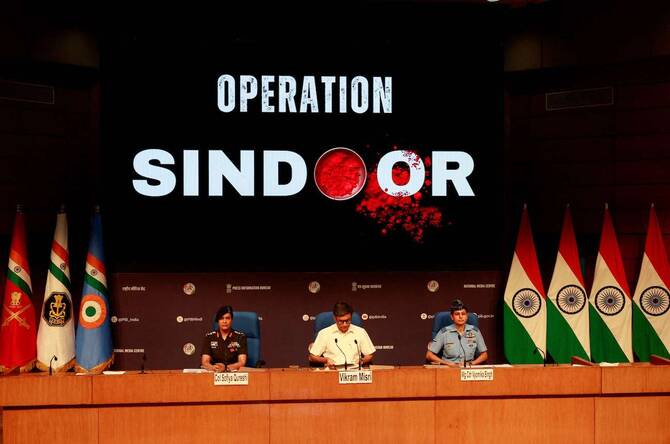
India’s Foreign Secretary Vikram Misri holds a press briefing with Indian army officials following India’s military strikes on Pakistan, in New Delhi, India on May 7, 2025. (Reuters)
Short Url
Updated 07 May 2025
Follow

India urges restraint but remains ‘fully prepared’ amid tensions with Pakistan, army says

  • Indian strikes were ‘measured, non-escalatory, responsible’ foreign secretary says
  • Pakistani officials say at least 26 civilians were killed in Indian missile strikes

NEW DELHI: Indian forces are fully prepared to respond to any retaliation from Pakistan, an army spokeswoman said on Wednesday, after Delhi launched missile strikes on Pakistani sites that it said were linked to last month’s deadly attack on tourists in Indian-administered Kashmir.

Indian Armed Forces launched “Operation Sindoor” in the early hours of Wednesday, hitting nine locations in Pakistan’s densely populated Punjab province and Pakistan-administered Kashmir, from where it said “terrorist attacks against India have been planned and directed.”

The strikes came amid heightened tensions between the rivaling neighbors in the aftermath of an attack on tourists near the resort town of Pahalgam in Jammu and Kashmir on April 22, in which 26 people — 25 Indians and one Nepali citizen — were killed.

“India has demonstrated considerable restraint in its response. However, it must be said that the Indian armed forces are fully prepared to respond to Pakistani misadventures, if any, that will escalate the situation,” Wing Commander Vyomika Singh told a joint briefing by the Indian military and Ministry of External Affairs in the Indian capital.

“Operation Sindoor was launched by Indian Armed Forces to deliver justice to the victims of Pahalgam terror attack and their families.”

She said that Indian forces used niche technology weapons and carefully chose warheads to avoid collateral damage to civilians and civilian infrastructure, without providing more detail.

Sindoor, which refers to the vermilion powder worn by married Hindu women, is an apparent reference to the widows left by the April 22 attack, in which the victims were all men.

Indian officials showed footage of what they said were strikes on the targets in Pakistan during the Delhi briefing, as well as a map marking locations of what they said were “terror infrastructure.”

“Over the last three decades, Pakistan has systematically built terror infrastructure. It is a complex web of recruitment and indoctrination centers, training areas for initial and refresh of courses and launch pads for handlers. These camps are located both in Pakistan as well as Pakistan-occupied Jammu and Kashmir areas,” Singh said.

Foreign Secretary Vikram Misri said India’s actions were “measured, non-escalatory, proportionate and responsible.”

“They focused on dismantling the terrorist infrastructure and disabling terrorists likely to be sent across to India.”

He said the strikes were launched because there was “no demonstrable step” from Pakistan to “take action against the terrorist infrastructure on its territory or on territory under its control” since the Pahalgam attack.

“Instead, all it has indulged in are denials and allegations. Our intelligence monitoring of Pakistan-based terrorist modules indicated that further attacks against India were impending,” he said.

Kashmir has been the subject of international dispute since the 1947 partition of the Indian subcontinent into Hindu-majority India and Muslim-majority Pakistan.

Both countries claim the Himalayan region in full and rule in part, and have fought two of their three wars over it.

Indian-administered Kashmir has for decades witnessed outbreaks of separatist insurgency to resist control from the government in Delhi, which accuses Pakistan of arming and training militants since 1989. Islamabad has denied those allegations, saying it offers only moral and diplomatic support to the Kashmiri people in their struggle for self-determination.

A Pakistan military spokesperson said at least 26 civilians were killed in the Indian strikes on Wednesday.

Pakistani Prime Minister Shehbaz Sharif said on Wednesday the country’s top national security body had authorized its armed forces to take “corresponding actions” in response to the Indian strikes.

India and Pakistan have had near daily exchanges of fire across the de facto border, called the Line of Control, which divides disputed Kashmir between them.

On Wednesday morning, they also exchanged intense shelling and heavy gunfire across much of the frontier, which reportedly killed and injured dozens of civilians on both sides.


Israel is risking global security, warns Somali Information Minister

Updated 6 sec ago
Follow

Israel is risking global security, warns Somali Information Minister

  • Tel Aviv’s actions boost terror groups he tells Arab News in exclusive interview
  • Jama accuses Tel Aviv of wanting to relocate Palestinians from Gaza to region

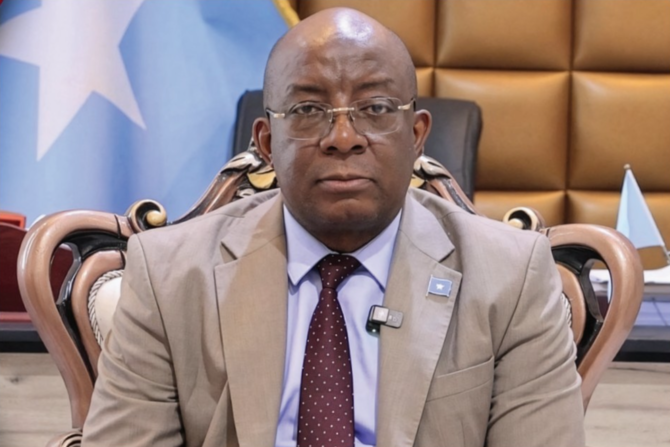
RIYADH: Israel’s recognition of Somaliland and its presence in the region risks inflaming the situation there, allowing terrorist groups to undermine regional security and stability, according to Somali Information, Culture and Tourism Minister Daud Aweis Jama.

In a special interview with Arab News, Jama insisted that Israel’s unprecedented Dec. 26 move to recognize Somaliland as a sovereign state represents a major setback for Mogadishu’s fight against terrorist organizations like Al-Shabab and Daesh.

“The presence of Israel will be used by the terrorist groups to expand their operations in the region. (They will) have a pretext to spread their ideologies in the region,” he said.

“That is another factor that is also risking global security and regional stability, because we have been in the last stage of overcoming the challenges of the terrorist groups Al-Shabab and ISIS,” he added, using another term for Daesh.

Jama added: “We have been putting all our resources and all our time into making sure that we finalize the final stages of the fight against Al-Shabab. So, if something else interrupts us, that means that we are not going to focus fully on the operations against Al-Shabab. And that means we are giving more opportunities to Al-Shabab or other organizations.”

The consequences of this hit to Somalia’s ability to fight terror will not be restricted to the country’s borders, according to Jama, but will spread across the region and beyond.

“This might invite other, external terrorist groups to the region, because they will take advantage of this crisis and will make sure that they take over all the areas that have been defeated before,” the minister said.

“We believe this has come at a time that is going to affect our security as a Somali government, the security of the Horn of Africa, the security of the Gulf of Aden, the security of the Red Sea, the security of the Middle East and global stability. This is a very important location that holds the trade of the world.”

The minister underlined that Israel’s recognition and larger presence in the region are leading to more challenges, “putting more fuel on the ongoing challenges that exist in the region, especially in Somalia.” He added: “And at this time, it is not only limited to Somalia, but it’s going to be a challenge that is going to spread like a fire all over the region and all over the world.”

Jama told Arab News that Israel has other strategic motives for its recognition of Somaliland — including the forced resettlement of Palestinians from Gaza.

“According to reliable sources that our intelligence gathered, one of the conditions that Israel put forward (for recognizing Somaliland) was to have a place that they can settle the people from Gaza,” he said.

“We find that it is a violation also of the people of Palestine, because we believe that the people of Palestine have the right to self-determination. The two-state solution that has been the call of the international community has to be adhered to and implemented.”

Israel’s coalition government, the most right-wing ‌and religiously conservative in its history, includes far-right politicians who advocate the ‍annexation of both Gaza and the West ‍Bank and encouraging Palestinians to leave their homeland.

Somalia’s UN Ambassador Abukar Dahir Osman said ‍Security Council members Algeria, Guyana, Sierra Leone and Somalia “unequivocally reject any steps aimed at advancing this objective, including any attempt by Israel to relocate the Palestinian population from Gaza to the northwestern region of Somalia.”

Israel last month became the first country to recognize Somaliland as an independent nation. In the three-plus decades since its self-declaration of independence in 1991, no state had recognized the northwestern territory as being separate from Somalia.

Mogadishu immediately rejected the Israeli move, alongside countries all over the world.

Saudi Arabia affirmed its rejection of any attempts to impose parallel entities that conflict with the unity of Somalia. It also affirmed its support for the legitimate institutions of the Somali state and its keenness to preserve the stability of Somalia and its people.

A group of foreign ministers from Arab and Islamic countries, alongside the Organization of Islamic Cooperation, also firmly rejected Israel’s announcement. In a joint statement, the ministers warned that the move carries “serious repercussions for peace and security in the Horn of Africa and the Red Sea region” and undermines international peace and security.

The 22-member Arab League rejected “any measures arising from this illegitimate recognition aimed at facilitating forced displacement of the Palestinian people or exploiting northern Somali ports to establish military bases,” the organization’s UN Ambassador Maged Abdelfattah Abdelaziz told the UN Security Council.

In the most recent development in Israel-Somaliland relations, less than two weeks after Tel Aviv’s recognition, Israeli Foreign Minister Gideon Saar visited the region on Tuesday to publicly formalize diplomatic relations.

“It was a blatant violation of Somalia’s sovereignty that Israel recognized a region within the Somali Federal Republic as an independent state,” Jama underlined. “That was a total violation of international laws. It was a violation of the territorial integrity and sovereignty of Somalia.

“From the beginning, our path was to follow diplomatic efforts. And we kind of started with a successful UN Security Council meeting that supported Somalia’s territorial integrity and sovereignty. (This was) followed by other international actors like the Arab League, the Organization of Islamic Cooperation, the African Union and regional bodies like the East African Community and IGAD.

“Also, the Peace and Security Council of the African Union has reiterated the importance of supporting Somali sovereignty and territorial integrity.”