

Saudi POS spending hits $4bn, fueled by increased spending across all sectors

Food and beverages, miscellaneous goods and services, and clothing and footwear accounted for 41.5 percent of the week’s total spending. Shutterstock
Short Url
Updated 07 May 2025
Follow

Saudi POS spending hits $4bn, fueled by increased spending across all sectors

RIYADH: Saudi Arabia’s point-of-sale transactions climbed 36.2 percent to SR15.4 billion ($4.1 billion) in the week ending May 3, driven by increased spending across all sectors. 

The latest data from the Kingdom’s central bank, also known as SAMA, showed that education led the growth, registering the largest jump in transaction value, up 74.7 percent to SR239.7 million. The sector also saw a 32.4 percent rise in the number of transactions, reaching 192,000.

The clothing and footwear sector followed, recording a 51.2 percent increase in transaction value to SR917.6 million. Telecommunication spending ranked next, rising 45.1 percent to SR136.4 million, with transactions up 37.3 percent to 3.4 million.

Food and beverages — the sector with the biggest share of total POS value — recorded a 44.9 percent increase to SR2.4 billion.

Transportation spending rose 27.9 percent to SR852 million, while restaurants and cafes saw a 28.8 percent increase, totaling SR2.1 billion and claiming the second-biggest share of this week’s POS.

The smallest spending gains were on jewelry, rising by 12.6 percent to SR361 million, and construction and building materials, which increased by 13.1 percent to SR354.7 million.
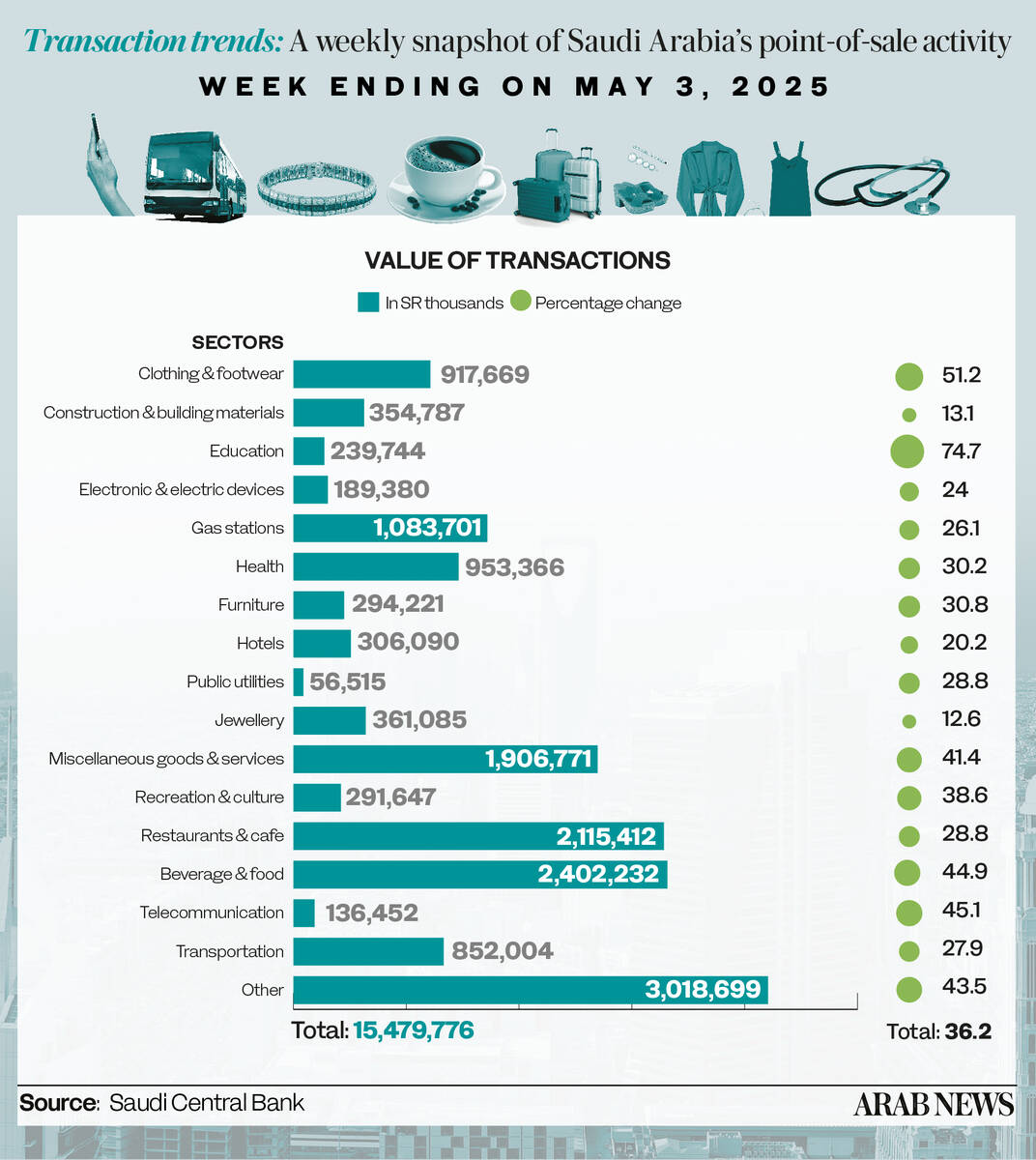
The health and public utilities sectors also saw upward changes, increasing by 30.2 percent and 28.8 percent to reach SR953.3 million and SR56.5 million, respectively.

Spending on electronics followed the trend, rising 24 percent to SR189.3 million, and recreation and culture edging up by 38.6 percent to SR291.6 million. 

Miscellaneous goods and services claimed the third-largest share of total transactions value, with an uptick of 41.3 percent to SR1.9 billion.

The top three categories — food and beverages, miscellaneous goods and services, and clothing and footwear — accounted for 41.5 percent of the week’s total spending, amounting to SR6.4 billion. 

Geographically, Riyadh dominated POS transactions, with expenses in the capital reaching SR5.2 billion, a 28.5 percent increase from the previous week. 

Jeddah followed with a 27.2 percent rise to SR2.1 billion, while Dammam ranked third, up 28.1 percent to SR772 million. Hail saw the biggest increase, inching up 60.8 percent to SR268.9 million, followed by Tabuk with a 60.6 percent uptick to SR325.2 million.

Hail recorded 4.5 million deals in transaction volume, up 33 percent, while Tabuk reached 5.4 million transactions, rising 29 percent.


Kuwait to boost Islamic finance with sukuk regulation

Updated 8 sec ago
Follow

Kuwait to boost Islamic finance with sukuk regulation

  • The move supports sustainable financing and is part of Kuwait’s efforts to diversify its oil-dependent economy

RIYADH: Kuwait is planning to introduce legislation to regulate the issuance of sukuk, or Islamic bonds, both domestically and internationally, as part of efforts to support more sustainable financing for the oil-rich Gulf nation, Prime Minister Sheikh Ahmad Abdullah Al-Ahmad Al-Sabah said on Wednesday.

Speaking at the World Governments Summit in Dubai, Al-Sabah highlighted that Kuwait is exploring a variety of debt instruments to diversify its economy. The country has been implementing fiscal reforms aimed at stimulating growth and controlling its budget deficit amid persistently low oil prices. Hydrocarbons continue to dominate Kuwait’s revenue stream, accounting for nearly 90 percent of government income in 2024.

The Gulf Cooperation Council’s debt capital market is projected to exceed $1.25 trillion by 2026, driven by project funding and government initiatives, representing a 13.6 percent expansion, according to Fitch Ratings.

The region is expected to remain one of the largest sources of US dollar-denominated debt and sukuk issuance among emerging markets. Fitch also noted that cross-sector economic diversification, refinancing needs, and deficit funding are key factors behind this growth.

“We are about to approve the first legislation regulating issuance of government sukuk locally and internationally, in accordance with Islamic laws,” Al-Sabah said.

“This enables us to deal with financial challenges flexibly and responsibly, and to plan for medium and long-term finances.”

Kuwait returned to global debt markets last year with strong results, raising $11.25 billion through a three-part bond sale — the country’s first US dollar issuance since 2017 — drawing substantial investor demand. In March, a new public debt law raised the borrowing ceiling to 30 billion dinars ($98 billion) from 10 billion dinars, enabling longer-term borrowing.

The Gulf’s debt capital markets, which totaled $1.1 trillion at the end of the third quarter of 2025, have evolved from primarily sovereign funding tools into increasingly sophisticated instruments serving governments, banks, and corporates alike. As diversification efforts accelerate and refinancing cycles intensify, regional issuers have become regular participants in global debt markets, reinforcing the GCC’s role in emerging-market capital flows.

In 2025, GCC countries accounted for 35 percent of all emerging-market US dollar debt issuance, excluding China, with growth in US dollar sukuk issuance notably outpacing conventional bonds. The region’s total outstanding debt capital markets grew more than 14 percent year on year, reaching
$1.1 trillion.