Germany’s Merz voices ‘concern’ on Gaza, to send foreign minister to Israel

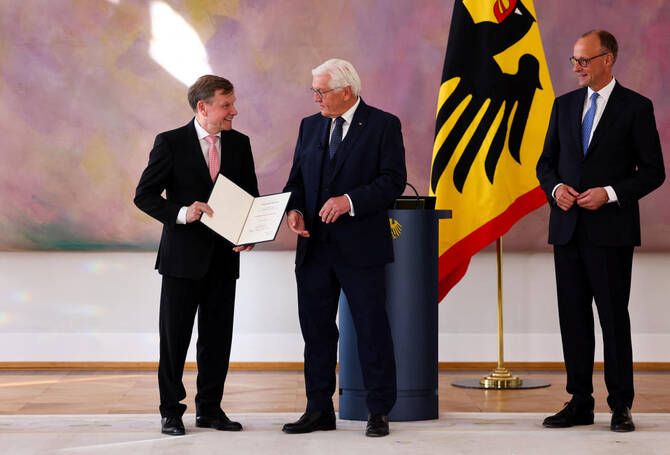
FM Johann Wadephul receives his certificate of appointment from President Frank-Walter Steinmeier with Chancellor Friedrich Merz in attendance, Bellevue Palace, Berlin, May 6, 2025. (Reuters)
Short Url
Updated 06 May 2025
Follow

Germany’s Merz voices ‘concern’ on Gaza, to send foreign minister to Israel

  • Friedrich Merz said FM Johann Wadephul would travel to Israel at the weekend and that ‘we are currently preparing this trip together’
  • Friedrich Merz: ‘Israel must remain a country that lives up to its humanitarian obligations’

BERLIN: Germany’s new Chancellor Friedrich Merz on Tuesday voiced “considerable concern” about the Gaza conflict and said he would send his foreign minister to Israel this weekend.

The conservative Merz, 69, long a strong supporter of Israel, said that Israel has a right to fight the Palestinian militant group Hamas but must follow international law.

Merz, who took office on Tuesday, said Germany’s new Foreign Minister Johann Wadephul would travel to Israel at the weekend and that “we are currently preparing this trip together.”

Israel’s security cabinet has approved plans for the “conquest” of Gaza, an official said Monday, and Israel’s military has said expanded operations would entail displacing “most” of its residents to the southern part of the territory.

Merz, speaking to public broadcaster ARD, said: “We view the developments of the last few days with considerable concern.”

“Israel has the right to defend itself against the brutal attack by Hamas terrorists on October 7 and everything that followed,” said Merz.

“But Israel must also remain a country that lives up to its humanitarian obligations, especially as this terrible war is raging in the Gaza Strip, where this confrontation with Hamas terrorists is necessarily taking place.”

He added that “it must be clear that the Israeli government must fulfil its obligations under the international law of war and that humanitarian aid in the Gaza Strip must be provided.”


Global AI summit in India still without final statement

Updated 4 sec ago
Follow

Global AI summit in India still without final statement

NEW DELHI: A summit statement on how the world should approach the promises and pitfalls of artificial intelligence was still not published Saturday afternoon, a day after it had been expected at global talks in New Delhi.
Dozens of national delegations, including leaders from France, Brazil and other countries, had gathered in the Indian capital this week to discuss the fast-developing technology.
On Friday, India’s IT minister Ashwini Vaishnaw said there was “huge consensus on the declaration,” the details of which he declined to provide.
He said the statement already had more than 70 signatories, but he hoped it would pass 80.
“We are just trying to maximize the number,” the minister said as the five-day AI Impact Summit drew to a close.
AFP contacted summit organizers and the IT ministry for comment on Saturday.
The summit, attended by tens of thousands of people including top tech CEOs, was the fourth annual international meeting to discuss the implications of generative AI, and the first hosted by a developing country.
Some visitors had complained of poor organization, including chaotic entry and exit points, at the vast summit and expo site.
Hot topics included the societal benefits of multilingual AI translation, the threat of job disruption and the heavy electricity consumption of data centers.
But analysts said that the summit’s broad focus, and vague promises made at its previous editions in France, South Korea and Britain, would make concrete commitments unlikely.
The United States, which did not sign last year’s AI summit statement, released its own bilateral declaration with India on Friday.
The two countries agreed to “pursue a global approach to AI that is unapologetically friendly to entrepreneurship and innovation.”
Also on Friday, White House technology adviser Michael Kratsios, head of the US delegation, warned against centralized control of generative AI.
“As the Trump Administration has now said many times: We totally reject global governance of AI,” he said.